Category Archives: Barack Obama

Questioning Conventional Wisdom — “Jobless Recovery”

By Marc Seltzer; originally published January 6, 2010

Don’t be too sure

. .

“Jobless Recovery”

No adjective characterizes political and media discussions of the recovery from the 2008 recession more than the word “jobless.”

Is it true?  Have the stars aligned to deny us a bright future?  Should we be worried?

LIBERAL EXPRESSIONS OF CONCERN

One way to evaluate what people are saying is to look at their motivation.  In this case, liberals and conservatives are both motivated to characterize the job prospects as worse than they likely are.  Many liberals, such as outspoken Nobel Laureate Economist Paul Krugman, want the government to take action in support of job creation so they focus on the high unemployment rate.  Ten percent is certainly higher than a more ideal 5 or 6 percent that would be a healthy level for the economy, if it were not in either an excessive boom or bust cycle.  But the current high unemployment reflects the depth of the recession, not a “jobless” recovery.

In 2009, the growth rate only turned positive in the third quarter.  Jobs are a lagging indicator and always follow the business turn-around and improvement in growth rate by many months.

Thus, the 2009 recovery is not “jobless” because unemployment has not yet come down.  Every recession involves the loss of jobs and every recovery involves the improvement in business conditions and higher growth rate long before jobs return.

Professor Krugman is worried about a weak recovery and thus wants to see additional stimulus aimed at creating jobs.  He is particularly concerned that the slow return of jobs creates great suffering and harms employment prospects for the long-term unemployed.  His proposals could help alleviate high unemployment and move the economy more quickly towards full employment, but they do not indicate that this is a jobless recovery whereas other recoveries were not.  Rather they reflect the fact that the severity of the recession led to millions of layoffs and that it will take time for millions of workers to be rehired into the labor market.

HOW ABOUT THOSE REPUBLICANS?

On the other side of the isle, the Republicans are constantly saying that the Obama administration actions such as stimulus spending and health care reform are bad for the economy and that we are headed for a jobless recovery.  However, it serves the Republican political goals if the Obama administration can be described as failing to lead an economy out of recession.  Millions of people are unemployed and many who are employed face job insecurity.  The Republicans exploit this to political advantage by claiming that current policies are wrong and pointing to a “jobless” recovery as evidence of failure.  The Republicans will continue to have every incentive to claim that Democratic policies are causing a jobless recovery until the 2010 elections.

But that doesn’t make it so.  Remember that it is far quicker to lay off employees than it is to rehire them.  Layoffs can be done by thousands on a single day, while rehiring takes substantial human resource department efforts, paperwork and staffing in itself.  Unless employees were simply furloughed, a thousand employees laid off in a single afternoon could take months to rehire in ordinary conditions.  For this reason, and because the recession of 2007-2008 involved a spectacular financial crisis with fast and deep layoffs, reaching a peak 750,000 a month in January of 2009, unemployment may only decrease by 750,000 to two million new jobs a year in coming years.  Remember, we lost more than seven million jobs.

Nonetheless, six to eighteen months after the growth rate becomes strong, we should expect to see substantial gains in employment.  It will be correct to say during the recovery that jobs are not created as fast as they were lost, but that is a hardly the standard for a “jobless” recovery.  The real key is the growth rate.  It reached more than 2% in the third quarter of 2008.  Six months from now it should be higher still.   The activity is reflected in increased hours and temp job hires for now, but inevitably job creation will follow.

The real question is whether innovative action in the public and private sector can increase the speed of job creation without distorting the marketplace and creating waste.  Nations such as Germany subsidized jobs during the crisis to limit layoffs.  Many nations, including ours, supported public and private sectors with stimulus spending, preventing layoffs from getting worse than they did.  Now, the question is whether means will be found to efficiently return to higher employment more quickly than in other deep recessions.

May 6, 2010 UPDATE:  Recent jobs data finally confirming predictions:  Denver Post

Combining the House and Senate Health Care Bills

By Marc Seltzer; originally published on December 29, 2009, at care2.com

. .

While the House and Senate health care reform bills are nearly identical, they differ in a couple of important ways — and this can potentially make the final bill much better than what has so far been contemplated.  Comparisons:  Bloomberg & New York Times.

The just-passed Senate bill partially funds health care insurance for those who cannot afford it by taxing luxurious insurance plans.  (I see it as ending a subsidy, not a tax at all — as I explain here)  This is not only a source of revenue, but crucially the tax will create an incentive for insurance companies to create cost-savings plans, “bending the cost curve,” of the entire system by reducing excess health care services.  Decreasing the unneccessary care lowers demand, cutting prices for insurers and eventually for businesses and individuals.  See Atul Gawande, New Yorker, Dec. 14 — a must-read on costs (and also June 1, New Yorker).

However, the House bill takes a different tack.  It raises taxes on high-income Americans, under the theory that they can afford to pay more without cutting into food, shelter or health care.  At some point, increasing taxes on wealthy Americans does lower their overall investment in new businesses — a drag on the economy — but such taxes are at a relative low point and the proposed tax is not so dramatic as to significantly damage investment potential.

The conventional wisdom is that the Conference Committee, which will meet in the new year to create one final health care bill, will choose between House and Senate options.  On many provisions, the Senate bill will prevail, because it is more cost-conscious, as already noted, and there is less support for the House provisions in the Senate, where the Democrats have no margin of error on the final vote.  Senate legislation has already been CBO (Congressional Budget Office) scored to reduce the deficit at ten- and twenty-year projections.  This does require doctors to take less payment from Medicare patients than they have in the past and requires individuals to buy insurance or pay a fine, which will be unpopular for some people who neither have insurance nor want to pay for it.  On the other hand, projected cost savings of the Senate legislation do not entirely factor in other cost-containment approaches, which are being tested, from malpractice reform to replacing the fee for service model, and which will likely bear fruit over the next decade.

Deficit Reduction and Health Care Cost Containment

The conference committee should take both the Senate tax on high value insurance plans and the House tax on wealth in the final form of the bill.  This would lower the deficit even further.  It might upset a moderate Democrat or two and it might not induce any Republicans to vote for health care reform, so Harry Reid needs to shepherd his flock and ask Olympia Snowe and Susan Collins where they stand on the idea, but it has the distinct advantage of creating universal health care legislation that is strongly positive on deficit reduction and still stepping in the right direction by changing health care incentives.

Currently incentives in the profit-driven system reward over-testing and overuse of resources by those who have, and tolerate underuse by those who have not. The Senate legislation, as it stands, gives the have-nots a chance to participate in the health-care marketplace.  While taxing wealth must be done cautiously so as not to damage investment and new business potential, here the benefit of lowering the deficit in the process of providing the opportunity for basic health care for all Americans is a worthy purpose for a moderate wealth tax.  Control of the deficit will return rewards to many who pay the tax by improving confidence in the economy and raising prospects for investments.  This could be a win-win in the long run, provided that the economy was emerging from the current recession before tax increases were imposed.

The Senate’s health care legislation is a monumental accomplishment in the direction of universal coverage. It also begins to tackle cost issues by taxing luxurious insurance plans and pointing towards other models of care that will lower demand and drive down costs.  We could add substantial deficit reduction to the legislation — an unplanned bonus — by including the House’s moderate tax on wealth in addition to the Senate bill’s revenue measures.

What are your priorities?  If this sounds appealing, please spread the word.

Listen to care2.com blogger Jessica Pieklo and I discuss health care and more on our weekly podcasts.

January 4, 2009 UPDATEHendrik Hertzberg at the New Yorker on support and opposition to the health care bill.  An outspoken liberal, Mr. Hertzberg is in favor of the current legislation.

On the White House blog, a comparison of President Obama’s Transition period positions on health care reform compared with the near final product.

January 11, 2009, UPDATE:  PBS Newshour hosted a good discussion on whether it was better to adopt Senate or House approaches, but there was no mention of taking both.  Why not?

President Obama Achieving the Possible

By Marc Seltzer; originally published on December 20, 2009, at care2.com

. .

I, for one, would like to see a re-energized Republican party.  I don’t think its good for America when one party has lost its way and we have to rely, at least temporarily, on the leadership of only one political team.

I rather like medical malpractice reform, a piece of the current Republican puzzle.  If Republicans could coalesce around a message of discipline and sacrifice for the common good on post-recession budgets — and maybe cleaning up the terrible problem in states that elect judges without asking them to recuse themselves when they preside over the cases of their campaign donors, they could have the beginning of a party platform.

Instead, I had to read in the NY Times today that the Republican response to President Obama’s efforts to reach reasonable and practical agreements to reduce international pollution and to the President’s leadership on health care — again seeking compromise in order to achieve what is possible — is that the President should only be working on the economy.

As if it weren’t bad enough that the Republicans have opposed serious efforts at health care reform — including opposing the current reform package that takes significant steps at cost control, while providing health care to those priced out of the system.  (The New York Times reported “the $871 billion cost of the bill would be more than offset by the new revenues and cuts in spending, so that it would reduce future federal budget deficits by $132 billion between 2010 and 2019” per the CBO.)

As if denying that environmental pollution could have a global impact, and claiming that serious scientists doing their best to understand and report climate change were balanced by a far smaller number of skeptics, many of whom represent polluting interests, wasn’t holding America back.

Now the Republican message is that the President of the United States should not do more than one thing at a time.  No matter that the nation is at war, that China presents capitalist competition at a whole new level, that environmental damage is not bound by borders and China, India, Brazil and the like are industrializing fast, that regulation of our private financial system needs obvious overhall and that the great gains in productivity and commerce of recent years got absorbed into rising health care costs rather than making our products more competitive on the international market or our workers better paid and businesses more profitable.  The Republicans want the President to address no more than the economy.  And on the economy, they want unregulated markets, without government action.  In other words, laissez faire, and let the chips fall where they may.

This President is tackling real problems in the economy, health care, and national security, and laying the groundwork for longer-term progress on environmental protection, education, and financial regulation.  His administration is developing new partnerships in international cooperation in keeping with changes in the dynamic power and nature of world nations.

Take for example, the health care compromise aiming to garner 60 votes in the Senate.  It will be picked on mercilessly by those who wanted something more or something less.  Some will say it does nothing and others will say it remakes the American economy into a socialist order.  But read the basics of what it achieves and think.  It offers an estimated 30 million people, who were rejected from or priced out of health insurance, the opportunity to obtain coverage.  It subsidizes low income wage earners and it taxes enough of those parts of the health care industry that are subsidized and overused to achieve significant cost-cutting.  It has features which draw the praise of economists like Paul Krugman. See his recent NY Times op-ed “Pass the Bill.”

The fact that Mr. Obama speaks well and that he uses expressions, such as “don’t let the perfect be the enemy of the good,” which turn out to perfectly capture the political dynamic, is a mighty bonus.  The President has clear insight into what realistic progress looks like.  Those who criticize compromise do not, although they may have a point that in the future progress can go beyond what we agree to today.  But we have to start from where we are, and sometimes getting started is the hardest part.  Once we move in the direction of cleaner energy, we can invest our education, creativity, entrepreneurial spirit and regulatory know-how to take us farther than we can now imagine.  Or more dire circumstances may force us to take other measures.  But this is still the beginning.  We are not lacking leadership at the top.  Let’s take advantage of where we are and get started.

To hear my conversation with care2.com blogger Jessica Pieklo on Copenhagen hopes and Health Care votes follow this link and click on the “December 15, 2009 podcast, Copenhagen’s Promise and Health Care Reform Politics.”

The Vice President’s Op-ed is also worth reading:  Joe Biden in the NY Times.

December 21, 2009 UPDATE: NY Times Editorial in favor of the Senate bill.

Sacrificing the Public Option, Expanding Medicare and Universal Coverage

By Marc Seltzer; originally published on December 13, 2009, at care2.com
. . .

How does the latest health-care proposal in the U.S. Senate measure up on Progressive principles?

The Progressive movement has rallied behind single payer and public option reform proposals in the belief that not only is universal coverage a fundamental right, but not-for-profit medicine is a better way to get quality health care at a reasonable price.

Unlike most developed nations, the United States has a sizeable part of its population that goes without health insurance.  President Obama took up the cause of greatly expanding coverage in his presidential campaign. He also spoken firmly of reform in terms of bending the cost-curve, making insurance and medical care more affordable to individuals and to the nation, in light of fast-rising health-industry costs.  However, Mr. Obama stopped short of embracing single payer, leaving in question what type of structural changes would be used to achieve reform goals.

The political reality is that both the House of Representatives and Senate are split among those who want to change the system towards government-run health insurance and those intent on maintaining a mostly private system.  In the House of Representatives, the Democratic majority was able to pass legislation substantially expanding coverage and including a limited public option, a small government-run insurance program for those not insured through their employer.  The vote was fairly close and may have reflected inclusion of a controversial abortion-funding restriction, such that the exact count of Representatives who would support a public option if the anti-abortion funding provision were not part of the final bill is uncertain.

In the Senate, Democrats need sixty votes to close debate and move forward.  They have close to, but not quite, that many, who will accept some form of a public option.  Thus, negotiations have continued to explore what types of limited government insurance programs would be acceptable to at least a few conservative Democrats, independents or moderate Republicans.

This week a Senate group reached a compromise that attempts to replace the public option with a public/private non-profit insurance program like that which is currently offered to Congressional legislators and federal employees.  The compromise proposal did not stop there, however.   It also included a provision to significantly expand Medicare, by lowering the age of participation from 65 to 55.

How should Progressives look on this proposal?

All the proposals under consideration push towards universal coverage.  It is really the structure that makes them different.  The use of a public/private program is not equivalent to the public option, or government-run program.  However, the federal authority sets rates, controls profits, and guides provision of health care.  It is a strong control on profit-driven insurance.

Moreover, expanding Medicare is a major step in the direction of single payer.  The Medicare program is single payer for its participants.  Private insurance does not participate except in supplemental programs.  There are approximately 35 million additional Americans who would be eligible to participate, if the age requirement was lowered — more than 10% of the population.  Those under fifty-five would remain in their current employer-provided plans and a small number would participate in the new public/private plan.

Given that there is not political power to create a nationwide single-payer program, the expansion of Medicare to include 35 million additional participants and the coverage of uninsured by a public/private program is much more than could have been achieved by the limited public option as it was contemplated.  The small public option is replaced by a public/private plan, which covers those currently uninsured.  The vast expansion of Medicare offers many more Americans a single payer model of insurance.  Whether this shifts the political equation in the Senate or House is the big question, and this should become known in coming days.

Care2.com/causes blogger Jessica Pieklo and I discussed the new proposal as soon as we got word.  You can hear our conversation by following this link and clicking the December 11, 2009, podcast, and more information should become available as soon as the Congressional Budget Office provides “scoring” or budget estimates.

December 14, 2009, UPDATE: First responses — Senator Lieberman

Job Creation or Deficit Reduction — How Should We Spend Your Money?

By Marc Seltzer; originally published on December 9, 2009, at care2.com

. . .

Should the unused TARP funds go to support middle class job creation or be used to pay down the deficit?

The question has arisen recently after the Treasury reported that its losses on the 350 billion dollars that Congress provided for the administration’s Troubled Assets Relief Program (TARP) are expected to be much lower than originally predicted.

The President and Democratic leaders are calling for a portion of the remaining funds (as much as $200 billiion) to be used for job creation programs.  The President has outlined several ideas that the administration believes could help bring unemployment rates down faster than at the current rate of economic recovery:

  1. Small business financial assistance and tax breaks
  2. Unemployment benefits, cobra subsidies, and emergency assistence to seniors
  3. Additional infrastructure and incentives for home energy conservation

However, this money could alternatively be used to pay down the deficit and Republicans are calling for committing all of the funds to deficit reduction.

The PBS Newshour recently featured a brief debate between Princeton Professor and Nobel Laureat economist Paul Krugman and columnist and former Treasury official and Reagan administration advisor Bruce Bartlett on whether President Obama should direct unused TARP funds towards creating jobs or paying down the deficit.

Krugman called for action on the basis that the unemployment rate was devastating and unacceptable.  He noted that unemployment was expected to remain far higher than normal in the next two years.  Extended unemployment would cause lasting harm to people who were forced to use up their savings and cause long-term damage to future employment prospects, he argued.

Bartlett cautioned that Congress had appropriated the money specifically to help financial institutions under TARP and that it should not be rerouted without congressional approval.  While he said he was “agnostic” about the President’s ideas for job creation, he did not support action now because Congress had already enacted substantial stimulus legislation.

Paul Krugman:  “And we have what is really an ongoing economic emergency. I mean, this — it’s not just that we’re not creating jobs. The level of unemployment we have got is doing enormous damage. So, I think the president is justified in reaching for whatever mechanism he can.

If — if he can say — you know, it really doesn’t make a difference in terms of the economics, where it’s funded from. If he can say, look, what we’re doing is redirecting funds, and make it happen, then he needs to do it, because, ultimately, what we have is a jobs crisis. Action must be taken. I think the paperwork is relatively less important at this point.”

BRUCE BARTLETT:  “Well, I thought, if we were facing the kind of crisis situation that we were when TARP and the original stimulus were enacted, that would be one thing.  But I don’t think we’re facing that. I think we have — we did enact the stimulus. The money is — there’s a lot of money still to come from that in the pipeline. I think we have only spent about a fourth of it so far.

The unemployment rate is coming down. I think that there’s a case for, let’s wait a little while. Why not wait until after the president submits his budget in February? Why rush to act this minute?”

With high deficits and high unemployment there are strong competing interests for the money.  What do you think is the most important priority at this time?

For a podcast conversation on jobs stimulus between care2.com blogger Jessica Pieklo and myself, follow this link and click on the December 9, 2009, podcast.

Follow me on Twitter

Bailout Losses Smaller Than Expected

By Marc Seltzer; originally published on December 6, 2009, at care2.com
. . .

The good news is that the losses from the government bailout are far less than many feared.  The New York Times reported yesterday that the Treasury currently counts losses of only 42 billion dollars out of its several hundred-billion-dollar rescue program.

Of course, 42 billion is still beyond comprehension.  It is bad news to lose those public funds, and there are other funds still at risk.  Nonetheless, it’s better than the hundreds of billions that were in doubt.

In fact, for those who feel that the government bailed out Wall Street at the expense of Main Street, the facts may prove otherwise.  It turns out, for example, that the banks are rapidly repaying much of what was given to them.  The financial industry still has TARP funds that may cause public losses over time — no final accounting is available — but the largest share of the current estimated losses, 30 billion, come from the bailout of automobile giants G.M. and Chrysler.

The bailout of the Detroit automobile companies was designed to protect Main Street, not Wall Street.   Middle class workers at the big factories and at the auto-parts supplyers would have lost their jobs without government intervention.  The U.S. was losing more than 500,000 jobs a month at that point.  Adding auto factory closures, that number might have hit a million a month, and who knows what else might have collapsed?

I am still haunted by Thomas Friedman’s New York Times Op-ed saying that giving money to G.M. and Chrysler might stop smaller, greener, entrepreneurial auto innovators from inventing the wonder cars of the future because the competition from a subsidized G.M. was too great to overcome.  Be that as it may.  Main Street jobs and an entire industry were saved at a point when the economy was very vulnerable.

The bailout of the banks, though ostensibly done to save the financial system, gave the government rescue a bad name as it appeared to protect Wall Street over Main Street.  It certainly saved financial industry shareholders and employees from their share of losses.  It turned even uglier when it created windfalls in compensation for the already rich.  However, if the bulk of the money lost went to saving middle class jobs and helping the car companies retain some value in the bankruptcy reorganization process, we may need to rethink who we say was bailed out and why.

Follow my writing on Twitter.

December 7th, 2009 UPDATE:  Food for thought in Newsweek’s take on the jobs data.

December 9th, 2009 UPDATE: A NYT article on the congressionally mandated review of TARP’s effectiveness.

Employment Poised to Turn Positive

Job losses Reported Through November 2009

By Marc Seltzer; originally published on December 4, 2009, at  care2.com.

. .

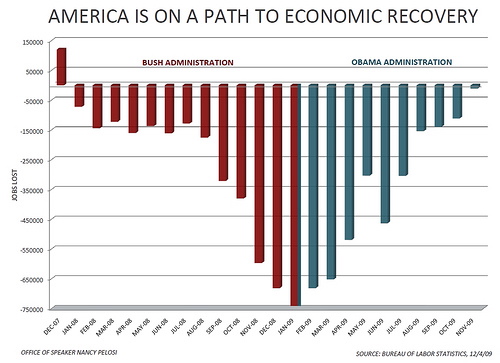
Despite doom and gloom in Republican talking circles, the overall jobs data is right on track in reflecting a rebound in economic activity.  Just released unemployment numbers show the lowest number of monthly job losses in two years, down to 11,000.

When Republicans handed over the Presidency to Barack Obama in January 2009, the monthly losses were 741,000.  If the automobile companies had folded, as they would have in the Spring without government support, another  million-plus people would have been thrown out of work, sending the monthly number over 1,000,000 for several months in a row.

It would have been preferable if private business activity had caused employment to improve.  But the financial freeze robbed businesses of their confidence and their financial capital, so businesses have shedded jobs, delayed plans, and closed down.

The government rescue gave money to states to stop layoffs at schools and police departments.  In other ways, from the Fed’s low interest rates to funds for infrastructure, education grants, promoting green technology and the like, the government injected money into the economy.  Job losses in September of this year were down to 139,000 and in October, 111,000.  The stimulus is working, despite Representative Boehner’s (R-Oh) claims of failure.

Jobs are a lagging indicator, which means that new business planning, funding and activity happens first, and then the hiring of employees occurs many months later after confidence improves, and opportunities require new staffing.  The growth rate for the economy as a whole was around three percent for the quarter ending in September, in line with the positive growth rates that the U.S. hopes to sustain for long-range growth, although more is desired now to make up for negative growth during the recession.

The goal is for employment to come roaring back and for private business to take over for public support of the economy. However, businesses large and small are still shell-shocked by the financial freeze and destruction of wealth that it wrought.  They must also adjust to lower spending as consumers behave more responsibly and unemployment remains significantly elevated. Fortunately, there is still a lot of stimulus money left to power infrastructure projects before the handoff to the private sector takes place.

The government has done the lion’s share.  It still needs to implement sound financial reform legislation, giving the public and financial industries confidence in a sound and fair system.  In addition, health care reform in the public and private sectors could free up wasted money for productivity in other areas that serve American business, such as exports.

Insurance regulation and universal coverage, already contained in proposed legislation, will spread the burden of costs more equally.  However, systemic overspending in health care robs families of wages and businesses of profits that could be put to better use.  Following evidence-based medicine rather than custom and practice and market-driven medicine could go a long way to giving us more for our money.  Malpractice reform, consistent with evidence-based medicine, would also eliminate waste.

Look for December or January employment numbers to finally turn positive and fourth quarter growth to remain healthy.  This will be welcome news to the unemployed and businesses, and should give the country more confidence that we are, in fact, on the road to recovery.

Follow my writing on Twitter.

December 8, 2009 UPDATEBloomberg Economics podcast of Dec. 7, 2009.  Tom Keen’s interview with Steven Wieting, Managing Director of Economics and Market Analysis reflects on the jobs data and recovery.   It’s technical, but provides some thoughtful observations.

(The original publication of this story contained an older employment graphic; this version has been updated).

Federal Reserve Independence Under Threat

By Marc Seltzer; originally published on December 1, 2009, at care2.com

. . .

Readers of this website (care2.com)  have a healthy skepticism of government. They see that well-heeled special interests assert too much power in Congress.  Our representatives in Washington should devote themselves to the public interest, but too often appear to serve lobbyists and work for campaign contributions, instead. This view is held by Democrats and Republicans alike, one of few shared beliefs.

Unfortunately, this bipartisan, anti-government nexus has led to legislation to audit the Federal Reserve, the powerful financial stewards of the economy.

This is likely a bad idea and one that suckers good activist public energy down the wrong path.  The reason that the Federal Reserve is unelected and insulated from political manipulation is that its powers would be very tempting to misuse for political gain.  If Congress or the President could, for example, force the Federal Reserve to lower interest rates and stimulate the economy when unemployment goes up, they would do so.  However, the Federal Reserve manages long-term monetary policy to obtain stability and growth in light of concerns over inflation, exchange rates, and productivity.  This may include inflicting a certain amount of household suffering on the American economy to fight inflation or deal with crises where sacrifice today insures wealth and stability tomorrow.  If politicians could interfere, this would never happen.

The audit legislation responds to anguish about the failure of the government to regulate financial activity and risk in the lead-up to the current crisis. It also channels anger over the solutions to the crisis that the Fed has created.

Those who are against corporate greed and excessive wealth could better use the tax code to force corporations to pay their fair share.  Moreover, the proper response to failures of deregulation is increased regulation forcing private institutions to have higher capital reserves, lower leverage ratios and more significant safeguards and oversight than existed since Clinton-era deregulation.  No one is claiming that government got it all right.  But remember, it was political and financial interests that led to the current crisis.  And note that politicians have proposed everything from doing nothing to nearly twice the stimulus that was passed in response to the crisis.

The Federal Reserve is made up of professional economists and financial experts fulfilling a public service.  It is not immune to mistakes, but the Federal Reserve has, with specific limited exceptions, maintained a healthy independence from political authority.

Sacrificing that independence when the Fed makes mistakes or when we don’t like its decisions — which is what this legislation is really about — is not the answer.  Once the Federal Reserve is damaged, political and financial interests will use the Fed to serve current political goals at the expense of the long term financial health of the nation.

We know what that scenario looks like in practice because we have the example of Congress.  Congress never cuts expenses because our representatives are beholden for their jobs to special interests served by that government spending. One of the great examples of cost-cutting in government was done by the Base-Closings Commission, an independent panel appointed for the purpose of solving a problem that congress could not otherwise solve.

What we need is more fiscal responsibility, not less.

May 6, 2010 UPDATE:  The Senate voted down an amendment to the financial reform legislation today that would have subject the Federal Reserve to more congressional authority.

President Obama, is Afghanistan more like Vietnam or Germany?

By Marc Seltzer; originally published on November 30, 2009, at care2.com

. . .

When President Barack Obama addresses the nation on Tuesday evening, December 1, from the U.S. Military Academy at West Point, I will be looking for the President to answer specific questions I have about the United States’ conduct of the war in Afghanistan.

I would like to hear Mr. Obama state clearly the current objective.  Is it to build a modern nation in Afghanistan, create a quasi-democratic state, or simply stand a government that can police its own population and take actions that support U.S. security objectives?  Eighty percent of Afghanistan’s population live in 32,000 rural villages. Economic and political life is different there than in modern societies, and I want to see that the President’s plan does not rest on unrealistic expectations and assumptions.

President Bush’s military mission in Afghanistan was to remove the Taliban from power and stop Al Qaeda and its associates from conducting violent action against the United States.  The initial invasion succeeded in ending the Taliban national government, and the ongoing campaign has forced Al Qaeda to seek more hospitable territory elsewhere.  However, installing a democratic government with control of the entire country has proved impossible, and in the face of such difficulty, the mission has become less clear.

The most important issue in the war in Afghanistan may be its impact on Pakistan.  If any nation could be the catalyst for a WWIII scenario it is a nation with a nuclear arsenal and a violent extremist insurgency.  Pakistani Taliban and other insurgents are actively fighting against the democratic government of Pakistan and lethal bombings of civilian and military targets are becoming daily occurrences.  An all-out civil war in Pakistan would be catastrophic and could require international forces to secure nuclear weapons, at the very least.  If this is part of the calculation of continuing our military effort in neighboring Afghanistan, Mr. Obama should say so. The Bush administration played fast-and-lose with the reasoning behind the invasion of Iraq, and confidence in American credibility suffered as a result.

And then there’s the Vietnam question.  Are we even capable of defeating the Taliban?

In Vietnam, we were unwilling to risk a direct military confrontation with the Soviet Union and China, and yet could not defeat the North Vietnamese people without risking such an all-out superpower war.  Thus, we were in an unwinnable war with no good diplomatic solutions.

While there is no superpower behind insurgent forces in Afghanistan, there is significant support in the population and financial backing from abroad.  We have been fighting insurgents for eight years and are no closer to victory.

It is a combination of troop strength and strategy that will make or break the U.S. effort in Afghanistan.  Not just critics of the war, but top military brass, have said that a political solution is ultimately necessary.  In Iraq, an important part of the “surge” strategy was hiring the unemployed former army members and others who were fighting against us.  The concurrent increase in U.S. troops also supported government and military efforts to control violence, but the change in strategy was key. A similar initiative to pay local Talibs to switch sides is now underway in Afghanistan.

If the new strategy for Afghanistan is not producing positive results in a year or two, will the President accept defeat and withdraw our resources?  There is evidence that President Lyndon Johnson did not want to be involved in the Vietnam war and did not think it was winnable.  Yet, he continued to increase American participation based on domestic political consequences and complex international uncertainties.  However, our resources are precious and should be used with serious intentions, not squandered, or commited by default.

Will there be an honest assessment as to whether the new strategy in Afghanistan is working?  Does the President have the courage to recognize and accept failure?  It was one thing to refuse to accept defeat in a WWII.  The war against Germany and Japan saw a far greater commitment of resources and manpower.  Our entire nation was transformed into an armament factory and the committment to destroy the enemy and remake its society was total.  On the military front, we used all the force we had and accepted both our own heavy losses and devastating destruction of German and Japanese civilian targets.  Total victory was necessary and total defeat was not an option.  However, the situation in Afghanistan is not a world war.  Failure of a operation does not mean the surrender of all objectives.  Only fourteen years after South Vietnam fell to the Communist North, the Berlin Wall came down and international communism was on its way out.  (If you still have an image of Communism guiding China and Vietnam today, travel there and test your ideas.  Both nations provide thriving business environments and gradual reforms).

The lesson here is that we should not follow a failing strategy for long.  The risk of failure is substantial, and the President and his military command must be able to evaluate and change course, as necessary, including abandoning losing causes.

I will listen with an open mind to the President’s reasoning on Afghanistan.  What I hope to hear is not so much an answer that fits my preconceived notions, but an explanation of the U.S. mission there and a realistic assessment of strategy designed to achieve our goals.

For an Afghan voice and perspective (although somewhat dated), see my Interview with Massoud Quiam and Commentary by Massoud Quiam.

December 2, 2009 Update: C-Span 3 is covering live Congressional testimony of Defense Secretary Gates and Admiral Mullen on Afghanistan.

Point of contention is whether it makes sense to ramp up the battle now, while at the same time saying that we intend to start transferring responsibility for security to the Afghan authorities by mid 2011.  Is this just the usual attack on the President, or is there a contradition here?  Can we say that we are only willing to spend so much time and money (and risk to our troops) and that that time is running out — a limmited commitment — without hurting our chances of success?  It is a legitimate question, but the benefits of such a policy may still outweigh the costs.

Obama Approval, Progressive Politics and Democratic Unity

By Marc Seltzer; originally published on November 25, 2009, at care2.com

. . .

Pundits have focused recently on President Obama’s declining public opinion polls.  As the President drops to fifty percent approval ratings, the talk speculates on whether the poor economy will sink Democratic prospects in the 2010 midterm elections.  The economy is important and the administration’s policies will not cure recession blues before the election, but of greater concern is the question of Democratic political unity.

Republicans have criticized the President’s leadership and policies from the get go, but with Progressives attacking the administration and fracturing the President’s base, some of the moderates who elected him are beginning to wonder.  Have the progressives gone off in search of Ralph Nader?

Neither the left nor the right have a majority in national American politics.  The candidate that convinces the pragmatic middle to join the ideological left or right wins both in electing candidates and in charting policy.  President Bush succeeded in maintaining the right-middle coalition between 2000 and 2008.  He used the power he was given to lower taxes on the wealthy, promote hands-off financial oversight, conduct aggressive foreign and military policy and tilt the delicate balance between rights and security not so delicately in favor of security.

President Obama won back moderates in 2008, promising to shift economic policy towards the middle class, embracing government regulation in finance, the environment and health care, and seeking new strategic solutions in international relations.  His is not, in fact, a liberal vision, despite Republican characterizations, but it is a more moderate one than what came before, and one that aims to learn from the experiences of prior administrations.As long as his coalition continues, the President’s approach to taxes and budget, justice and rights, and foreign policy and war will prevail.

However, after nine months in office, it seems the President can no longer count on the Progressive wing for support.  In the guise of influencing the President to move to the left, Progressive critics attack the President and his administration.  Calls for Treasury Secretary Geithner to resign by Rep. Peter DeFazio D-Or are but the most recent example.  The left is also troubled by economic decision-making and the potential increase in troops headed for Afghanistan.  Of course, any coalition will contain different viewpoints.  A goal of our democratic process is for hearty debate to distinguish the best ideas from all others.  But Progressives fail to grasp that the President needs the full support of those that elected him in order to achieve his agenda and present a successful Democratic party to the electorate in 2010 and 2012.  If the party is not unified, the President will not succeed and the power will shift back to the Republicans.

It is only because President Obama joined, at least temporarily, the moderate center of the electorate with the traditional Democratic party that he succeeded in bringing his moderate voice to the fore.

Follow me on Twitter