Category Archives: Barack Obama

In Republican Victories a Lesson for President Obama

By Marc Seltzer; originally published on November 5, 2009, at care2.com

. .

What does a master politician learn from defeat?

Republicans are claiming the November election shows a renunciation of Barack Obama’s nine months of leadership.

Democrats are reassured by the Owens victory in New York: The Conservative candidate was too far to the right for mainstream America.

But President Obama must surely be licking his wounds.  He, and his party, should have won the Virginia and New Jersey governors’ races.

Candidate Obama won those states forcefully in November 2008.  How could they be lost so decisively now?

Mr. Obama has been in office 9 months. The public saw in candidate Obama a fix for the errors of President Bush:  Bad wars would be ended; good wars would be fought successfully; special interests would be put in their place; the super rich would pay their taxes; average Joes would find jobs, and decisions on health care, foreign policy, financial regulation and immigration would solve knotty problems of budget woes, and nuclear fears while making humanitarian advances.

Ruling is far different from campaigning.  We are three-hundred million people living under the representational leadership of one head-of-state who shares power with 500 or so others representing each and every bit of our union from the Hawaiian Islands to the Eastern seaboard.

Every President suffers in the elections following their inauguration as the public’s hopes are dashed by the realities of governance.  What seemed so obvious and positive in a speech during the campaign becomes so complicated and expensive when you face it squarely and manifest it in policy and law.

But is that it?  Is it just disappointment with reality?

I don’t think so.  It’s more than that.

The President has presided over one of the most remarkable economic events in U.S. history.  The financial industry – a core pillar of American and international business — was brought to the brink of collapse.  Democratic and Republican leaders acted quickly and creatively without a playbook to rescue the financial sector.  This was not an average recession, but an international crisis of finance that was bigger than the financial system itself.  That’s why the government had to step in, but the results will be debated and lessons included in the next generation’s history books.

Possibly fearful of making a mistake, the President has hesitated to explain clearly to the American people just what has happened.  Treasury Secretary Timothy Geithner and a league of economists in government and academia have spoken to the causes and reform proposals.  With all due respect to Secretary Geithner’s intellect and articulateness, President Obama, with his commanding charisma and office of authority, must lead on this issue.

If the nation had plunged into a depression, rather than skirting perilously around the edge, the President would be expected to lead us through.  The fact that we may have avoided more catastrophic losses does not obviate the profound need for leadership to speak powerfully to the causes, remedies, and reform.  It is not enough that competent leaders work the process through congressional committees and administrative working groups.  The President must face the event squarely and communicate to the public about his presidency’s relationship to these historic times.  When I think of the Great Depression, I think of Roosevelt telling the nation “the only thing we have to fear is fear itself.”  When I think of the bombing of Britain, there is Churchill saying, “I have nothing to offer but blood, toil, tears, and sweat.”  But when I think of the financial crisis of 2008-2009, I think of Paul Krugman and Bloomberg Economics.

And this leads back to November 3, 2009.  The reason that the Democrats lost in battles against Republicans is that the public is concerned about direction of the government on the economy.   What has the President done in 9 months of office?  He has addressed the financial crisis and pushed ahead on health care.  Both of these programs deal fundamentally with economics (if money grew on trees, we wouldn’t bother with insurance reform) and the fiscal state of the nation.  Yet the President has not yet done what he is capable of to express a coherent financial plan on either issue.  He is, of course, subject to Republican criticism no matter what, but more important than that, he does not have the confidence of the moderate middle of the country who decide close elections.

Bill Clinton lost a great deal of his authority in 1994 when the Republicans retook power in Congress two years into his presidency.  President Obama has had a hint of what can happen in the losses in Virginia and New Jersey.  A gift in disguise?

Mr. Obama needs to refocus his communication priorities to explain to the American people his short- and long-term economic vision.  He needs to include a convincing dose of reality in his message rather than campaign rehtoric — not just “economic recovery” and “bend the cost curve” but targets for deficit and debt, goals for long term spending and revenue, transition from stimulus to private economic activity.  And the President must deliver and stay on the message himself in order to inspire confidence in the majority of Americans.
Follow my writings on Twitter.

Taxing Health Insurance Plans

By Marc Seltzer; originally published on October 13, 2009, at care2.com

When is a tax a good idea?

NEVER!  (Say it cause it feels good.  Then get real and move on.)

One important proposal for lowering costs in health care is taxing higher-value health insurance plans.  The principle here is that currently the U.S. government is subsidizing high-level insurance plans purchased by employers.  Health insurance premiums are not taxable, while employers do have to pay tax, such as payroll/social security tax, on income paid to employees.  The employers thus provide additional compensation to their employees without paying full price.  This deduction encourages over-spending by employer and employee.  By comparison, individuals who purchase insurance cannot deduct their premiums or costs of health care from their income.

The thinking goes something like this:  An employer deciding to purchase insurance looks at an $8,000 plan and a $10,000 plan.  It realizes that the $10,000 is a deal because of the subsidy, and it knows its employees will value the plan and consider it as part of the reason to work there.  The employee then has incentive to use medical benefits more than on the lesser plan because the higher-cost plan has lower deductibles, coverage of alternative care and lower co-pays.

There is nothing wrong with an individual choosing to pay more for health insurance and then making use of more in benefits.  But if the U.S. government is subsidizing the plans, then the incentives are distorted.  When conservatives talk about what is wrong with taxation and government, their best argument is that government does not efficiently allocate resources because it distorts the market to redistribute wealth in wasteful ways.  This is a prime example.

If progressives want the government to distort the market in health care, it would make sense to provide help to those who can’t afford care, or to provide subsidies to promote certain types of care such as free annual physicals that could be valuable in improving health or lowering costs, through prevention for the public as a whole.  But there is no reason that the government should redistribute wealth to encourage high-end employer-provided insurance and use of such plans to the fullest.

The result of the system in place today is that working individuals with expensive plans are encouraged to get any and all recommended medical care.  Some procedures are covered 100%.  Some 90%, 80%, 75%. What’s the right formula, where people correctly balance the need for health care against the cost?

Take away the subsidy and find out.

In my own experience, I broke my leg badly, while covered by a great insurance plan.  Surgery was recommended and the $30,000 bill turned into only $1,500 in out-of-pocket expenses.  This is exactly what insurance is designed to protect against and it worked well for me.  This involved emergency hospitalization, which, though expensive, is often well covered by all types of plans.  However, in rehabilitation, I sought chiropractic, acupuncture and physical therapy and remember that my out-of-pocket expenses were remarkably low or non-existent.  My firm offered this plan to compete for employees in the marketplace, but the tax code also underwrote my plan.  Remember, under current law, the more an employer spends on health care plans, the more money it avoids paying tax on.

Current proposals are structured to tax plans on the part of the premiums that go above $8,000 per year and family plans on the premiums above $21,000 (For example, $10,000 in premiums for an individual would be taxed on the $2,000 above the exemption at a rate of 40% for a tax of $800.)  The tax would affect employers and individuals who purchase insurance equally and would likely have several impacts:

1.   It would lower the number of high-end plans, as employers and individuals sought to avoid the tax.  In that case, affected employees, who previously would have received higher-value insurance packages underwritten by the government subsidy, would have lower-value insurance with somewhat higher co-payments.  Shifting some additional burden to the insured in this way would lower national spending on health care, yet continue individual choices on where to spend and where to save.

2.   It would raise an estimated $200 billion dollars from tax revenue on plans that were higher end.  Thus, employers and individuals who continued to purchase high-value plans would pay a new tax on those plans.  This revenue would go to underwrite the efforts to subsidize insurance to those who cannot afford it.  $200 billion represents about 1/4 of the cost estimated to subsidize insurance over the period of ten years.

3.   For people at or below the limits, there would be little change in premium or co-payment prices.  Theoretically, the lower use of medical resources would lower the price of health care in the overall marketplace.  This would likely be countered by the increased use of medical services by individuals who will gain coverage through the new legislation.  However, if the new legislation did not contain this tax provision, prices would continue to rise from increased demand as more people with insurance sought health care services.

There are a number of different ways that health care costs can be lowered and different options for how to bring more people into the insurance marketplace.  The current proposal is but one piece of reform.  Taxing of high-cost health plans is bound to be controversial because Americans are allergic to all tax hikes.  However, this proposal removes a tax loophole that encourages overuse, or at least subsidized use, of the health care system.  Even without the use of the revenue to provide subsidies for those who cannot afford health care, this tax makes sense.

N.Y. Times has an excellent story with political background including issues for unions whose members have received high-level benefits in lieu of compensation.  A detailed Huffington Post piece discusses how the tax may impact middle class Americans and a Commentary blog suggests it will change the health care we have now, against Obama’s promises.  Be that as it may, a loop-hole is a loop-hole, and it creates distortion and waste among executives and union employees alike.

Senator Olympia Snowe, (R)-Maine, who announced today that she is supporting the Democrats’ Senate Finance Committee bill (the Baucus bill) being sent to the full Senate today, supports taxing insurance plans, although she aims to ensure that middle and lower income members of the public and those above age 55 do not bear the burden of the tax.

We all want an efficient government that does not encourage waste of resources.  Calling or writing your congressional representative to demand a tax on excess health care premium plans is the same as demanding the end of an egregious tax loophole.  Remember, the point of health care reform is to insure more Americans and strengthen the financial foundation of the nation.

Obama Nobel Prize for Multilateralism

By Marc Seltzer; originally published on October 9, 2009, at care2.com

President Obama’s winning of the 2009 Nobel Peace Prize recognizes his multilateral emphasis in resolving international conflicts.  Critics, who wonder what he has done, are overlooking the importance of this cooperative approach to the rest of the world.

During the first decade of the 21st Century, President Bush rattled Europe with his willingness to take unilateral action and use force to achieve America’s international goals. The U.S. is more willing to go this route in part becauses it has not been scarred by international wars on its home soil.  The attacks on Pearl Harbor, New York and Washington D.C. were painful, but Europe lost far more than fifty million lives, many of them civilians, during World War II.

President Obama struck a chord with the Nobel committee and people of all nations when he spoke of working in cooperation with the international community.  With the benefit of hindsight, President Obama recognizes that problems such as Middle-East conflicts and totalitarian regimes are not so easily fixable by the United States, despite great diplomatic and military power.

It is worth noting that many European nations were still monarchies in the 20th century.  Even as those monarchies were replaced by democracies, Europe plunged into two destructive wars and needed help from the United States to free itself, first of Nazi aggression, and then of Soviet oppression.

In many ways immitating the U.S. and Canadian models, European nations have now solidly pursued a democratic vision and free markets, trade and immigration among member states.  These policies have led to prosperity, stability and increased international leadership.

Since the Second World War, Europe gradually built a stable community of nations using organizations such as European Union and NATO and determined, constructive, diplomatic efforts.  European nations have used negotiation to form a union.

The current U.S. concerns over nuclear proliferation, totalitarian regimes, and violent extreamists may or may not resolve through diplomatic efforts.  But President Obama’s multilateral approach is the best option for peaceful resolution of conflicts.  Finding common ground with China, Russia and the European Community can bring tremendous power to our efforts to diffuse dangers abroad.  There is no magic wand that guarantees peaceful solutions, but the President is both realistic and savvy about how to ally the greatest force against enemies of democracy and peace.

In this light, the Nobel prize is a high honor for Barack Obama, a recogotion of a new attitude in U.S. foreign policy, and a confirmation that there is great desire in the world for 21st century international cooperation.

Follow my writing on Twitter.

Irony of Obama’s Opposition

Marc Seltzer ⓒ 2009

By Marc Seltzer; originally published on October 5, 2009, at care2.com

. .

By my calculation, we elected in Barack Obama, a leader who is expert in reasoning.  He distinguished himself academically to get into Harvard law school, and there, he competed in talking and writing about law and society to become editor-in-chief of the Harvard Law Review.

He went on to teach others to learn, analyze and debate at the University of Chicago Law School, a critical-thinker’s heaven.

More recently, his presidential campaign included a vision of bringing more reasoning to governance:  Rules against conflicts of interest and restrictions on lobbying aimed to insulate decisionmaking-by-reasoning from special-interest influence.

And now, as President, Mr. Obama consistently speaks of solving problems by using “what works,” instead of employing ideological approaches.  This too is reasoning and judgment, rather than resort to theory without consideration for the facts on the ground.  It does not mean that the President will not consider free-market economics, on the one hand, or government intervention, on the other, but he looks for solutions that take into account the myriad of consequences, rather than simply going with a principle, results be damned.

What is ironic, although maybe karmicly inevitable, is that this king of reason is being confronted with logic’s nemesis:  emotion, belief and intentional deception.

Take, for example, Mr. Obama’s first acts as President.  The economy was diving into a deeper recession.  The financial industry was frozen.  The President supported a huge rescue program.

He was branded a socialist revolutionary — taking society in a new direction.  Honestly, what would have been truly radical would have been to do nothing.  What he did was big and risky but not radical.  Radical would have been allowing the chips to fall where they may. It would have been emotionally satisfying, and some would have preferred to risk economic depression, international bank failure, destruction of real estate, stock and who-knows-what other markets to bailouts.  Mr. Obama could have stood firm and said, “I am a man of principle, and being responsible means paying the price for your mistakes.”  Many a man-on-the-street was calling for this approach, but it would have had radical consequences.

And to health care.  President Obama says, let’s fix the system.  A liberal vision would be the single-payer model, successfully used in Canada (see first-hand “comments” to blog).  It cuts costs and delivers excellent universal health care.  It is tax-payer funded and not connected to employment.  But the President seeks no such leap of faith from the American people.  He simply wants to adjust the current system, to bend the cost curve so that public systems he inherited do not go bankrupt in ten years, and so that more people can afford health care.  He doesn’t have to do this.  Medicare will not go bankrupt on his watch, and any action taken to solve this problem will be unpopular in some circles as excess is taken out of the system.  But acting now, instead of waiting for a crisis, is prudent.  In truth, President Obama’s approach is again quite cautious.

Yet look at the arguments stacked against him:  “Citizenship,” “Socialism,” “Nazism,” “government takeover,” “revolutionary policies,” “health care for illegal aliens,” “death panels for grandma,” and “take back our country.”  Lively conspiracy theories, expressions of fear and its anger, and political taunts, but hardly addressable through reason.

Insecure times have brought anger and fear to the fore.  Humans project their dislikes onto suitable targets, whether reasonable or not.  If we do it to our relatives, colleagues and celebrities, we certainly do it to our presidents.

If President Obama were publicly casting blame on the Muslim fundamentalists or communists in our midst, or stoking up anger and fear of some enemy, he would channel the feelings bubbling up.  Instead, he is playing the technocrat, using logic to solve problems and avoiding the messy emotions spewed about.  In areas like climate change, health care and the economy, where real-world concerns need to be addressed, the work of the government is finally getting done.

But feelings of fear and anger may be unsatisfied and may exacerbate if the economy fails to improve quickly enough.  Is the President, who reasons so well, who almost never shows anger, able to deal with the unreasonable?

Is reason itself an antidote, or is this like the dark forces bringing Kryptonite to Superman?

Eight Years Later, Conspiracy Theories about September 11, Live on

By Marc Seltzer; originally published September 14, 2009, at politicsunlocked.com

. .

As we acknowledge another anniversary of September 11, our national attention focuses on various aspects of the 9/11 experience. From personal grieving and reflecting to rekindled feelings about political ramifications of the 9/11 response — two wars, increased security, intrusions into privacy, and controversial treatment of detainees, to name only the most obvious — the date has meaning for nearly everyone old enough to have experienced the 2001 attacks.

A significant number of people in the United States, and likely worldwide, are captivated by alternative stories of 9/11 events and their aftermath. According to those referred to as “9/11 doubters,” or “truthers” the cause of the destruction was not foreign political extremists, but a yet undiscovered conspiracy.  For these conspiracy theorists the investigations since 9/11 have been part of a cover-up, to keep the true plotters hidden.

Having conflicting and alternative views is nothing new in the American experience. Freedom of thought and belief were so fundamental to the founding of the nation that they were institutionalized in the First Amendment to the Bill of Rights as freedom of expression and freedom of religion. The Founding Fathers had seen mayhem and destruction result from the conflicting beliefs of Catholics and Protestants in 17th and 18th century Europe. Their solution was not to reconcile the different beliefs, but to guard against abuse protect those who express them.

Civilizations have come to demand decision-making based on reason in dealing with issues of engineering, law, economics, medicine, security, etc. The numerous and thorough investigations of 9/11 have answered the questions about what happened that day.  Continuing disputes over responsibility for the government’s failure to anticipate the Al Qaeda threat and disagreement over the appropriate military response illustrate that people can reason differently from the same facts.

What can be disturbing about conspiracy theories is that they are maintained in the face of substantial factual evidence. Claims such as Holocaust denial, the belief that the Apollo Moon landing was a fabrication, President Obama’s foreign birth or that 9/11 was perpetrated by a secret U.S. government program seem as wildly improbably and unrealistic as science fiction or fantasy literature to those who judge them on a scale of reason.

It is worth remembering that logical reasoning is only one human approach to understanding. Love, friendship, religion, philosophy and politics are largely governed by intuition and cultural beliefs rather than logic.

9/11 conspiracy theorists, who disregard a mountain of evidence to maintain their belief in mysterious acts, demonstrate that intuition and belief are alive and well in the 21st century.

Have the Military Responses to 9/11 Been Equal to their Costs?

By Marc Seltzer; originally published on September 11, 2009, at care2.com

. .

Reflecting on 9/11 includes thinking about eight years of foreign policy. What concerns me is the massive commitment we have made in two foreign wars and the uncertain accomplishments we have to show for it.

In Afghanistan and then Iraq we invested tremendous human and economic resources.  We may in the long run succeed in giving Iraq the opportunity to create a functioning democracy, but the cost was high.

In Afghanistan, it is still not clear that a positive outcome can be achieved, although the committment of sufficient resources may also bring results that were not possible previously.

During President Ronald Reagan’s eight years in office, he responded to various threats without engaging in a substantial ground war.  When he chose to react with force to Libyan terrorism, he bombed Moamar Gadaffi’s compound.  Gadaffi survived, although immediate family members were killed in the attack.  One military act, with small risk to our forces and cost to our economy, backed up by economic sanctions.  We did not attempt to replace a regime or transform a society.

Since then, Gadaffi has renounced terrorism and sought to comply with international norms. Gradually, sanctions have been removed and Libya has begun its return to the community of nations.

President Reagan did commit tremendous national resources to oppose the Soviet Union, the major Cold War threat.  But despite “Star Wars’” failings, the U.S. investment in missile-shield technology fostered American economic and technological superiority, which ultimately forced the Soviet Union to change.  Not all former soviet states are success stories today, but many are, and the 30-year threat of nuclear war subsided.

Since 9/11, the loudest complaints about our use of force have been over justification for our invasion of Iraq.  Those who believe that military action wasappropriate focus on security to be gained from defeating the enemy and establishing stable government.  What about the security to be lost, if we demonstrate that we are unable to accomplish our mission or unwilling to face new threats (Iranian and North Korean nuclear programs), because we have already given too much?

Our military proves itself every day in discipline, bravery, organization and tactics.  But do our political leaders have the strategic wisdom to use force so that we achieve the most for the least expenditure of precious resources?

Health Care Politics

Originally published at care2.com on June 23, 2009

Consistent with his free-market approach to all things economic (emergencies aside), President Barack Obama has given some suggestions on how he believes reforms can make health care more affordable and efficient.  Mr. Obama has endorsed the creation of a public insurance entity from which Americans could choose to buy their health insurance, and which would offer competition to private insurers.

This approach is par-for-the-course for a President who addressed the financial crisis with public-private solutions instead of wholesale nationalization, and who believes in helping all Americans obtain health insurance but rejects the Canadian and European approaches to socialized medicine.

Mr. Obama has also smartly pressed for putting medical records on line as a way to track care and results in order to find ways to reduce costs and provide superior care.  A much-talked-about article by New Yorker writer and M.D., Atul Gawande, has illustrated that high costs in health care sometimes serve private financial interests at the patient’s and public’s expense rather than primarily reflecting patient needs.  Reformers hope that a public insurer could seek to both lower costs and provide high-quality care, inducing private insurers to match better care for lower cost.

While Congressional Republicans, some Democrats and insurance companies are speaking out against the public plan, saying it will undermine private insurers, recent public-opinion polls show popular support for a public insurance entity. Seventy-two percent of respondents in a nationwide poll supported the idea, including one in four Republicans. The President is going on the offensive, going so far as to mock lobbyists and legislators for protecting the insurance industry from competition.

Congressional Democratic leaders Henry Waxman, Charles Rangel and George Miller have unveiled a house bill containing the outlines of a public plan and proposal to insure 95% of Americans.  Senate legislation, being spearheaded by Democrat Max Baucus and separately in the offices of Senator Kennedy and others, is still being developed.

Any reform of such a massive sector of the economy is bold.  But with health care costs eating up an ever-greater share of public and private resources, change is required.  It will take years for the new legislation to transform our health care system, but the mantra of “more for less” is a good guiding principle.  Our spending on health care is unsustainable, damaging to public sector budgets and private business competativeness.  If we don’t want to give up the excellent care a majority of us enjoy, we will have to innovate.  Looking to competition, even that created by the introduction of a public insurance entity, and trying to bring more people into an efficiently-managed program, makes sense.

It’s about time Mr. Obama and Democratic leaders on health care received some bipartisan support for their efforts.

Immigration Enforcement

Originally published at care2.com on July 6, 2009

The U.S. Citizenship and Immigration Services reported that more than 500 U.S. military servicemembers would take the Oath of Allegiance to become U.S. citizens this July 4th.  Some participated in ceremonies in Iraq, others at military bases in the United States.   These new citizen soldiers make up only a small portion of the hundreds of thousands of recent immigrants given citizenship every year, but they are an apt symbol of how important immigrants are to this country.  Last year, breaking previous records, more than a million immigrants became citizens.

Meanwhile, the administration of Barack Obama is taking action to increase policing of employers who hire illegal workers.  The administration reported that its investigations recently targeted more than 600 businesses.  In fact, the New York Times reported that 650 businesses were notified on just one day of pending audits, up from 503 audits for the entire last year of the Bush administration. The enhanced enforcement is part of President Obama’s policy of emphasizing border enforcement and employer compliance rather than stepping up action against individual illegal immigrant workers.

The President has also called on lawmakers to write immigration legislation that further increases border enforcement and legal immigration, but also creates a path towards legalization for many illegal residents.  Democratic Senator Charles Schumer of New York, who chairs a subcommittee on immigration, will likely take the Senate lead.  He may not have an easy task.

The issue has aroused passionate debate in support of and opposition to the estimated 12 million illegal residents already in the United States.  Commentators, such as CNN’s Lou Dobbs, fan the flames of anti-immigrant anger by focusing on criminal activity and threats from abroad as though every immigrant was a member of a gang or terror cell.  Criticism of illegal immigration is fierce, and most opponents strongly object to proposals to solve the problem through reform legislation containing any form of legalization (often described as “amnesty”). Besides seeing illegal residents as breaking the law, opposition to legalization focusess on the competition for jobs, burden on public resources, and crime and security concerns.

Reform advocates, while still seeking legalization of the vast majority of those already in the country, are concentrating on border enforcement and workplace compliance in an effort to meet some of the concerns raised by illegal immigration.  However, a CNN commentary by Ruben Navarrettepoints out that there are disagreements among those seeking comprehensive legislation.  For example, pro-business Republicans are seeking a guest worker program, but working against employer sanctions.   Pro-labor Democrats are against guest worker plans but support a path to citizenship.

Navarrette warns everyone in search of a solution to avoid going to the extremes:  For legalization supporters, that is advocating open borders; and for those opposed to a path to citizenship, that is racism and ethnic prejudice, he says.

President Obama’s enforcement program and the economic downturn may have a significant effect on lowering illegal entry into the United States.  It is not yet known whether this could also significantly lower the vast number of illegal residents in the United States.  It is logical that as the labor market for low-wage workers weakens, some workers might return to their home countries, at least if there are prospects for work or a lower cost-of-living to be found there.

But could this adequately resolve the illegal resident issue?

Even if illegal residency decreases, there will likely remain a demand for low-cost labor.  For U.S. manufacters, exports will be an important aspect leading the U.S. out of the recession.  They will need low-cost labor to trade competatively in the global marketplace.  One reason jobs were exported from the United States in recent years was because of higher labor costs.  Moreover, countries with abundant labor supplies such as China and India have higher economic growth rates and are poised to economically overtake Western nations during the 21st century.

Organizations such as the Federation for American Immigration Reform (FAIR) work in the opposite direction, calling for a “time-out” or decrease in the number of legal immigrants coming to the United States. Most anti-immigrant or anti-illegal immigrant positions come from the perspective of protecting the public – from crime, from cultural change, unfair employment competition, etc.  But the concerns of organizations like FAIR would be better resolved by demanding government support tocommunities heavily burdened by an influx of legal and illegal immigrants.  Support could take the form of free English classes, greater federal funds to public schools, hospitals and clinics, and additional law-enforcement.  Other nations, such as Canada, provide substantial governmental support to ease the assimilation and immigration transition.

If new legislation eased the burden of immigration on American communities, the focus on illegal immigration might be decreased.  Then we could turn to increasing the number of legal immigrants permited to work in the United States to match the needs of the U.S. labor market. This would offer a path to prosperity for the nation that would serve established as well as new Americans. 

Those doubting that the nation’s economic needs are sufficient to increase the number of legal residents should remember that, before the recent recession, unemployment rates in the United States were remarkably low, despite the fact that a substantial percentage of twleve million undocumented immigrants were generally participating in the labor market.  Their work, which could not have been done by others in such a tight pre-recession labor market, created wealth for the nation, although this wealth was not spread evenly through society.

Rather than debating whether to remove or legalize illegal residents, we should be welcoming more immigrants and working to make their assimilation and transition as positive as possible for our national community.  Let’s share the costs and benefits of expanded legal immigration, removing some of the reasons for its opposition.

President Obama’s African Visit

1191379_370

Originally published at care2.com on July 12, 2009

President Obama chose to visit Ghana, a functioning democracy in West Africa, despite his personal ties to Kenya, his father’s homeland.  The President’s diplomatic tour put Ghana on the map purposely, a show of diplomatic respect. In his speech to the Ghanaian Parliament, which the U.S. embassy helped make available more widely, Mr. Obama recognized that, through democracy and honest government, Ghana had made progress for its people.

The President’s message was that all Africans should look to Ghana for examples of what works.  Recognizing endemic problems with development in Africa, Mr. Obama said, “No business wants to invest in a place where the government skims 20 percent off the top, or the head of the port authority is corrupt.”  “No person wants to live in a society where the rule of law gives way to the rule of brutality and bribery. That is not democracy, that is tyranny, and now is the time for it to end.”

In one of the most inspirational passages, the President noted that Martin Luther King traveled to Ghana in 1961 to watch Ghana’s rebirth as an independent nation.  Then to the future of Africa he said, “I am particularly speaking to the young people all accross Africa and right here in Ghana. . . . And here is what you must know.  The world will be what you make of it.  You have the power to hold your leaders accountable and build institutions that serve the people. . . . But only if you take responsibility for your future. . . . But I can promise you this, America will be with you every step of the way.”  Full transcript

The Ghanain President John Atta Mills responded, “This encourages us also to sustain the gains that we have made in our democratic processes.”  “I can say without any fear of contradiction that all Ghanaians want to see you. I wish it was possible for me to send you to every home in Ghana.” Public response;  NYTimes Images from Ghana

President Obama also sought to put U.S. foreign aid in a sober context saying that the United States was willing to give aid to support new development, but the burden should be on Africans to make their own progress sustainable. He urged self-reliance across the continent and offered help getting started. “Aid is not an end in itself,” he said. “The purpose of foreign assistance must be creating the conditions where it is no longer needed.”

Ghana is a bustling country with a large metropolitan coastal city, Accra, and vast natural resources, including rainforest.  It has substantial tourism and was host to the 2008 Africa Cup soccer tournament and is a center of trade in African arts and crafts.  It is also the site of Cape Coast, a major slave-trade port from which slaves were shipped to the Americas (pictured above).

A great humorous moment of the President’s visit was when he was introduced to the Parliament of Ghana by a trumpet flourish.  Laughing, and likely wondering how long it was going to go on, the President started his addresss at the pause with, “I think Congress needs one of those horns.”  See first link below.

(the rest of the speech)

Deficit Spending

1189424_370

Originally published at care2.com on July 9, 2009

California government struggles.

Forced to match public spending with revenue (some monkey-business excluded), leaders have only two good options:  Cut spending or raise taxes.  You would think that this would be easy enough.  But either option takes money from people who feel it should be theirs. The conflict is so fierce, the interests so entrenched, that leaders will walk dangerously close to default, to failing to meet obligations, rather than give up what they defend.

In the federal government, we have a different problem.

The Bush administration did away with Clinton-era commitments to pay for spending increases or tax cuts by finding sources of revenue.  Without even that modest amount of discipline, legislators, who get elected by pleasing their constituents, consistently spent their way into incumbancy.

I do not fault the Bush or Obama administrations for their emergency efforts to buy off an economic Depression (or substantial risk thereof)through massive deficit spending on short-term stimulus.  It was the best judgment of the experts, and it seems to have worked.  A Depression is far more costly than the money spent on stimulus.  But neither does this deal with the underlying problems in long-term public spending.  How do we reverse course and begin to bring the long-term spending equation in line with the revenue picture?

It may be that our political system is able to solve the problem.  The public is aware and concern over public spending is growing.  President Barrack Obama has called for a return to “pay as you go” legislation. This will make it far more difficult for Congress to add new deficit spending.  Even the roughly one-trillion dollars discussed as a budget for health care reform is being treated as “pay as you go” spending requiring an offsetting spending cut or tax increase to protect the overall national budget.

However, we have traveled so far down the path of deficit spending, that we will have to do more than maintain our course.  Bloomberg podcast — “Rivlin Says Fed More Concerned About Deflation Than Inflation”

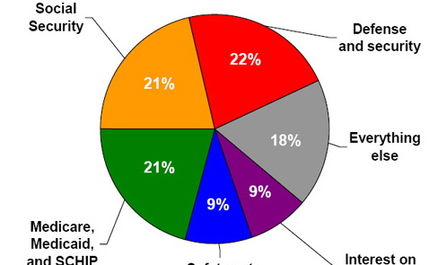
The nation has already made commitments to spending on Medicare and Medicaid that will dig us deeper in debt over the next ten years.  We would have to legislate cuts in Medicare and Medicaid in order to get out of those commitments, if we wanted to.  Therefore, new efforts must be made to raise revenue or cut spending in order to just maintain the level of deficit we have now.  We need courageous leadership, willing to ask for sacrifice from all parts of our society, and we need disciplined leaders, willing to put their careers on the line in order to do what is right.

The recession will end and revenue will therefore increase, but that does not mean we will be out of the woods.  If Congress is not able to legislate long-range fiscal responsibility we will need new solutions.  One approach, discussed in the past, is across-the-board spending cuts.  Another would be to create a deficit Czar or independent commission with responsibility for recommending spending cuts and revenue increases that would lead to a reasonable deficit.

We should think of the deficit as a percentage of the national economy, not a dollar figure.  When the percentage begins moving down, towards historic norms, we will be on the right track.

It might be that a group of leaders we trust, who are not elected officials, could do a better job giving us tough medicine than the people we pay to give us only good news.  In any case, the sooner we take the medicine, the sooner we will begin the road to recovery.