Category Archives: Barack Obama

Justice Sonia Sotomayor Fits the Obama Mold

By Marc Seltzer; originally published on May 29, 2009 at politicsunlocked.com

. .

The nomination of Justice Sonia Sotomayor to the U.S. Supreme Court fits perfectly with President Obama’s vision for good government: independent intellect, moderate politics, and pragmatism.

Sotomayor is a first generation Puerto-Rican American of humble upbringing. She distinguished herself academically, graduating summa cum laude from Princeton and editing the Yale Law Journal. Like Mr. Obama she proved herself and opportunity followed academic excellence.

Sotomayor has acknowledged that being Hispanic and a woman may be qualifications, or at least qualities, important to her professional career. “I would hope that a wise Latina woman with the richness of her experiences would more often than not reach a better conclusion than a white male who hasn’t lived that life,” she said in a speech. This differs from President Obama who hesitated to make distinctions part of his political language and for whom “we” most often meant middle-class Americans.

Republicans have attacked Sotomayor’s remarks as identity politics and raised fears of a judicial philosophy of preferences. But is this just grasping for straws?

First, simply, is the question of what she meant. Did she mean that it was about time for women and Hispanics to be better represented in government service? After all, there have been 110 Supreme Court Justices since the nation’s founding, and only two have been women. None have been Hispanic except Justice Benjamin Cordozo, of European Jewish ancestry, who may have had Portuguese bloodlines a few centuries back. Arguing that Cordozo keeps Sotomayor from being recognized as potentially the first Hispanic on the Court is nonsense.

Or did Justice Sotomayor mean that experience in life – adversity, discrimination, and disadvantage – helped her to build character and taught her about life in a way that wealth and social status might not have?

Conservatives may worry that she would be an advocate for women and for minorities on the court, emphasizing sympathy over the legal rules. This treads into especially difficult waters. Politically, liberals have often taken up the causes of women’s and minority rights. In the legal context, at least, conservatives have opposed affirmative action, or race-conscious government actions as reverse discrimination.

Commentators refer to decisions rendered by Ms. Sotomayor as technical and narrow rather than ideological and sweeping. In one case she emphasized how “embarrassing and humiliating” the school strip searches can be to teenage girls. Is this comment a sign of prejudice and activism? Because Sotomayor’s decisions are mainstream and are specific responses to facts rather than sweeping pronouncements of political theory, it is a stretch to find in them judicial activism or bias.

What is easier to find is pragmatism. Justice Sotomayor is known for concentrating on the facts of each case and for diligence and care in crafting her decisions.
A Judicial Review: Justice Richard Posner

By Marc Seltzer; originally published on May 20, 2009 at politicsunlocked.com

. .

A potential candidate for the U.S. Supreme Court?

Justice Richard Posner of the U.S. Court of Appeals for the 7th Circuit is a giant in the field of legal theory. In association with others at the University of Chicago Law School, Posner is a chief architect of a movement called “law and economics”: efforts to bring free-market economic thinking into legal theory. Consequently Posner is known as a conservative for his economic principles. However, he does not take broad ideological positions. For example, he supported the government’s recent efforts to stimulate the economy using public funds, but he opposed the use of tax rebates because he concluded that the public would save this money rather than spend it. Instead, he endorsed spending on roads, bridges and other infrastructure, generally in line with Democratic Party positions.

Justice Posner is also a unique Supreme Court candidate because he has expressed so many opinions outside of the courtroom. He has written 40 books and hundreds of articles. He also maintains an active blog with colleague Gary Becker and is considered the most prolific justice in U.S. history. He has expressed support for environmental regulation, abortion rights and other principles that make him appear socially liberal. On the other hand he has supported a powerful government in the context of national security, defending the use of torture and limiting press freedoms in a way that is not popular with critics of the Bush administration.

Can such a person be nominated to the U.S. Supreme Court?

In the past, this would not have been a problem. However, since the 1980s, every Supreme Court nomination has become a power struggle and performance where the political parties attack the other side and try to score points while painting the opposition as extreme. The nomination of Posner would be difficult because it would appeal to centrists from both parties, but it would also be a sitting duck for attack by ideologues from both parties.

The question for President Obama is whether he believes Posner would make a great justice. Obama knows Posner from their time together on the faculty at the University of Chicago Law School. They share a pragmatic view of politics and policy. Is the President willing to apply his political capital in support of a candidate who will draw fire from his own party? Is Obama comfortable appointing a justice with such an independent mind that his judicial decisionmaking is difficult to predict?

Immigration Solutions

By Marc Seltzer; originally published May 12, 2009, at care2.com

. .

Last month, after President Obama announced the beginning of a discussion on immigration reform, I wrote a blog discussing the fundamental political conflict at the heart of the matter:  Legalization for twelve million or so immigrants, whose status is currently illegal.

The two solutions offered by opposing sides are:  (1) strict enforcement of current law, leading to deportation of the illegal work force and those family members without legal residence; or (2) legal status and a path to citizenship with a fine for breaking the law.

The first option is not realistic because of the human costs, economic disruption and political beliefs of the majority of Americans and their representatives.  Those who see this as a black and white issue, where illegal means “no rights” are missing the historic context of a nation built on immigrants and hard work, not entitlement and status.  It’s not that illegal immigration is right, it’s that this solution is not right.  The nation may or may not be capable of policing its borders, but it is not capable of ten million deportations.

The second option is essentially the same “Amnesty” program that was implemented under President Ronald Reagan, with the addition of a potentially significant fine to punish and discourage the immigration law violations.

There has not been much discussion of the fine or potential restrictions of this type of legalization.  This may be where there is some room for compromise.  There is no reason that the fine could not be substantial, that the path toward citizenship could not be long, or that some immigrants could not be put in legal worker programs, where they would not be entitled to a path to citizenship without further application along with other non-resident applicants.

A stricter, more “punishing,” legalization program would serve to discourage illegal immigration in the future, especially if legal quotas for immigration kept up with the labor needs of U.S. employers and employers who broke the law were sanctioned.

If the second option (legalization) can be achieved politically, then the 12 million people who can take advantage of the program will come out from the shadows of the law and establish legal identities in the American system.  If this option cannot be achieved politically, the status quo may continue for another period.  This option has many negative consequences.   For the illegal residents, they suffer exploitation and lack of legal participation in the society in which they live.  Society loses their number in the census, in some tax collection and public allocation of resources.  Unfair competition with the legal workforce is also a problem.

So far, anti-legalization forces have not shown an interest in creative compromise.  It’s time they did so.  The failure to enact legal reform does not create a better real-world solution.  Helping to create an immigration program for the future that is realistic and firm is the best way to get the legal framework in line with an enforceable legal reality.

A Judicial Review: Justice Sonia Sotomayor

By Marc Seltzer; originally published on May 11, 2009 at politicsunlocked.com
. .

President Barack Obama will soon name a Supreme Court nominee to fill the shoes of Justice David Souter.

Mr. Obama has stirred the pot in explaining what he is looking for in a justice, saying, “I will seek somebody with a sharp and independent mind, and a record of excellence and integrity. . . I will seek someone who understands that justice isn’t about some abstract legal theory or footnote in a case book, it is also about how our laws affect the daily realities of people’s lives, whether they can make a living, and care for their families, whether they feel safe in their homes, and welcome in their own nation. I view that quality of empathy, of understanding and identifying with peoples hopes and struggles as an essential ingredient for arriving at just decisions and outcomes.”

This is more a working man’s justice than an ivory tower intellectualism. Critics have already attacked Mr. Obama’s statement as though it sacrifices legal principles in favor of emotional sympathy. This is hardly likely, given Mr. Obama’s own background in education, role as a constitutional law professor and keen intellect, but it remains to be seen whether the issue will play into the selection of a candidate or the argument at hearings on confirmation. The overwhelming Democratic majority in the Senate may finally reduce the hearings to the pro-forma confirmation of years gone by.

Last week I profiled Justice Kim McLane Wardlaw of the 9th Circuit Court of Appeals. Another leading contender for the position is Justice of the 2nd Circuit Court of Appeals, Sonia Sotomayor. Sotomayor was nominated by President George H.W. Bush to the federal bench and promoted by President Clinton to the federal court of appeals. She received bi-partisan support in both Senate confirmation votes, however, her nomination for the appellate position was stalled in the Senate committee by Republican Senators. She was seen as too liberal for objecting Senators who saw the nomination to the 2nd Circuit as preparation for a Supreme Court appointment.

Justice Sotomayor is considered a centrist although her opponents will likely paint her as a liberal in any attempt to derail her nomination. She is fifty-four years old and was born in New York to Puerto Rican immigrant parents. She would be the first Latina Supreme Court Justice if confirmed.

In 1994 she was the trial judge in the Major League Baseball strike case and her decision against the League and its effort to hire replacements and impose a new collective bargaining agreement effectively ended the strike.

The work of judges becomes a political football game when it comes time for nominations. Already Justice Sotomayor is being criticized in the press without much consideration for her judicial ability. More to the point are a list of evaluations of Justice Sotomayor by lawyers who interacted with her in court, provided by Loyola Law Professor Rob Kar:

“She is a brilliant judge and has been mentioned as a potential justice on the Supreme Court.”

“She’s of Supreme Court caliber. She’s very smart.”

“She’s very smart and well-educated, but she comes from very humble roots and I don’t think she’s forgotten that. She’s still human. She’s an outstanding judge.”

“I liked her when she was on the Southern District of New York, but I think she’s doing an even better job now that she has been elevated to the Second Circuit.”

“She’s brilliant.”

“She’s very impressive. She has really done a good job and made a name for herself.”

“She’s usually right on target.”

“She’s very scholarly.”

“She’s really able to tackle anything. She really is a quick learner.”

“Even though she’s still relatively young, she has a very keen legal mind. She’s outstanding.”

“She’s very well-qualified for the job. She’s really very impressive.”

Immigration 2009

By Marc Seltzer; originally published on March 19, 2009 at care2.com

. .

No Easy Answers

The announcement that President Barack Obama will begin a public discussion of immigration reform in May will reawaken debate on a highly contentious issue.  At core, the issue pits those fiercely opposed to allowing illegal residents in the United States to convert their status to legal residency against those who, albeit with conditions, seek to legalize most of the U.S.’s estimated 12 million illegal residents.

Political Risks

If the President follows his campaign position in seeking a legislative solution that includes offering legal status to those in the country illegally, he will be investing his political capital in an extremely divisive issue at great political risk.

Prior to the 2008 election in which Democrats gained in both houses of congress, anti-illegal immigrant forces had the upper hand.  While Democratic gains make the congressional votes for reform more plausible, the economic crisis and growing unemployment will intensify concern that giving illegal residents the opportunity to obtain legal status will make already-difficult competition for jobs that much worse.

The President will have his hands full with this one and risks a political fight of an uglier, nastier and more divisive nature than even the financial turmoil has wrought.

Increasing Attention and Concern

The economic crisis and growing unemployment is likely to increase opposition to immigration generally and make compromise more difficult.  However, some commentators such as Thomas Friedman, in his NY Times column, have noted that allowing more legal immigration could bring wealthy immigrants eager to buy homes, shoring up the contracting real estate market.

Illegality is troubling, but what are the alternatives?

Illegal immigration presents the difficult combination of illegal entry into the United States, perceived competition for jobs, and use of public resources that is a too-bitter pill for many Americans.  Yet with nearly 12 million illegal immigrants residing in the United States, it is difficult to realistically imagine a solution that does not involve granting some form of legal status.

One approach would be to grant permission to work for a period of years, without giving traditional legal permanent residency, which begins a path towards citizenship.  However, advocates of a path to citizenship for illegal immigrants, recognize that people who have effectively moved to the U.S., will likely be in financial and family jeopardy if they are forced to leave after having lived for five, ten or more years in the United States.  This type of compromise has not received significant support from immigration opponents, either, who chafe at the idea of rewarding those here illegally with any form of legitimate legal status.

Reagan’s Leadership, or a matter of time?

One thing is certain, poor management of the immigration issue in the past has set up a nearly impossible predicament in the present.  Congress could have largely managed the issue by raising legal immigration quotas sufficiently to keep up with the needs of employers during the 1990s and first decade of the new century.   Instead, the demand for labor far outstripped the legal supply and the debate shifted to unrealistic proposals of effective border enforcement on the one hand and mass deportation on the other.

In the end, Obama’s political skill and the Democratic congressional majorities may forge a “legalization” solution, much as Ronald Reagan did in 1986.  However, the opposition will be charged, and losing control of the issue could not only lead to defeat of immigration reform, but chip away at the President’s momentum and, so far, commanding authority.  While both sides in the debate should compromise and seek to offer creative solutions to the real problems that exist, within their principles, there will be those primarily looking to use the issue against Presidential authority and to position candidates for the 2010 congressional elections.

What to expect, at least initially

President Obama will likely push for a legalization process that aims to implement legal status after the recession eases and the unemployment rate declines.  Mr. Obama is opening the debate in May, and it would not be a surprise for legislation enacted in 2009 or 2010 to provide opportunities for legal status in 2010, 2011 or 2012, when employment is predicted to increase, if the recession ends.

Any proposal is likely to impose penalties and conditions as an attempt to deal with and discourage “unlawful” entry and residence.  More today than in the past, surveillance technology at the border and electronic identification procedures in the workplace make future enforcement of immigration laws possible, although by no means guaranteed.

UPDATE: In Immigration Solutions I push towards a compromise and ask both sides if they are willing to meet half way.  Whether it was because his hands were full with health care of because the prospect for immigration reform legislation was not good, President Obama has put off immigration legislation for at least a year.  In a later post I will review what is going on in enforcement and changes that result from the economic downturn with respect to illegal immigration.

First Steps

Originally published on November 21, 2008, at politicsunlocked.com


creative commons

creative commons


The nomination of Senator Hillary Rodham Clinton to be the nation’s next Secretary of State says a lot about President-elect Barack Obama.  

The nomination shows Obama’s confidence to bring a former rival into his inner circle. Throughout her presidential nomination campaign, Senator Clinton demonstrated intelligence and charisma, not to mention the popularity and good will she earned as New York’s U.S. Senator and as First Lady from 1992 to 2000.

That said, Hillary Clinton does not have universal appeal.  

According to an August 2008 Gallup survey, 72% of Republicans viewed Hillary Clinton negatively, although she was viewed favorably by 80% of Democrats and by 54% of all respondents, including independents.  Her vocal role in the health care reform campaign in 1992 was derided as arrogant or, at least, beyond the responsibility of the First Lady.  Her very presence, imbued with contemporary feminism, has always rubbed some conservatives the wrong way.  

Despite polar reactions to her in the United States, Clinton should be well received by the international community.  More than any other figure in today’s American political landscape, she symbolizes theBill Clinton presidency’s international popularity.  He was admired for his eloquence and prized for his effort to bring about negotiated solutions to international conflicts. It is not that Senator Clinton can share responsibility for her husband’s accomplishments, but that through her appointment, Obama undoubtedly sends a clear signal of the kind of international relations he seeks.

After eight difficult years of U.S. foreign policy marked by faulty intelligence and planning, abrogation of international rules, and unilateral action, many in the international community are eager for change. Obama campaigned for a return to respect for conventions and negotiation in international leadership. His campaign was followed widely with great enthusiasm throughout the world. 


With the nomination of Hillary Clinton, Obama has smartly linked with the success of the prior Democratic administration and has immediately created some international foundation.  Hillary Clinton not only brings the goodwill engendered from the Clinton Presidency, but is also failry well-known politically.  

While she was criticized by her party for her initial vote authorizing war in Iraq, in her role as Secretary of State, a voting record demonstrating the willingness to use force if diplomacy fails, is a mark of strength.  Her personal familiarity with world leaders, through extensive official travel as First Lady and Senator, should not be discounted either. Obama has chosen both an able politician and a person symbolizing engagement in multilateralism from a position of power.  He has made the most of this high level appointment.

Upon leaving the Senate, Hillary Clinton must forgo the opportunity to shepherd health care legislation through Congress.  However, Senators Baucus and Kennedy, among others, are stepping ino the lead.  

As for Republicans harboring disapproval of Hillary Clinton, she may yet win them over in the role of Secretary of State, where strength and assertiveness are viewed as assets.  

Making the Grade

Along with banks, foreclosures, and jobs, education stands as a key focus of President Barack Obama’s vision for restoring prosperity in America. To address the immediate crisis, the president emphasized that he would direct public funds to banks, shovel-ready infrastructure, and state budgets, including funding for teacher’s jobs. In the long run, though, public investment in education will be even more central to reinstating American prosperity and leadership among nations.

Obama’s recently passed Economic Recovery and Reinvestment Act of 2009 allocated one hundred billion dollars in aid to education, including substantial investment in building new schools and shoring up resources like student loan and grant programs. Beyond the funding, what is Obama’s education philosophy?

The president’s education agenda is not so much a radical break from the past as it is a radical commitment of resources to support publicly funded education. Obama’s program embraces the standardized testing imposed by the Bush administration, but seeks to add funding to improve and support programs envisioned, but not budgeted for, in Bush’s No Child Left Behind legislation.

While the Bush administration sought to move toward competition among schools through support for private school vouchers as a way out of problems in public schooling, the Obama administration seeks to invest in and better manage the public system.

The President’s agenda is outlined on the administration’s website. The plan for grades K-12 includes the following steps:

• Reform No Child Left Behind

• Support High-Quality Schools and Close Low-Performing Charter Schools

• Make Math and Science Education a National Priority

• Address the Dropout Crisis

• Expand High-Quality After school Opportunities

• Support College Outreach Programs

• Support College Credit Initiatives

• Support English Language Learners

• Recruit Teachers

• Prepare Teachers

• Retain Teachers

• Reward Teachers

The hundred billion stimulus dollars earmarked for education will likely prove only a down payment on these goals, but Obama’s belief seems to be that education prepares the work force for the kind of business, academic, government, and creative leadership that will be necessary to compete in the global market place.

In Obama’s recent address to Congress, he received a standing ovation when he said his goal was to have a greater percentage of students graduating college in the United States in 2020 than anywhere else in the world. This would be a notable accomplishment, as American schools have lost the edge in certain key areas during the past twenty-five years. Math and reading scores among twelfth-graders have slipped appreciably, and the percentage of black and Latino students who fail to graduate from high school continues to dismay.

Obama has appointed Arne Duncan, formerly Superintendent of the Chicago School District, as his Secretary of Education. With one hundred billion dollars to spend and a chief executive commited to prioritizing American education going forward, one anticipates that Duncun will be an important voice in domestic policy in the coming years.

Health Care on the Horizon

Originally published November 17, 2008

President-elect Barack Obama made health care reform a central tenant of his campaign. The fact that so many Americans are not covered and that coverage is so costly for those who are, brought the public together behind Obama’s call for change.

Recent polls confirm a substantial consensus for government action on health care.

Ninety-two percent of Obama supporters, 88 percent of undecided voters, and 57 percent of McCain supporters in an August 2008 WorldPublicOpinion.org poll, recognized that the government bears some responsibility for the health care of its citizens. This may not be a call for nationalized health care as was toyed with during the Clinton administration, but it does signal government involvement in a health care solution will be welcomed. 69 percent of respondents also said the government was “doing a poor job” ensuring basic health care needs are met.

Obama’s proposals, voiced prominently during the campaign, call for federal regulation of insurers and public spending to help uninsured Americans obtain coverage. Keys to any new legislation are likely to be mandatory coverage for pre-existing conditions, tax credits for small businesses that insure their employees, fees for large corporations who don’t, coverage of all children and subsidies for those that need help with premiums.

Obama estimated the costs of reform to be $50-65 billion and suggested that a repeal of Bush tax cuts for upper income Americans would offset increased spending in the federal budget.

The real question now is what shape health care reform will take in light of the financial crisis. President-elect Obama has put economic recovery at the top of his agenda and hinted that other issues will be considered in this light.

The concern on health care reform is that tax increases for the wealthy and for some businesses could negatively impact economic growth. With economic indicators bleak, and all eyes on fiscal stimulus, the country can ill-afford to burden any segment of the economy.

Health care policy experts are speculating on a limited phase-in of reforms, with insurance for children touted as a first step. Longtime advocates for reform, such as Senator Ted Kennedy, are preparing draft legislation in time for inauguration day on January 20th, 2009.

The new president is all about pragmatism, so he will undoubtedly consider any potential harm to the economy before taking action. However, there is reason to expect progress on health care.

Obama has spoken passionately about health care from the very beginning of his campaign and has stated how crucial it is to improving the lives of middle class Americans. His own mother faced “preexisting illness” denial-of-coverage issues for treatment of her terminal ovarian cancer.

This President will begin his term with a substantial electoral victory, strong majorities in the Senate and House of Representatives, and public opinion in support of government action.

This is a mandate for change and the power to see it through.

Changing Global Priorities

Our new foreign policy must prize cooperation over competition.

Barack Obama took office fifty-one days ago, assuming the presidency during a crucial time for American foreign policy. Instability in key areas is on the rise, and the economic contractions around the world are likely to bring unrest, violence, and change to a degree previously thought impossible.

The United States may be tempted to face the nations of the world with the same preferences and policies as before. A different party is in power now, but aside from his position on the war in Iraq, President Obama has not yet voiced foreign-policy positions that differ substantially from those of the preceding administration.

He should.

George W. Bush singled out North Korea, Iran, and Iraq as evildoers early in his presidency. He approached each nation differently, taking regime change to Iraq, sanctions to Iran, and bilateral negotiations to North Korea. Each of these nations had taken positions troubling to American interests. The Bush administration’s actions, most dramatically in Iraq, can be debated and the results evaluated for their long-term effectiveness. But in recent years, the geopolitical landscape in which those three nations stood out as dangers is all but gone.

Today Pakistan looks more precarious than Iran, Iraq, or North Korea ever could have. As Pakistan transitioned toward more democracy in October 2008, it also became less stable. It has always tolerated militants operating within its borders. Recently, a large area in the country’s northern region, known as the Swat Valley, has become a haven for Taliban, giving them opportunities to fundraise, organize, and plan operations in Afghanistan and beyond. The Pakistani government has agreed to bring the entire region under Sharia, the Islamic system of religious law, in a concession to local leaders, and officials have claimed to be negotiating with moderate elements of the populace in order to undermine radical groups.

For now, the United States must decide how to handle events in Pakistan as they affect our goals in Afghanistan. But in the long run, the United States will have to face the fact that Pakistan itself could descend into civil war, state-sanctioned radicalism, or general and indefinite instability. Pakistan is a substantial nuclear power; fringe elements of its population have already, on numerous occasions, exported terrible violence to neighboring India and Afghanistan. The danger of militant possession of nuclear weapons must be mitigated and planned for.

The U.S. has also regarded China and Russia with too much distrust. The corruption and authoritarianism of these nations runs against the fundamental principles of open, democratic society; individual liberties are compromised in both countries, and there is nothing that we would recognize as a free press. Like the United States, these nations have issues of security, but theirs are more dire and occur closer to home — China has North Korea on its border; Russia faces insurgent activity in Chechnya and Dagestan.

Now is the time for mutual cooperation and assistance. The recent skirmish between Chinese and American vessels would not have happened between friendly nations. More can be done diplomatically to find points of agreement, so that these three great powers can be allowed to focus their collective resources on international problem-solving, not rivalry.

Both China and Russia have loosely followed our free-market model, although their economies are informed by far too much authoritarian power from the state. Neither country is a threat to our national security or that of our allies, in the long run. Indeed, it seems reasonable to expect that coöperation between China, Russia, and the West will continue to bring gradual reform to those nations, as it has in the past. China’s government is far more open and its leadership far more accountable today than it was twenty years ago. The forthcoming diplomatic era must be one of accord and common ground, not withdrawal and alienation.

Closing Guantanamo Bay

Originally published on February 9, 2009, at politicsunlocked.com

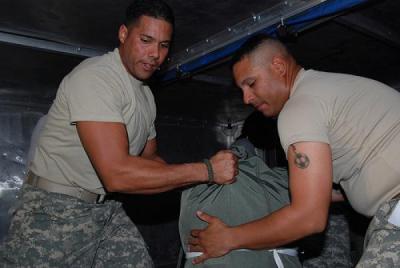
Photo: Puerto Rico National Guard troops pack it in after a year's deployment at Guantanamo; The National Guard; licensed under creative commons

Photo: Puerto Rico National Guard troops pack it in after a year's deployment at Guantanamo; creative commons http://www.flickr.com/photos/thenationalguard/3229073306/in/photostream/

President Barack Obama has signaled that the U.S. military will close Guantanamo Bay detention camp within one year.  The prison has become a divisive symbol of the controversial handling of enemy combatants by the Bush administration’s War on Terror. 

President Obama has shifted responsibility for the remaining 245 Gitmo prisoners from the Defense Department to the Justice Department.  Newly appointed Attorney General for the United States, Eric Holder, Jr., will take responsibility for determining whether those prisoners will be given civil or military trials, transferred to foreign countries or released.

The outlines of the President’s new policy on detention will be filled in in coming months, but certain things are clear.

The President has forbidden the use of torture against detainees in American custody.  “The United States will not torture,” the President stated.  

This policy includes prisoners under CIA control, and while extraordinary renditions will be allowed to continue during the Obama administration review of policy, the CIA will not be allowed to transfer prisoners to any country where they will be subject to torture.  

Outgoing CIA chief Michael Hayden sent a message to staff at the agency stating that the new policy would be carried out, “without exception, carve-out or loophole.”

Holder’s justice department has begun review of enemy combatant court cases beyond Guantanamo Bay, such as that of Ali Al-Marri, held at a military brig in North Carolina.  Al-Marri has appealed to the United States Supreme Court for review of the Defense Department’s decision to imprison him without trial.  Al-Marri was living in the United States as a legal resident at the time of his arrest, giving him a stronger position to seek a trial than, say, an enemy combatant captured by coalition forces in Afghanistan.

However, the Obama administration sought a postponement of hearing by the Supreme Court.  Al-Marri “is clearly a dangerous individual,” Obama has said. “We have asked for a delay in going before the Supreme Court to properly review the evidence against him.”  

The Bush administration had also decided to close the Guantanamo Bay facility, but ran into difficulty finding new places to house the remaining detainees.  Bush policy was to hold enemy combatants without trial or transfer them to foreign countries for incarceration.

However, the U. S. Supreme Court has ruled that all Guantanamo detainees are entitled to habeas corpus, or, the right to petition a federal court for review of the decision to imprison them.

Recently, a federal court in Washington D.C. ordered five Algerian detainees to be released for lack of sufficient evidence against them.  Other detainees have been caught in legal limbo because the United States would like to release them to their native China, but are constrained by the probability that they will be subject to ill treatment or execution if returned, because of their opposition to the Chinese regime.

The Obama administration will also deal with the question of detainees held in U.S. military custody abroad, such as those held at the Bagram base in Afghanistan.

These prisoners were captured in military operations and are thus more like traditional enemy combatants, but some have been held for as long as eight years and there is still no end in sight for conflict in Afghanistan.

From a policy perspective, Obama’s intent to increase U.S. troops and coalition commitments in Afghanistan soon, will likely result in more enemy combatant prisoners, going forward.