Category Archives: economics

Combining the House and Senate Health Care Bills

By Marc Seltzer; originally published on December 29, 2009, at care2.com

. .

While the House and Senate health care reform bills are nearly identical, they differ in a couple of important ways — and this can potentially make the final bill much better than what has so far been contemplated.  Comparisons:  Bloomberg & New York Times.

The just-passed Senate bill partially funds health care insurance for those who cannot afford it by taxing luxurious insurance plans.  (I see it as ending a subsidy, not a tax at all — as I explain here)  This is not only a source of revenue, but crucially the tax will create an incentive for insurance companies to create cost-savings plans, “bending the cost curve,” of the entire system by reducing excess health care services.  Decreasing the unneccessary care lowers demand, cutting prices for insurers and eventually for businesses and individuals.  See Atul Gawande, New Yorker, Dec. 14 — a must-read on costs (and also June 1, New Yorker).

However, the House bill takes a different tack.  It raises taxes on high-income Americans, under the theory that they can afford to pay more without cutting into food, shelter or health care.  At some point, increasing taxes on wealthy Americans does lower their overall investment in new businesses — a drag on the economy — but such taxes are at a relative low point and the proposed tax is not so dramatic as to significantly damage investment potential.

The conventional wisdom is that the Conference Committee, which will meet in the new year to create one final health care bill, will choose between House and Senate options.  On many provisions, the Senate bill will prevail, because it is more cost-conscious, as already noted, and there is less support for the House provisions in the Senate, where the Democrats have no margin of error on the final vote.  Senate legislation has already been CBO (Congressional Budget Office) scored to reduce the deficit at ten- and twenty-year projections.  This does require doctors to take less payment from Medicare patients than they have in the past and requires individuals to buy insurance or pay a fine, which will be unpopular for some people who neither have insurance nor want to pay for it.  On the other hand, projected cost savings of the Senate legislation do not entirely factor in other cost-containment approaches, which are being tested, from malpractice reform to replacing the fee for service model, and which will likely bear fruit over the next decade.

Deficit Reduction and Health Care Cost Containment

The conference committee should take both the Senate tax on high value insurance plans and the House tax on wealth in the final form of the bill.  This would lower the deficit even further.  It might upset a moderate Democrat or two and it might not induce any Republicans to vote for health care reform, so Harry Reid needs to shepherd his flock and ask Olympia Snowe and Susan Collins where they stand on the idea, but it has the distinct advantage of creating universal health care legislation that is strongly positive on deficit reduction and still stepping in the right direction by changing health care incentives.

Currently incentives in the profit-driven system reward over-testing and overuse of resources by those who have, and tolerate underuse by those who have not. The Senate legislation, as it stands, gives the have-nots a chance to participate in the health-care marketplace.  While taxing wealth must be done cautiously so as not to damage investment and new business potential, here the benefit of lowering the deficit in the process of providing the opportunity for basic health care for all Americans is a worthy purpose for a moderate wealth tax.  Control of the deficit will return rewards to many who pay the tax by improving confidence in the economy and raising prospects for investments.  This could be a win-win in the long run, provided that the economy was emerging from the current recession before tax increases were imposed.

The Senate’s health care legislation is a monumental accomplishment in the direction of universal coverage. It also begins to tackle cost issues by taxing luxurious insurance plans and pointing towards other models of care that will lower demand and drive down costs.  We could add substantial deficit reduction to the legislation — an unplanned bonus — by including the House’s moderate tax on wealth in addition to the Senate bill’s revenue measures.

What are your priorities?  If this sounds appealing, please spread the word.

Listen to care2.com blogger Jessica Pieklo and I discuss health care and more on our weekly podcasts.

January 4, 2009 UPDATEHendrik Hertzberg at the New Yorker on support and opposition to the health care bill.  An outspoken liberal, Mr. Hertzberg is in favor of the current legislation.

On the White House blog, a comparison of President Obama’s Transition period positions on health care reform compared with the near final product.

January 11, 2009, UPDATE:  PBS Newshour hosted a good discussion on whether it was better to adopt Senate or House approaches, but there was no mention of taking both.  Why not?
Job Creation or Deficit Reduction — How Should We Spend Your Money?

By Marc Seltzer; originally published on December 9, 2009, at care2.com

. . .

Should the unused TARP funds go to support middle class job creation or be used to pay down the deficit?

The question has arisen recently after the Treasury reported that its losses on the 350 billion dollars that Congress provided for the administration’s Troubled Assets Relief Program (TARP) are expected to be much lower than originally predicted.

The President and Democratic leaders are calling for a portion of the remaining funds (as much as $200 billiion) to be used for job creation programs.  The President has outlined several ideas that the administration believes could help bring unemployment rates down faster than at the current rate of economic recovery:

  1. Small business financial assistance and tax breaks
  2. Unemployment benefits, cobra subsidies, and emergency assistence to seniors
  3. Additional infrastructure and incentives for home energy conservation

However, this money could alternatively be used to pay down the deficit and Republicans are calling for committing all of the funds to deficit reduction.

The PBS Newshour recently featured a brief debate between Princeton Professor and Nobel Laureat economist Paul Krugman and columnist and former Treasury official and Reagan administration advisor Bruce Bartlett on whether President Obama should direct unused TARP funds towards creating jobs or paying down the deficit.

Krugman called for action on the basis that the unemployment rate was devastating and unacceptable.  He noted that unemployment was expected to remain far higher than normal in the next two years.  Extended unemployment would cause lasting harm to people who were forced to use up their savings and cause long-term damage to future employment prospects, he argued.

Bartlett cautioned that Congress had appropriated the money specifically to help financial institutions under TARP and that it should not be rerouted without congressional approval.  While he said he was “agnostic” about the President’s ideas for job creation, he did not support action now because Congress had already enacted substantial stimulus legislation.

Paul Krugman:  “And we have what is really an ongoing economic emergency. I mean, this — it’s not just that we’re not creating jobs. The level of unemployment we have got is doing enormous damage. So, I think the president is justified in reaching for whatever mechanism he can.

If — if he can say — you know, it really doesn’t make a difference in terms of the economics, where it’s funded from. If he can say, look, what we’re doing is redirecting funds, and make it happen, then he needs to do it, because, ultimately, what we have is a jobs crisis. Action must be taken. I think the paperwork is relatively less important at this point.”

BRUCE BARTLETT:  “Well, I thought, if we were facing the kind of crisis situation that we were when TARP and the original stimulus were enacted, that would be one thing.  But I don’t think we’re facing that. I think we have — we did enact the stimulus. The money is — there’s a lot of money still to come from that in the pipeline. I think we have only spent about a fourth of it so far.

The unemployment rate is coming down. I think that there’s a case for, let’s wait a little while. Why not wait until after the president submits his budget in February? Why rush to act this minute?”

With high deficits and high unemployment there are strong competing interests for the money.  What do you think is the most important priority at this time?

For a podcast conversation on jobs stimulus between care2.com blogger Jessica Pieklo and myself, follow this link and click on the December 9, 2009, podcast.

Follow me on Twitter

Bailout Losses Smaller Than Expected

By Marc Seltzer; originally published on December 6, 2009, at care2.com
. . .

The good news is that the losses from the government bailout are far less than many feared.  The New York Times reported yesterday that the Treasury currently counts losses of only 42 billion dollars out of its several hundred-billion-dollar rescue program.

Of course, 42 billion is still beyond comprehension.  It is bad news to lose those public funds, and there are other funds still at risk.  Nonetheless, it’s better than the hundreds of billions that were in doubt.

In fact, for those who feel that the government bailed out Wall Street at the expense of Main Street, the facts may prove otherwise.  It turns out, for example, that the banks are rapidly repaying much of what was given to them.  The financial industry still has TARP funds that may cause public losses over time — no final accounting is available — but the largest share of the current estimated losses, 30 billion, come from the bailout of automobile giants G.M. and Chrysler.

The bailout of the Detroit automobile companies was designed to protect Main Street, not Wall Street.   Middle class workers at the big factories and at the auto-parts supplyers would have lost their jobs without government intervention.  The U.S. was losing more than 500,000 jobs a month at that point.  Adding auto factory closures, that number might have hit a million a month, and who knows what else might have collapsed?

I am still haunted by Thomas Friedman’s New York Times Op-ed saying that giving money to G.M. and Chrysler might stop smaller, greener, entrepreneurial auto innovators from inventing the wonder cars of the future because the competition from a subsidized G.M. was too great to overcome.  Be that as it may.  Main Street jobs and an entire industry were saved at a point when the economy was very vulnerable.

The bailout of the banks, though ostensibly done to save the financial system, gave the government rescue a bad name as it appeared to protect Wall Street over Main Street.  It certainly saved financial industry shareholders and employees from their share of losses.  It turned even uglier when it created windfalls in compensation for the already rich.  However, if the bulk of the money lost went to saving middle class jobs and helping the car companies retain some value in the bankruptcy reorganization process, we may need to rethink who we say was bailed out and why.

Follow my writing on Twitter.

December 7th, 2009 UPDATE:  Food for thought in Newsweek’s take on the jobs data.

December 9th, 2009 UPDATE: A NYT article on the congressionally mandated review of TARP’s effectiveness.

Employment Poised to Turn Positive

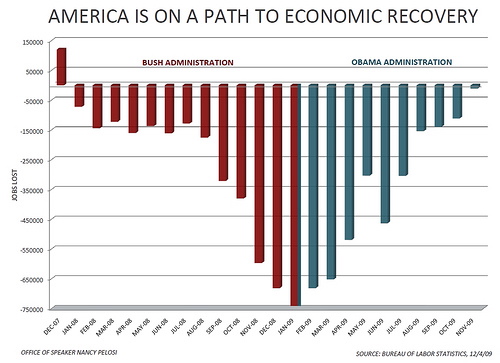
Job losses Reported Through November 2009

By Marc Seltzer; originally published on December 4, 2009, at  care2.com.

. .

Despite doom and gloom in Republican talking circles, the overall jobs data is right on track in reflecting a rebound in economic activity.  Just released unemployment numbers show the lowest number of monthly job losses in two years, down to 11,000.

When Republicans handed over the Presidency to Barack Obama in January 2009, the monthly losses were 741,000.  If the automobile companies had folded, as they would have in the Spring without government support, another  million-plus people would have been thrown out of work, sending the monthly number over 1,000,000 for several months in a row.

It would have been preferable if private business activity had caused employment to improve.  But the financial freeze robbed businesses of their confidence and their financial capital, so businesses have shedded jobs, delayed plans, and closed down.

The government rescue gave money to states to stop layoffs at schools and police departments.  In other ways, from the Fed’s low interest rates to funds for infrastructure, education grants, promoting green technology and the like, the government injected money into the economy.  Job losses in September of this year were down to 139,000 and in October, 111,000.  The stimulus is working, despite Representative Boehner’s (R-Oh) claims of failure.

Jobs are a lagging indicator, which means that new business planning, funding and activity happens first, and then the hiring of employees occurs many months later after confidence improves, and opportunities require new staffing.  The growth rate for the economy as a whole was around three percent for the quarter ending in September, in line with the positive growth rates that the U.S. hopes to sustain for long-range growth, although more is desired now to make up for negative growth during the recession.

The goal is for employment to come roaring back and for private business to take over for public support of the economy. However, businesses large and small are still shell-shocked by the financial freeze and destruction of wealth that it wrought.  They must also adjust to lower spending as consumers behave more responsibly and unemployment remains significantly elevated. Fortunately, there is still a lot of stimulus money left to power infrastructure projects before the handoff to the private sector takes place.

The government has done the lion’s share.  It still needs to implement sound financial reform legislation, giving the public and financial industries confidence in a sound and fair system.  In addition, health care reform in the public and private sectors could free up wasted money for productivity in other areas that serve American business, such as exports.

Insurance regulation and universal coverage, already contained in proposed legislation, will spread the burden of costs more equally.  However, systemic overspending in health care robs families of wages and businesses of profits that could be put to better use.  Following evidence-based medicine rather than custom and practice and market-driven medicine could go a long way to giving us more for our money.  Malpractice reform, consistent with evidence-based medicine, would also eliminate waste.

Look for December or January employment numbers to finally turn positive and fourth quarter growth to remain healthy.  This will be welcome news to the unemployed and businesses, and should give the country more confidence that we are, in fact, on the road to recovery.

Follow my writing on Twitter.

December 8, 2009 UPDATEBloomberg Economics podcast of Dec. 7, 2009.  Tom Keen’s interview with Steven Wieting, Managing Director of Economics and Market Analysis reflects on the jobs data and recovery.   It’s technical, but provides some thoughtful observations.

(The original publication of this story contained an older employment graphic; this version has been updated).

Federal Reserve Independence Under Threat

By Marc Seltzer; originally published on December 1, 2009, at care2.com

. . .

Readers of this website (care2.com)  have a healthy skepticism of government. They see that well-heeled special interests assert too much power in Congress.  Our representatives in Washington should devote themselves to the public interest, but too often appear to serve lobbyists and work for campaign contributions, instead. This view is held by Democrats and Republicans alike, one of few shared beliefs.

Unfortunately, this bipartisan, anti-government nexus has led to legislation to audit the Federal Reserve, the powerful financial stewards of the economy.

This is likely a bad idea and one that suckers good activist public energy down the wrong path.  The reason that the Federal Reserve is unelected and insulated from political manipulation is that its powers would be very tempting to misuse for political gain.  If Congress or the President could, for example, force the Federal Reserve to lower interest rates and stimulate the economy when unemployment goes up, they would do so.  However, the Federal Reserve manages long-term monetary policy to obtain stability and growth in light of concerns over inflation, exchange rates, and productivity.  This may include inflicting a certain amount of household suffering on the American economy to fight inflation or deal with crises where sacrifice today insures wealth and stability tomorrow.  If politicians could interfere, this would never happen.

The audit legislation responds to anguish about the failure of the government to regulate financial activity and risk in the lead-up to the current crisis. It also channels anger over the solutions to the crisis that the Fed has created.

Those who are against corporate greed and excessive wealth could better use the tax code to force corporations to pay their fair share.  Moreover, the proper response to failures of deregulation is increased regulation forcing private institutions to have higher capital reserves, lower leverage ratios and more significant safeguards and oversight than existed since Clinton-era deregulation.  No one is claiming that government got it all right.  But remember, it was political and financial interests that led to the current crisis.  And note that politicians have proposed everything from doing nothing to nearly twice the stimulus that was passed in response to the crisis.

The Federal Reserve is made up of professional economists and financial experts fulfilling a public service.  It is not immune to mistakes, but the Federal Reserve has, with specific limited exceptions, maintained a healthy independence from political authority.

Sacrificing that independence when the Fed makes mistakes or when we don’t like its decisions — which is what this legislation is really about — is not the answer.  Once the Federal Reserve is damaged, political and financial interests will use the Fed to serve current political goals at the expense of the long term financial health of the nation.

We know what that scenario looks like in practice because we have the example of Congress.  Congress never cuts expenses because our representatives are beholden for their jobs to special interests served by that government spending. One of the great examples of cost-cutting in government was done by the Base-Closings Commission, an independent panel appointed for the purpose of solving a problem that congress could not otherwise solve.

What we need is more fiscal responsibility, not less.

May 6, 2010 UPDATE:  The Senate voted down an amendment to the financial reform legislation today that would have subject the Federal Reserve to more congressional authority.

Taxing Health Insurance Plans

By Marc Seltzer; originally published on October 13, 2009, at care2.com

When is a tax a good idea?

NEVER!  (Say it cause it feels good.  Then get real and move on.)

One important proposal for lowering costs in health care is taxing higher-value health insurance plans.  The principle here is that currently the U.S. government is subsidizing high-level insurance plans purchased by employers.  Health insurance premiums are not taxable, while employers do have to pay tax, such as payroll/social security tax, on income paid to employees.  The employers thus provide additional compensation to their employees without paying full price.  This deduction encourages over-spending by employer and employee.  By comparison, individuals who purchase insurance cannot deduct their premiums or costs of health care from their income.

The thinking goes something like this:  An employer deciding to purchase insurance looks at an $8,000 plan and a $10,000 plan.  It realizes that the $10,000 is a deal because of the subsidy, and it knows its employees will value the plan and consider it as part of the reason to work there.  The employee then has incentive to use medical benefits more than on the lesser plan because the higher-cost plan has lower deductibles, coverage of alternative care and lower co-pays.

There is nothing wrong with an individual choosing to pay more for health insurance and then making use of more in benefits.  But if the U.S. government is subsidizing the plans, then the incentives are distorted.  When conservatives talk about what is wrong with taxation and government, their best argument is that government does not efficiently allocate resources because it distorts the market to redistribute wealth in wasteful ways.  This is a prime example.

If progressives want the government to distort the market in health care, it would make sense to provide help to those who can’t afford care, or to provide subsidies to promote certain types of care such as free annual physicals that could be valuable in improving health or lowering costs, through prevention for the public as a whole.  But there is no reason that the government should redistribute wealth to encourage high-end employer-provided insurance and use of such plans to the fullest.

The result of the system in place today is that working individuals with expensive plans are encouraged to get any and all recommended medical care.  Some procedures are covered 100%.  Some 90%, 80%, 75%. What’s the right formula, where people correctly balance the need for health care against the cost?

Take away the subsidy and find out.

In my own experience, I broke my leg badly, while covered by a great insurance plan.  Surgery was recommended and the $30,000 bill turned into only $1,500 in out-of-pocket expenses.  This is exactly what insurance is designed to protect against and it worked well for me.  This involved emergency hospitalization, which, though expensive, is often well covered by all types of plans.  However, in rehabilitation, I sought chiropractic, acupuncture and physical therapy and remember that my out-of-pocket expenses were remarkably low or non-existent.  My firm offered this plan to compete for employees in the marketplace, but the tax code also underwrote my plan.  Remember, under current law, the more an employer spends on health care plans, the more money it avoids paying tax on.

Current proposals are structured to tax plans on the part of the premiums that go above $8,000 per year and family plans on the premiums above $21,000 (For example, $10,000 in premiums for an individual would be taxed on the $2,000 above the exemption at a rate of 40% for a tax of $800.)  The tax would affect employers and individuals who purchase insurance equally and would likely have several impacts:

1.   It would lower the number of high-end plans, as employers and individuals sought to avoid the tax.  In that case, affected employees, who previously would have received higher-value insurance packages underwritten by the government subsidy, would have lower-value insurance with somewhat higher co-payments.  Shifting some additional burden to the insured in this way would lower national spending on health care, yet continue individual choices on where to spend and where to save.

2.   It would raise an estimated $200 billion dollars from tax revenue on plans that were higher end.  Thus, employers and individuals who continued to purchase high-value plans would pay a new tax on those plans.  This revenue would go to underwrite the efforts to subsidize insurance to those who cannot afford it.  $200 billion represents about 1/4 of the cost estimated to subsidize insurance over the period of ten years.

3.   For people at or below the limits, there would be little change in premium or co-payment prices.  Theoretically, the lower use of medical resources would lower the price of health care in the overall marketplace.  This would likely be countered by the increased use of medical services by individuals who will gain coverage through the new legislation.  However, if the new legislation did not contain this tax provision, prices would continue to rise from increased demand as more people with insurance sought health care services.

There are a number of different ways that health care costs can be lowered and different options for how to bring more people into the insurance marketplace.  The current proposal is but one piece of reform.  Taxing of high-cost health plans is bound to be controversial because Americans are allergic to all tax hikes.  However, this proposal removes a tax loophole that encourages overuse, or at least subsidized use, of the health care system.  Even without the use of the revenue to provide subsidies for those who cannot afford health care, this tax makes sense.

N.Y. Times has an excellent story with political background including issues for unions whose members have received high-level benefits in lieu of compensation.  A detailed Huffington Post piece discusses how the tax may impact middle class Americans and a Commentary blog suggests it will change the health care we have now, against Obama’s promises.  Be that as it may, a loop-hole is a loop-hole, and it creates distortion and waste among executives and union employees alike.

Senator Olympia Snowe, (R)-Maine, who announced today that she is supporting the Democrats’ Senate Finance Committee bill (the Baucus bill) being sent to the full Senate today, supports taxing insurance plans, although she aims to ensure that middle and lower income members of the public and those above age 55 do not bear the burden of the tax.

We all want an efficient government that does not encourage waste of resources.  Calling or writing your congressional representative to demand a tax on excess health care premium plans is the same as demanding the end of an egregious tax loophole.  Remember, the point of health care reform is to insure more Americans and strengthen the financial foundation of the nation.

Baucus Bill Insurance Mandate

Last week, Senator Max Baucus released for public consumption the health care reform legislation that was crafted by a group of bipartisan senators over the last six months.  Evidently because the proposal goes beyond what the Republican members of the Finance Committee’s “gang of six” sub-group wanted, the final draft did not obtain the endorsement of any of the group’s three Republicans.

Initial media reactions have been mixed, with applause for the seriousness of cost containment provisions and concern for what those very same provisions will mean to average Americans.  (Paul Krugman, is a good example)

One aspect of the proposal is eliciting discussion of the freedoms and obligations of participation in democratic society.  The proposal includes a mandate, backed up by substantial fees, that requires that everyone obtain health-care insurance.  Of course, most people receive insurance through their employer, and of those who don’t, many want insurance, if they can get it at a price they can afford.  But it would no longer be a choice under this proposal.  Those who cannot afford to purchase insurance would have their costs subsidized, but everyone would be required to make a substantial commitment of household income towards insurance coverage, which may or may not be in line with the spending choices that they are currently making.

Voices in the media, from the progressive left’s Robert Scheer of Truthdig.com to Washington Times columnist Tony Blankley on the conservative right, reacted to the proposed impingement of freedom.

From KCRW’s: “Left, Right & Center” podcast, Scheer and Blankley:

Robert Scheer:

What I don’t understand is . . . and here let me put on a libertarian hat, you’re forcing people to buy health insurance; you’re penalizing rather substantially if they don’t have; so your making it a crime to live without health insurance; a crime.  At least when you make it a crime to drive a car without insurance you can stop driving a car.

That’s not considered socialism when the government delivers people to private industry but when you have a robust public option that’s considered socialism to the lobbyists.

Also distinguishing auto insurance requirements, Blankely said:

This proposal would mandate that everybody has to buy insurance as a condition of living, which is not a condition and not a privilege the government has but a right we have given to us from god.

President Obama, in his weekend talk show blitz, recognized that this part of the proposal would raise questions, but called it very important for cost cutting.

From “Meet the Press” interview with David Gregory:

Gregory:

What are the hard choices that you are now asking the American people to make?

President Obama:

What I have said, for example, on what is called an individual mandate.

During the campaign, I said “look, if health care is affordable, then I think people will buy it.”  So we don’t have to say to folks “you know what? You have to buy health care.” And when I talk to health care experts on the left and the right, what they tell me is that even after you make health care affordable, there’s still going to be some folks out there, who, whether out of inertia or they just don’t want to spend the money, would rather take their chances.

Unfortunately what that means is that you and I and every American out there who has health insurance and are paying their premiums responsibly every month they have got to pick up the costs for emergency room care when one of those people gets sick.

So what we have said is “as long as we are making this genuinely affordable to families, then you’ve got an obligation to get health care, just like you have an obligation to get auto insurance in every state.”

Gregory:

Are these the hard choices?

President Obama:

That’s an example of a hard choice.  That’s not necessarily wildly popular, but it’s very important.

Mr. Obama cites the costs that are being paid by the insured to cover the uninsured.  Moreover, it has also been reported that people with insurance manage their longer-term illnesses more effectively, potentially lowering emergency and overall health system costs.  But is something lost by way of individual decision-making in return for these financial gains?

Forcing everyone to participate in insurance will bring more customers to existing insurance companies, one of the reasons that they are generally supporting reform efforts, which they objected to in 1994. This could allow lower rates, as insurers earn more and have more premium income to use to pay claims.  Will the benefits be passed on to consumers?

Commentators have also questioned whether the subsidies for those who cannot afford insurance are large enough; the high cost of health insurance could create an unmanageable burden for many Americans.

Of course, we all pay taxes, thus making contributors towards, police, fire, civic authority and other shared costs in society.  But the insurance requirement, even in a system maintaining private insurance coverage, will be a fundamental change in our rights and obligations as Americans.

Deficit Spending

1189424_370

Originally published at care2.com on July 9, 2009

California government struggles.

Forced to match public spending with revenue (some monkey-business excluded), leaders have only two good options:  Cut spending or raise taxes.  You would think that this would be easy enough.  But either option takes money from people who feel it should be theirs. The conflict is so fierce, the interests so entrenched, that leaders will walk dangerously close to default, to failing to meet obligations, rather than give up what they defend.

In the federal government, we have a different problem.

The Bush administration did away with Clinton-era commitments to pay for spending increases or tax cuts by finding sources of revenue.  Without even that modest amount of discipline, legislators, who get elected by pleasing their constituents, consistently spent their way into incumbancy.

I do not fault the Bush or Obama administrations for their emergency efforts to buy off an economic Depression (or substantial risk thereof)through massive deficit spending on short-term stimulus.  It was the best judgment of the experts, and it seems to have worked.  A Depression is far more costly than the money spent on stimulus.  But neither does this deal with the underlying problems in long-term public spending.  How do we reverse course and begin to bring the long-term spending equation in line with the revenue picture?

It may be that our political system is able to solve the problem.  The public is aware and concern over public spending is growing.  President Barrack Obama has called for a return to “pay as you go” legislation. This will make it far more difficult for Congress to add new deficit spending.  Even the roughly one-trillion dollars discussed as a budget for health care reform is being treated as “pay as you go” spending requiring an offsetting spending cut or tax increase to protect the overall national budget.

However, we have traveled so far down the path of deficit spending, that we will have to do more than maintain our course.  Bloomberg podcast — “Rivlin Says Fed More Concerned About Deflation Than Inflation”

The nation has already made commitments to spending on Medicare and Medicaid that will dig us deeper in debt over the next ten years.  We would have to legislate cuts in Medicare and Medicaid in order to get out of those commitments, if we wanted to.  Therefore, new efforts must be made to raise revenue or cut spending in order to just maintain the level of deficit we have now.  We need courageous leadership, willing to ask for sacrifice from all parts of our society, and we need disciplined leaders, willing to put their careers on the line in order to do what is right.

The recession will end and revenue will therefore increase, but that does not mean we will be out of the woods.  If Congress is not able to legislate long-range fiscal responsibility we will need new solutions.  One approach, discussed in the past, is across-the-board spending cuts.  Another would be to create a deficit Czar or independent commission with responsibility for recommending spending cuts and revenue increases that would lead to a reasonable deficit.

We should think of the deficit as a percentage of the national economy, not a dollar figure.  When the percentage begins moving down, towards historic norms, we will be on the right track.

It might be that a group of leaders we trust, who are not elected officials, could do a better job giving us tough medicine than the people we pay to give us only good news.  In any case, the sooner we take the medicine, the sooner we will begin the road to recovery.

Obama Power Source — Centrism and Pragmatism

By Marc Seltzer; originally published on July 21, 2009, at care2.com

In a fairly strong critique of the direction of Democratic party leadership, New York Times columnist David Brooks tells us Democrats in Congress and President Obama are going too far in a liberal direction (Liberal Suicide March, July 21).  Comparing their “out of touch-ness” with that of the Republican party’s loose deficit spending in the Bush years, Brooks asserts that the current President risks losing moderate support for his agenda, if liberals hold sway.

Mr. Brooks cites the $878 billion stimulus, the 2009 federal budget and now proposed health care legislation as three examples of where the President has abandoned the moderate center, inhabited by a majority of Americans.

I have to disagree on the stimulus count.  Such stimulus was offered up by moderate economists as one reasonable approach to protecting the economy from a Depression.  Other options, such as Republicans’ suggested payroll tax cut or Professor Roubini’s capital gains tax cut, were likewise logical, but no more certain to work or free of political problems (each could also have raised the short-term deficit and might been saved rather than spent).

The U.S. economy experienced an unprecedented financial freeze in the midst of a cyclical recession.  If we escape this disaster with only a severe recession and some unfair sharing of the burdensome bailout, contributors in the economic rescue will be the heros of the early 21st century.  The fact that people cannot fathom what could have happened or gloss over it for political gain does not change financial reality.

In this light, Brook’s impatience with the speed of stimulus spending is unwarranted.  Only 10% so far?  The spending was intended to be rolled out over two years and there is no question that this is happening.  Wasn’t the clamor in April that it was going out too quickly, without enough record-keeping?

Of course, there are few things as difficult as the loss of a job and financial safety, but that doesn’t mean that the unemployment rate can be kept below 10% or even 15% by force of will.  There is no magic wand — only reasonable policies that support the private economy and time for supply and demand to correct itself.  Republicans calling the stimulus a failure, at this point, or blaming Obama for the rising unemployment rate, play politics at the expense of their integrity.

The federal budget was a closer call.  It contained many earmarks and spending habits that did not fit with the President’s campaign rhetoric.  On the other hand, the bill was prepared during the previous year and Obama only took office weeks before Congress sent it to him for approval.  It might have been a great symbol of “change,” if the President had vetoed the bill and demanded that Congress change its ways from the start of his administration.  On the other hand, in the midst of financial devastation, a budget fight and potential government shutdowns would have caused further economic harm.  This would have been the more irresponsible, if emotionally satisfying, route.

But the health care debate is President Obama’s chance to demonstrate his leadership and vision.  Here, I agree with Mr. Brooks that pragmatic centrist leadership is necessary.  If the President doesn’t tackle the very real problems with health care costs, any solution will be unsustainable.

Mr. Brooks refers to polls showing that Americans are losing confidence in Democratic proposals for health care reform. Americans are savvy enough to know that additional deficit spending is irresponsible.  Thus, while many Americans support the President’s vision of providing insurance to nearly all and forcing change upon a powerful insurance industry, the public still needs to see a coherent financial plan.  Tax increases on upper-income Americans may be part of that plan, but large tax hikes would represent a change in policy beyond what President Obama spoke of in his campaign, and too fast or two great an increase could damage the economy.

The other option is to cut costs.  After efficiency, cutting costs equals cutting back on covered medical care.  Rationing already goes on, across the system as public and private insurers choose what procedures to cover.  After that, only those with enough money are able to purchase additional care. Those without insurance or funds have only what is offered in emergency rooms and subsidized or charitable clinics.

Somehow, many Americans have come to view raising taxes and cutting costs as bad options.  That’s why we find ourselves (Congress) legislating programs and services that we can’t pay for.

Brooks credits Obama for having ideas that go in the right direction, citing his proposed cost-cutting, limits on tax hikes, and an independent commission on Medicare spending.  But Brooks laments that Obama is not feared by the Congressional leadership, and he believes they have the power in the current battle, unless “Blue Dog” conservative Democrats can force a moderate compromise.

One such idea would be to lower the subsidy for employer-provided insurance.  The current system encourages overspending, exactly what we need to remove from the system.  Another would be to provide clearer limits on coverage for end of life treatment, which is very costly and often of debatable value.

I have hope that the President is up for a fight on health care.  He can speak to the nation like few others at this time, and his forceful leadership could shape a responsible compromise.  The President may be afraid that asking too much of Congress risks failing to achieve any reform.  But there is no reason for this to be a repeat of President Clinton’s experience.

President Obama should go to the mat for a bill that restrains costs, targets fiscal balance, aids the underserved, and corrects inefficiencies in the system.  If he fails to get the bill, he should start over after the recess, asking less.  Legislators will not want to go home empty handed a second time with a popular President telling the American people that they deserve more. The President has tremendous national goodwill and strong majorities in the Congress.  Americans will accept compromise, but not without fighting for what is right.  This is the time for the President to spend his political capital.

Recession Rant

Photo: caveman92223; licensed creative commons

By Marc Seltzer; originally published July 12, 2009, at politicsunlocked.com

. .

As I watch news coverage of the ongoing economic crisis and responsive stimulus legislation, I am constantly reminded of Abbott and Costello’s “Who’s on First” routine, where the comics discuss names of their team’s baseball players:

Abbott:  Well, let’s see, we have on the bags, Who’s on first, What’s on second, I Don’t Know is on third…

Costello: That’s what I want to find out.

Abbott: I say Who’s on first, What’s on second, I Don’t Know’s on third.

Costello: Are you the manager?

Abbott: Yes.

Costello: You gonna be the coach too?

Abbott: Yes.

Costello: And you don’t know the fellows’ names?

Abbott: Well I should.

In October 2008, when the sky was falling, and several of the biggest entities in the financial system collapsed, economists and journalists couldn’t bring themselves to say the “R” word.

We were deep in a Recession, as it turned out.  This recession started nearly a full year earlier, in December 2007.  But the National Bureau of Economic Research(NBER), which makes the call based on economic statistics over a period of months, allowed us to endure the near collapse of the financial system without an official proclamation.

Costello: Well then who’s on first?

Abbott: Yes.

Costello: I mean the fellow’s name.

Abbott: Who.

Costello: The guy on first.

Abbott: Who.

Costello: The first baseman.

Abbott: Who.

While economists and journalists did focus on the credit crisis, conveying the dire nature of what they were seeing, and making suggestions that we might be heading toward the unthinkable – a Great Depression Sequel – we still couldn’t use the word Recession.

Then, in December (after it was announced we had been in a recession all along), the press sought to make up for lost time.  Missing out on a full year’s worth of recession talk, they cut loose with a flurry of descriptors:  a deep recession, prolonged recession, economic crisis, catastrophe, financial disaster and what may turn out to be true, the worst downturn since the Great Depression.

Costello: The guy playing…

Abbott: Who is on first!

Costello: I’m asking YOU who’s on first

Abbott: That’s the man’s name.

Costello: That’s who’s name?

Abbott: Yes.

Costello: Well go ahead and tell me.

Abbott: That’s it.

Costello: That’s who?

Abbott: Yes.

750 banks fell within months of the 1929 stock market crash which began The Great Depression.  As many as 9,000 banks continued to fail during the 1930’s.  FDIC Insurance was nonexistent, so people simply lost their money when their bank ran out of funds.

13 banks have failed so far in 2009.  Another 25 failed in 2008.

The contemporary government response has been swift, if not altogether logical.  

Deposits up to $250,000 are now guaranteed by the federal government.  Under the TARP bailout program, banks may be given funds to keep them solvent and lending.  There is a fair amount of confusion over the purpose of the program and whether healthy banks or failing ones are actually seeing the government support.  Some initial money went to Citigroup, a behemoth multi-national organization considered “too big to fail” following the events in October of 2008, when investment bank Bear Sterns failed and cracked the confidence of the entire financial system.

Costello: Look, you gotta first baseman?

Abbott: Certainly.

Costello: Who’s playing first?

Abbott: That’s right.

Costello: When you pay off the first baseman every month, who gets the money?

Abbott: Every dollar of it.

The initial $700 billion bailout was passed in November of last year and was renamed a recovery package in December.  That was soon followed by a $789 billion stimulus bill.  And as furious as we all are at the cost of this crisis, be ready for toxic asset and real estate stabilization plans which will likely total even more than these first two.

Only $500 billion of the stimulus bill is true government spending.  The rest is tax relief or, in the case of the bailouts, investments in companies that should, in theory (it worked before in Sweden), allow the government to recoup the invested money in a few years.

Costello: All I’m trying to find out is the fellow’s name on first base.

Abbott: Who.

Costello: The guy that gets…

Abbott: That’s it.

Costello: Who gets the money…

Abbott: He does, every dollar. Sometimes his wife comes down and collects it.

Costello: Whose wife?

Abbott: Yes.

The original stimulus bill was designed to create 2-4 million new jobs.  Then, as the economy began losing a 500,000 jobs a month, the language changed to “save or create” 3-4 million jobs.

Politicians and pundits who say the stimulus bill will turn the economy around may overstate the case.  So too, those who doubt it will save or create a single job.

A more reasonable assessment is that it will soften the blow and make a long-lasting recession more tolerable.