Category Archives: economics

A Time for Financial Regulation

Time-for-Financial-Regulation1_large

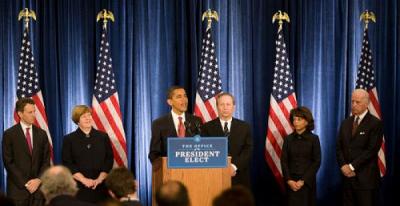
Photo credit: Obama-Biden Transition Project, licensed under creative commons

Originally published on January 28, 2009 at politicsunlocked.com

President Obama’s financial team, including Paul Volcker, Chairman of the Economic Advisory BoardTim Geithner, Treasury Secretary, Larry Summers, head of the National Economic Council and Austan Goolsbee, Advisory Board Economist, hit the ground running with a comprehensive plan for financial reform geared at filling holes in the existing regulatory system.


The plan is separate from the much discussed stimulus package before congress and provides no bailout, tax cuts or government spending to help the economy.  Yet this plan is a bold act of reasonable and necessary regulation designed to bring the government up to speed in its oversight of the financial industry.  

Against Abuses and Mismanagement, Not Free Markets

The plan calls for:

1. Increased oversight on the part of the Federal Reserve and regulatory agencies such as theSecurities and Exchange Commission.

2. Federal standards and scrutiny of insurance companies, mortgage brokers, hedge funds and credit rating agencies.

3. Oversight and listing or trading through a clearing house or exchange for derivatives and other financial instruments. 

4. Higher capitalization requirements for banks and large investment companies.  

The plan addresses specific concerns which led to some of the biggest financial scandals in history.  

Two points of focus are eliminating conflicts of interest which allowed financial rating agencies to profit from transactions with the institutions they themselves rated and limits on executive compensation for companies receiving federal bailout dollars.

Much of this regulation can be imposed by the executive branch, but some will require the passage of new legislation.  A general belief that significant failings in government oversight led to the current financial crisis is widely held, but even so, new legislation may run into opposition from those opposed to any and all government regulation of markets.  However, support for the proposed rules is coming from many corners of Washington, including Republican political circles.

The Group of 30, a respected committee of governmental and industry representatives, published a report on January 15th, 2009 calling for dramatic regulation and reform similar to the Obama administration plan.  This should be no surprise, as the commission was headed by Paul Volcker, a longtime Obama advisor prior to being named Chairman of his Economic Advisory Board.  Early reviews of the commission report and the administration’s plans are positive. 

Too Much Government Interference?
While there is a risk that new regulation will slow otherwise healthy investment and financial activity, something obviously needs to be done, and there are reasons to have faith in the proposals.  

The new administration’s economic team has a strong free-market philosophy.  The fact that these free-market economists are proposing stricter regulation is a testament to their certainty that the market is not able to correct itself.  The free reign of financial entities created layers of financial miscalculation and mismanagement which now threaten to collapse the entire economy.  

Those concerned that regulation of the financial industry is a move toward Socialism should rest assured that the regulations proposed are no bailout or nationalization.   These rules aim to stop financial mismanagement and criminal fraud rather than affect the redistribution of wealth.

While the traditional view is that stricter regulations do nothing to aid an economy in recession, our current problems may be the exception.  

Much of the distress in the credit market is a result of a failure in confidence.  This lack of confidence surrounding asset valuation, as well as the essential underlying health of the financial system, calls for the imposition of strict, yet reasonable regulations.  Such reform may indeed signal a return to responsible management and begin to restore shaken confidence in the financial system.

Our Government in Action — Will Stimulus Succeed?

By Marc Seltzer; originally published on November 17, 2008, at politicsunlocked.com

. .

Know Your History
The Federal Reserve lowered interest rates back in 2007, with hopes of persuading businesses to borrow more money, bolstering their operations and growth.  Unfortunately, there is a considerable lag time between when rate cuts are enacted and resulting increases in business activity occur.  These rate cuts may have stopped even more dramatic declines than we are currently seeing, but they certainly have not reversed the downward slide in stock prices or business activity leading the global recession.

Consumer and business spending reflects confidence in stable prices, employment and business prospects.  As exploding oil prices sucked up a disproportionate share of family budgets and business profits and as real estate values declined, confidence fell.  Now, with the unemployment rate rising significantly, people are increasingly less confident, and more importantly, spending less, regardless of whether they have a job or not.

Now What?
The talk in Washington and near water-coolers around the country, concerns fiscal policy related to revenue and spending.

There are two approaches:  Lowering taxes to leave money in private hands and government spending to boost commercial activity and jobs.

Polls have found that the middle class tended to pay off debts and save for a rainy day with recent tax rebates, although these rebates were meant to stimulate spending in the economy.  Small tax cuts for a distressed middle class may ease hardship in the heartland, but have not stimulated the economy as predicted.

On the other hand, rebates for the lowest income segment of society are immediately put back into the economy, being used on day-to-day necessities.  Tax cuts for wealthy Americans may promote entrepreneurial enterprise, but were already significantly lowered during the Bush administration.

President-elect Obama campaigned against the widening gap between the richest members of society and the middle class, so it is unlikely he will lower high-end income taxes further.  However, Obama may decide to delay repealing Bush’s tax cuts for the wealthy, so that in the near term, this money could enter the economy directly rather than being paid to the government.

Government spending programs also face a significant delay from the passage of legislation until full implementation.  If we could predict recessions more than a year in advance, it would be highly advantageous to commence most of our nation’s infrastructure spending before recessions and slow public spending when the economy heats up.

Traditional stimulus legislation allocates public money for infrastructure, although bailing out the auto industry could also be seen as maintaining or promoting economic activity.  Spending on defense programs such as FDR’s Manhattan Project or Reagan’s Strategic Defense Initiative, “Star Wars,” also created jobs, as did civilian spending, such as the Kennedy’s Moon Mission and the great dams of the Tennessee Valley Authority.  “Star Wars” led to a boom in civilian software and Internet technologies, which were responsible for a lion’s share of the prosperity and productivity gains in the 1990s.

President-elect Obama gave a hint of his thinking on fiscal stimulus recently, responding to a reporter’s question about aid to the auto industry, “It should be a bridge to somewhere, not a bridge to nowhere.”

The real risk with government spending is not deficit, but waste.  Temporary deficit spending that produces a stronger economy, more prepared to compete in the global marketplace, is well worth the cost.  Infrastructure such as bridges, ports, green technology and alternative energy or even a trained and educated workforce, that advances the productivity and competitiveness of the nation, creates employment and serves the long-range national interest.

However, if the money only temporarily stimulates jobs and spending, but produces no long term productive gains, it will be just a “bridge to nowhere,” the moniker attached to an expensive and unnecessary Alaskan pork-barrel spending project.  Such wasteful spending not only uses up limited resources, but increases the deficit without providing improvement to the foundation of our future economic prosperity.

The Right Direction Now and For The Future

To Senators Obama and Reid and Representative Pelosi:

In the sixties, President Kennedy put hundreds of thousands to work on the space program, putting a man on the moon, aptly symbolizing American leadership, and foretelling United States military superiority and civilian commercial dominance in aerospace and communications for thirty years. The technological advantage American industry gained on the investment could not have been achieved absent the governmental commitment or resources. 

In the eighties, President Reagan funded Star Wars, which achieved little in missile defense, but nonetheless, changed the world, leading to U.S. civilian computer, satellite and Internet superiority and prosperity for another thirty-year period.  The time is again right for government investment in creating the future. 

First, the beginning of a recession is a good time to act, because stimulus is helpful, jobs are at stake, and a government-funded program will immediately instill confidence in long-term labor conditions.  This is far more productive stimulus than refund checks, which do ease family budget concerns, but only  marginally improve commerce.  They do little to support employment prospects and nothing to support long-term wealth creation.

Second, there are many areas, such as pharmaceutical research, Green technologies or military hardware, that require massive investment to achieve their full potential.  No one can claim that research and development in alternative energy or pharmaceutical testing is near capacity.  Both are so financially risky that only a fraction of what could be done is being done, even though the lives of millions and the future economic health of many nations hang in the balance.  As with past science and technology programs, the initial public investment in energy, medical or environmental technology would surely be followed by decades of highly profitable private business applications.

Finally, the arguments against publicly funded investment misunderstand the real problems of government spending and deficit spending in particular.  We can agree that private investment and direction of resources is superior to public, and yet still acknowledge the need for a military, Civil Corps of Engineers, or law enforcement to meet national needs.  In the 1940s, the Government put the nation to work to produce armaments on a vast scale enabling our defeat of Fascism. Some tasks are just too large to be left to the private marketplace. 

The real question is what should public money be used for, and crucially, what should it be used for when we are over budget? 

The answers are not the same.  Most commentators today oversimplify the issues surrounding deficit spending.  They assert that a balanced budget or small deficits are always good and large deficits are bad, with the caveat that deficit spending during a recession is good as it stimulates the economy while spending during high growth periods is bad as it adds to inflation. 

Without more, neither view is adequate. 

Deficit spending is essentially borrowing from the future for the present.  Thus, deficit spending can be thought of as irresponsible, and in some ways unethical, because it uses future resources to satisfy today’s needs.  However, deficit spending only depletes future resources and weaken financial integrity when it does not lead to long-term financial health.  When such spending is for infrastructure and facilitates wealth and revenue in the future, it is neither irresponsible nor unethical. 

Such spending should be judged on the benefit versus risk of success at achieving its goals.  Kennedy’s Sending of a Man to the Moon was a huge risk, but it paid off handsomely in its political, scientific and commercial legacy.  Reagan’s Star Wars research was less of a reach and it paid off, even though the goal of the original research has still not been achieved.

In this light deficit funding for Green technologies would stimulate the economy during a recession and, if successful, would lower energy and environmental costs in the long run.   This is how prosperous periods have occurred.  Improvements in productivity mitigate inflationary pressures while increasing wealth during economic expansion.  

Politically and commercially the benefits are obvious as leadership and wealth will be the rewards to nations that meet the challenges of the future most efficiently and profitably.  Medical research presents similar cost/benefit prospects and military investment, though to a lesser extent, may also be useful given the difficulties we have had achieving military goals in the past decade.

The alternatives pale in comparison.  Giving stimulus to individuals and businesses in the form of refunds or tax cuts at a time of economic slowdown has short-term social and economic value at a cost that is roughly equal to what has to be paid back later with interest.  Investing in roads and bridges provides some job support and infrastructure upkeep, but no dynamic future benefits.  Doing nothing has such great lost-opportunity costs.  On the other hand, investing in the technology of the future will have a modest short-term economic benefit in confidence and jobs, and in the long term, if past is prologue, it will present unimagined opportunity.

Marc Seltzer