Category Archives: Uncategorized

Employment Poised to Turn Positive

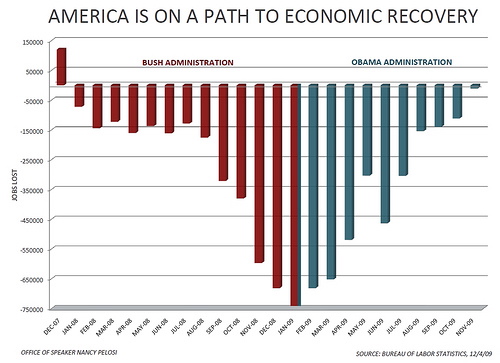
Job losses Reported Through November 2009

By Marc Seltzer; originally published on December 4, 2009, at  care2.com.

. .

Despite doom and gloom in Republican talking circles, the overall jobs data is right on track in reflecting a rebound in economic activity.  Just released unemployment numbers show the lowest number of monthly job losses in two years, down to 11,000.

When Republicans handed over the Presidency to Barack Obama in January 2009, the monthly losses were 741,000.  If the automobile companies had folded, as they would have in the Spring without government support, another  million-plus people would have been thrown out of work, sending the monthly number over 1,000,000 for several months in a row.

It would have been preferable if private business activity had caused employment to improve.  But the financial freeze robbed businesses of their confidence and their financial capital, so businesses have shedded jobs, delayed plans, and closed down.

The government rescue gave money to states to stop layoffs at schools and police departments.  In other ways, from the Fed’s low interest rates to funds for infrastructure, education grants, promoting green technology and the like, the government injected money into the economy.  Job losses in September of this year were down to 139,000 and in October, 111,000.  The stimulus is working, despite Representative Boehner’s (R-Oh) claims of failure.

Jobs are a lagging indicator, which means that new business planning, funding and activity happens first, and then the hiring of employees occurs many months later after confidence improves, and opportunities require new staffing.  The growth rate for the economy as a whole was around three percent for the quarter ending in September, in line with the positive growth rates that the U.S. hopes to sustain for long-range growth, although more is desired now to make up for negative growth during the recession.

The goal is for employment to come roaring back and for private business to take over for public support of the economy. However, businesses large and small are still shell-shocked by the financial freeze and destruction of wealth that it wrought.  They must also adjust to lower spending as consumers behave more responsibly and unemployment remains significantly elevated. Fortunately, there is still a lot of stimulus money left to power infrastructure projects before the handoff to the private sector takes place.

The government has done the lion’s share.  It still needs to implement sound financial reform legislation, giving the public and financial industries confidence in a sound and fair system.  In addition, health care reform in the public and private sectors could free up wasted money for productivity in other areas that serve American business, such as exports.

Insurance regulation and universal coverage, already contained in proposed legislation, will spread the burden of costs more equally.  However, systemic overspending in health care robs families of wages and businesses of profits that could be put to better use.  Following evidence-based medicine rather than custom and practice and market-driven medicine could go a long way to giving us more for our money.  Malpractice reform, consistent with evidence-based medicine, would also eliminate waste.

Look for December or January employment numbers to finally turn positive and fourth quarter growth to remain healthy.  This will be welcome news to the unemployed and businesses, and should give the country more confidence that we are, in fact, on the road to recovery.

Follow my writing on Twitter.

December 8, 2009 UPDATEBloomberg Economics podcast of Dec. 7, 2009.  Tom Keen’s interview with Steven Wieting, Managing Director of Economics and Market Analysis reflects on the jobs data and recovery.   It’s technical, but provides some thoughtful observations.

(The original publication of this story contained an older employment graphic; this version has been updated).
Obama Approval, Progressive Politics and Democratic Unity

By Marc Seltzer; originally published on November 25, 2009, at care2.com

. . .

Pundits have focused recently on President Obama’s declining public opinion polls.  As the President drops to fifty percent approval ratings, the talk speculates on whether the poor economy will sink Democratic prospects in the 2010 midterm elections.  The economy is important and the administration’s policies will not cure recession blues before the election, but of greater concern is the question of Democratic political unity.

Republicans have criticized the President’s leadership and policies from the get go, but with Progressives attacking the administration and fracturing the President’s base, some of the moderates who elected him are beginning to wonder.  Have the progressives gone off in search of Ralph Nader?

Neither the left nor the right have a majority in national American politics.  The candidate that convinces the pragmatic middle to join the ideological left or right wins both in electing candidates and in charting policy.  President Bush succeeded in maintaining the right-middle coalition between 2000 and 2008.  He used the power he was given to lower taxes on the wealthy, promote hands-off financial oversight, conduct aggressive foreign and military policy and tilt the delicate balance between rights and security not so delicately in favor of security.

President Obama won back moderates in 2008, promising to shift economic policy towards the middle class, embracing government regulation in finance, the environment and health care, and seeking new strategic solutions in international relations.  His is not, in fact, a liberal vision, despite Republican characterizations, but it is a more moderate one than what came before, and one that aims to learn from the experiences of prior administrations.As long as his coalition continues, the President’s approach to taxes and budget, justice and rights, and foreign policy and war will prevail.

However, after nine months in office, it seems the President can no longer count on the Progressive wing for support.  In the guise of influencing the President to move to the left, Progressive critics attack the President and his administration.  Calls for Treasury Secretary Geithner to resign by Rep. Peter DeFazio D-Or are but the most recent example.  The left is also troubled by economic decision-making and the potential increase in troops headed for Afghanistan.  Of course, any coalition will contain different viewpoints.  A goal of our democratic process is for hearty debate to distinguish the best ideas from all others.  But Progressives fail to grasp that the President needs the full support of those that elected him in order to achieve his agenda and present a successful Democratic party to the electorate in 2010 and 2012.  If the party is not unified, the President will not succeed and the power will shift back to the Republicans.

It is only because President Obama joined, at least temporarily, the moderate center of the electorate with the traditional Democratic party that he succeeded in bringing his moderate voice to the fore.

Follow me on Twitter

Taxing Health Insurance Plans

By Marc Seltzer; originally published on October 13, 2009, at care2.com

When is a tax a good idea?

NEVER!  (Say it cause it feels good.  Then get real and move on.)

One important proposal for lowering costs in health care is taxing higher-value health insurance plans.  The principle here is that currently the U.S. government is subsidizing high-level insurance plans purchased by employers.  Health insurance premiums are not taxable, while employers do have to pay tax, such as payroll/social security tax, on income paid to employees.  The employers thus provide additional compensation to their employees without paying full price.  This deduction encourages over-spending by employer and employee.  By comparison, individuals who purchase insurance cannot deduct their premiums or costs of health care from their income.

The thinking goes something like this:  An employer deciding to purchase insurance looks at an $8,000 plan and a $10,000 plan.  It realizes that the $10,000 is a deal because of the subsidy, and it knows its employees will value the plan and consider it as part of the reason to work there.  The employee then has incentive to use medical benefits more than on the lesser plan because the higher-cost plan has lower deductibles, coverage of alternative care and lower co-pays.

There is nothing wrong with an individual choosing to pay more for health insurance and then making use of more in benefits.  But if the U.S. government is subsidizing the plans, then the incentives are distorted.  When conservatives talk about what is wrong with taxation and government, their best argument is that government does not efficiently allocate resources because it distorts the market to redistribute wealth in wasteful ways.  This is a prime example.

If progressives want the government to distort the market in health care, it would make sense to provide help to those who can’t afford care, or to provide subsidies to promote certain types of care such as free annual physicals that could be valuable in improving health or lowering costs, through prevention for the public as a whole.  But there is no reason that the government should redistribute wealth to encourage high-end employer-provided insurance and use of such plans to the fullest.

The result of the system in place today is that working individuals with expensive plans are encouraged to get any and all recommended medical care.  Some procedures are covered 100%.  Some 90%, 80%, 75%. What’s the right formula, where people correctly balance the need for health care against the cost?

Take away the subsidy and find out.

In my own experience, I broke my leg badly, while covered by a great insurance plan.  Surgery was recommended and the $30,000 bill turned into only $1,500 in out-of-pocket expenses.  This is exactly what insurance is designed to protect against and it worked well for me.  This involved emergency hospitalization, which, though expensive, is often well covered by all types of plans.  However, in rehabilitation, I sought chiropractic, acupuncture and physical therapy and remember that my out-of-pocket expenses were remarkably low or non-existent.  My firm offered this plan to compete for employees in the marketplace, but the tax code also underwrote my plan.  Remember, under current law, the more an employer spends on health care plans, the more money it avoids paying tax on.

Current proposals are structured to tax plans on the part of the premiums that go above $8,000 per year and family plans on the premiums above $21,000 (For example, $10,000 in premiums for an individual would be taxed on the $2,000 above the exemption at a rate of 40% for a tax of $800.)  The tax would affect employers and individuals who purchase insurance equally and would likely have several impacts:

1.   It would lower the number of high-end plans, as employers and individuals sought to avoid the tax.  In that case, affected employees, who previously would have received higher-value insurance packages underwritten by the government subsidy, would have lower-value insurance with somewhat higher co-payments.  Shifting some additional burden to the insured in this way would lower national spending on health care, yet continue individual choices on where to spend and where to save.

2.   It would raise an estimated $200 billion dollars from tax revenue on plans that were higher end.  Thus, employers and individuals who continued to purchase high-value plans would pay a new tax on those plans.  This revenue would go to underwrite the efforts to subsidize insurance to those who cannot afford it.  $200 billion represents about 1/4 of the cost estimated to subsidize insurance over the period of ten years.

3.   For people at or below the limits, there would be little change in premium or co-payment prices.  Theoretically, the lower use of medical resources would lower the price of health care in the overall marketplace.  This would likely be countered by the increased use of medical services by individuals who will gain coverage through the new legislation.  However, if the new legislation did not contain this tax provision, prices would continue to rise from increased demand as more people with insurance sought health care services.

There are a number of different ways that health care costs can be lowered and different options for how to bring more people into the insurance marketplace.  The current proposal is but one piece of reform.  Taxing of high-cost health plans is bound to be controversial because Americans are allergic to all tax hikes.  However, this proposal removes a tax loophole that encourages overuse, or at least subsidized use, of the health care system.  Even without the use of the revenue to provide subsidies for those who cannot afford health care, this tax makes sense.

N.Y. Times has an excellent story with political background including issues for unions whose members have received high-level benefits in lieu of compensation.  A detailed Huffington Post piece discusses how the tax may impact middle class Americans and a Commentary blog suggests it will change the health care we have now, against Obama’s promises.  Be that as it may, a loop-hole is a loop-hole, and it creates distortion and waste among executives and union employees alike.

Senator Olympia Snowe, (R)-Maine, who announced today that she is supporting the Democrats’ Senate Finance Committee bill (the Baucus bill) being sent to the full Senate today, supports taxing insurance plans, although she aims to ensure that middle and lower income members of the public and those above age 55 do not bear the burden of the tax.

We all want an efficient government that does not encourage waste of resources.  Calling or writing your congressional representative to demand a tax on excess health care premium plans is the same as demanding the end of an egregious tax loophole.  Remember, the point of health care reform is to insure more Americans and strengthen the financial foundation of the nation.

Obama Nobel Prize for Multilateralism

By Marc Seltzer; originally published on October 9, 2009, at care2.com

President Obama’s winning of the 2009 Nobel Peace Prize recognizes his multilateral emphasis in resolving international conflicts.  Critics, who wonder what he has done, are overlooking the importance of this cooperative approach to the rest of the world.

During the first decade of the 21st Century, President Bush rattled Europe with his willingness to take unilateral action and use force to achieve America’s international goals. The U.S. is more willing to go this route in part becauses it has not been scarred by international wars on its home soil.  The attacks on Pearl Harbor, New York and Washington D.C. were painful, but Europe lost far more than fifty million lives, many of them civilians, during World War II.

President Obama struck a chord with the Nobel committee and people of all nations when he spoke of working in cooperation with the international community.  With the benefit of hindsight, President Obama recognizes that problems such as Middle-East conflicts and totalitarian regimes are not so easily fixable by the United States, despite great diplomatic and military power.

It is worth noting that many European nations were still monarchies in the 20th century.  Even as those monarchies were replaced by democracies, Europe plunged into two destructive wars and needed help from the United States to free itself, first of Nazi aggression, and then of Soviet oppression.

In many ways immitating the U.S. and Canadian models, European nations have now solidly pursued a democratic vision and free markets, trade and immigration among member states.  These policies have led to prosperity, stability and increased international leadership.

Since the Second World War, Europe gradually built a stable community of nations using organizations such as European Union and NATO and determined, constructive, diplomatic efforts.  European nations have used negotiation to form a union.

The current U.S. concerns over nuclear proliferation, totalitarian regimes, and violent extreamists may or may not resolve through diplomatic efforts.  But President Obama’s multilateral approach is the best option for peaceful resolution of conflicts.  Finding common ground with China, Russia and the European Community can bring tremendous power to our efforts to diffuse dangers abroad.  There is no magic wand that guarantees peaceful solutions, but the President is both realistic and savvy about how to ally the greatest force against enemies of democracy and peace.

In this light, the Nobel prize is a high honor for Barack Obama, a recogotion of a new attitude in U.S. foreign policy, and a confirmation that there is great desire in the world for 21st century international cooperation.

Follow my writing on Twitter.

Irony of Obama’s Opposition

Marc Seltzer ⓒ 2009

By Marc Seltzer; originally published on October 5, 2009, at care2.com

. .

By my calculation, we elected in Barack Obama, a leader who is expert in reasoning.  He distinguished himself academically to get into Harvard law school, and there, he competed in talking and writing about law and society to become editor-in-chief of the Harvard Law Review.

He went on to teach others to learn, analyze and debate at the University of Chicago Law School, a critical-thinker’s heaven.

More recently, his presidential campaign included a vision of bringing more reasoning to governance:  Rules against conflicts of interest and restrictions on lobbying aimed to insulate decisionmaking-by-reasoning from special-interest influence.

And now, as President, Mr. Obama consistently speaks of solving problems by using “what works,” instead of employing ideological approaches.  This too is reasoning and judgment, rather than resort to theory without consideration for the facts on the ground.  It does not mean that the President will not consider free-market economics, on the one hand, or government intervention, on the other, but he looks for solutions that take into account the myriad of consequences, rather than simply going with a principle, results be damned.

What is ironic, although maybe karmicly inevitable, is that this king of reason is being confronted with logic’s nemesis:  emotion, belief and intentional deception.

Take, for example, Mr. Obama’s first acts as President.  The economy was diving into a deeper recession.  The financial industry was frozen.  The President supported a huge rescue program.

He was branded a socialist revolutionary — taking society in a new direction.  Honestly, what would have been truly radical would have been to do nothing.  What he did was big and risky but not radical.  Radical would have been allowing the chips to fall where they may. It would have been emotionally satisfying, and some would have preferred to risk economic depression, international bank failure, destruction of real estate, stock and who-knows-what other markets to bailouts.  Mr. Obama could have stood firm and said, “I am a man of principle, and being responsible means paying the price for your mistakes.”  Many a man-on-the-street was calling for this approach, but it would have had radical consequences.

And to health care.  President Obama says, let’s fix the system.  A liberal vision would be the single-payer model, successfully used in Canada (see first-hand “comments” to blog).  It cuts costs and delivers excellent universal health care.  It is tax-payer funded and not connected to employment.  But the President seeks no such leap of faith from the American people.  He simply wants to adjust the current system, to bend the cost curve so that public systems he inherited do not go bankrupt in ten years, and so that more people can afford health care.  He doesn’t have to do this.  Medicare will not go bankrupt on his watch, and any action taken to solve this problem will be unpopular in some circles as excess is taken out of the system.  But acting now, instead of waiting for a crisis, is prudent.  In truth, President Obama’s approach is again quite cautious.

Yet look at the arguments stacked against him:  “Citizenship,” “Socialism,” “Nazism,” “government takeover,” “revolutionary policies,” “health care for illegal aliens,” “death panels for grandma,” and “take back our country.”  Lively conspiracy theories, expressions of fear and its anger, and political taunts, but hardly addressable through reason.

Insecure times have brought anger and fear to the fore.  Humans project their dislikes onto suitable targets, whether reasonable or not.  If we do it to our relatives, colleagues and celebrities, we certainly do it to our presidents.

If President Obama were publicly casting blame on the Muslim fundamentalists or communists in our midst, or stoking up anger and fear of some enemy, he would channel the feelings bubbling up.  Instead, he is playing the technocrat, using logic to solve problems and avoiding the messy emotions spewed about.  In areas like climate change, health care and the economy, where real-world concerns need to be addressed, the work of the government is finally getting done.

But feelings of fear and anger may be unsatisfied and may exacerbate if the economy fails to improve quickly enough.  Is the President, who reasons so well, who almost never shows anger, able to deal with the unreasonable?

Is reason itself an antidote, or is this like the dark forces bringing Kryptonite to Superman?

Eight Years Later, Conspiracy Theories about September 11, Live on

By Marc Seltzer; originally published September 14, 2009, at politicsunlocked.com

. .

As we acknowledge another anniversary of September 11, our national attention focuses on various aspects of the 9/11 experience. From personal grieving and reflecting to rekindled feelings about political ramifications of the 9/11 response — two wars, increased security, intrusions into privacy, and controversial treatment of detainees, to name only the most obvious — the date has meaning for nearly everyone old enough to have experienced the 2001 attacks.

A significant number of people in the United States, and likely worldwide, are captivated by alternative stories of 9/11 events and their aftermath. According to those referred to as “9/11 doubters,” or “truthers” the cause of the destruction was not foreign political extremists, but a yet undiscovered conspiracy.  For these conspiracy theorists the investigations since 9/11 have been part of a cover-up, to keep the true plotters hidden.

Having conflicting and alternative views is nothing new in the American experience. Freedom of thought and belief were so fundamental to the founding of the nation that they were institutionalized in the First Amendment to the Bill of Rights as freedom of expression and freedom of religion. The Founding Fathers had seen mayhem and destruction result from the conflicting beliefs of Catholics and Protestants in 17th and 18th century Europe. Their solution was not to reconcile the different beliefs, but to guard against abuse protect those who express them.

Civilizations have come to demand decision-making based on reason in dealing with issues of engineering, law, economics, medicine, security, etc. The numerous and thorough investigations of 9/11 have answered the questions about what happened that day.  Continuing disputes over responsibility for the government’s failure to anticipate the Al Qaeda threat and disagreement over the appropriate military response illustrate that people can reason differently from the same facts.

What can be disturbing about conspiracy theories is that they are maintained in the face of substantial factual evidence. Claims such as Holocaust denial, the belief that the Apollo Moon landing was a fabrication, President Obama’s foreign birth or that 9/11 was perpetrated by a secret U.S. government program seem as wildly improbably and unrealistic as science fiction or fantasy literature to those who judge them on a scale of reason.

It is worth remembering that logical reasoning is only one human approach to understanding. Love, friendship, religion, philosophy and politics are largely governed by intuition and cultural beliefs rather than logic.

9/11 conspiracy theorists, who disregard a mountain of evidence to maintain their belief in mysterious acts, demonstrate that intuition and belief are alive and well in the 21st century.

Recruiting Ex-Presidents

By Marc Seltzer; originally published on July 13, 2009, at politicsunlocked.com

(Written prior to the earthquake of 2010, but relevant)

It’s an odd life for American heads of state. After learning and practicing the lessons of leadership at the highest level and serving their country for, at most, eight years, they are termed-out and must retire to fundraising, public speaking, and unofficial political influence. Is leadership really in such great supply that there are no official duties for the likes of Bill Clinton and George W. Bush?

In our hemisphere, no less

Take a look at Haiti, a nation whose corrupt, unstable institutions have hampered its development as much as frequent natural disasters and the desperate poverty of its citizens. Haiti is the recipient of American foreign aid, diplomatic missions, and numerous visits by well-meaning politicians — everyone from Clinton to Jimmy Carter. Yet poverty, unemployment, corruption, and lack of infrastructure remain facts of daily life for huge segments of the Haitian populace. What Haiti really needs is good leadership in the form of a powerful world leader.

Bill Clinton, stopping by Port-au-Prince on a recent charitable visit, noted that his 1994 restoration of Jean-Bertrand Aristide, the twice-deposed former president of Haiti, was the beginning of something good. Why not follow through and give the Greater Antilles nation the leadership it so sorely needs? If Bill Clinton became the chief executive of Haiti, for example, his leadership could set the country on a path to recovery that René Préval, the divisive current president, may not be able to realize. Simply by virtue of who he is, Clinton enjoys a higher level of worldwide political capital than Préval, and would probably be able to command the attention of other world leaders in a way that Préval can’t.

What at first seems impossible should not. Haiti is not a rival; its goals are not likely to conflict with American policy. But just to be sure that he is not put in a position with a national conflict of interest, Bill Clinton would not have responsibility for foreign policy among his duties — hence the “chief executive” title. His service to Haiti, far from somehow compromising his loyalty to the United States, would benefit both nations, as a troubled state would gain a measure of stability and prosperity, adding security in the hemisphere and the world’s political goodwill would be reflected back upon Clinton and the U.S.

And just across the border

Mexico, meanwhile, is currently struggling with drug enforcement. President Filipe Calderon has stepped up enforcement efforts and the violence in border cities such as Juarez has skyrocketed.  The violent turf battles have been especially difficult to stop in part because of bribery and corruption within public institutions, from the police up to the courts.

Mexico’s drug and violence problems will probably require more government intervention, not less: more organization, more control, and more authority for law enforcement. This is an area in which former president Bush has more than suitable experience. President Bush oversaw the buildup of the largest intelligence and security network in history. While his programs were highly controversial in the United States for the way they prioritized intelligence and security issues over civil liberties, it may be what Mexico needs in order to successfully fight its internal drug war. Bush could be the Mexican drug czar and help that government assert greater authority in the fight against bloodshed and drug trafficking.

Bush concentrated power in the executive branch and conducted national security initiatives in secret.   While this approach nearly caused a Constitutional crisis in the United States, Bush would work at the discretion of the Mexican President Calderon.  The Mexicans would have to make their own decision about the proper balance of civil liberties and law enforcement.  In Mexico, it has not been easy to find politicians to oversee the enforcement of drug laws who are not themselves tainted by connections with the cartels.

Would developing nations ever want a former American head of state to take command? Not likely, given the current global climate of suspicion and uncertainty. It’s true that in a certain light, the idea bears a resemblance to the colonial practices of an earlier era. But that’s the wrong way to think about it. What is being proposed here, is more about leadership. A politician’s strengths need not pass into obsolescence after a certain number of years, not if international political leadership became a professionalized industry. The demand for experienced leaders is unquestionable; what’s needed now is the supply. The route is uncertain and new rules will surely have to be devised, but this is still an experiment worth making.

A Judicial Review: Justice Richard Posner

By Marc Seltzer; originally published on May 20, 2009 at politicsunlocked.com

. .

A potential candidate for the U.S. Supreme Court?

Justice Richard Posner of the U.S. Court of Appeals for the 7th Circuit is a giant in the field of legal theory. In association with others at the University of Chicago Law School, Posner is a chief architect of a movement called “law and economics”: efforts to bring free-market economic thinking into legal theory. Consequently Posner is known as a conservative for his economic principles. However, he does not take broad ideological positions. For example, he supported the government’s recent efforts to stimulate the economy using public funds, but he opposed the use of tax rebates because he concluded that the public would save this money rather than spend it. Instead, he endorsed spending on roads, bridges and other infrastructure, generally in line with Democratic Party positions.

Justice Posner is also a unique Supreme Court candidate because he has expressed so many opinions outside of the courtroom. He has written 40 books and hundreds of articles. He also maintains an active blog with colleague Gary Becker and is considered the most prolific justice in U.S. history. He has expressed support for environmental regulation, abortion rights and other principles that make him appear socially liberal. On the other hand he has supported a powerful government in the context of national security, defending the use of torture and limiting press freedoms in a way that is not popular with critics of the Bush administration.

Can such a person be nominated to the U.S. Supreme Court?

In the past, this would not have been a problem. However, since the 1980s, every Supreme Court nomination has become a power struggle and performance where the political parties attack the other side and try to score points while painting the opposition as extreme. The nomination of Posner would be difficult because it would appeal to centrists from both parties, but it would also be a sitting duck for attack by ideologues from both parties.

The question for President Obama is whether he believes Posner would make a great justice. Obama knows Posner from their time together on the faculty at the University of Chicago Law School. They share a pragmatic view of politics and policy. Is the President willing to apply his political capital in support of a candidate who will draw fire from his own party? Is Obama comfortable appointing a justice with such an independent mind that his judicial decisionmaking is difficult to predict?

A Judicial Review: Professor Cass Sunstein

By Marc Seltzer; originally published on May 13, 2009 at politicsunlocked.com

. .

Harvard Professor Cass Sunstein is 54, the same age as Justices Kim Wardlaw and Sonia Sotomayor, profiled here in recent weeks. A longtime Professor at the University of Chicago Law School, where he was a colleague of President Barack Obama, Sunstein is one of the country’s leading legal scholars. He has published widely with particular interest and expertise in environmental issues, information technology, and behavioral economics.

Sunstein is referred to as a liberal, but his political philosophy is not easy to categorize. He would appeal to some conservatives because of his belief that judges should carefully limit their focus to the case at hand, leaving the larger legal rulemaking to legislators. Mr. Sunstein supported the nomination of Bush appointee John Roberts Jr. to the Supreme Court. Roberts had articulated this philosophy of judicial minimalism in his Senate confirmation hearing.

However, when Justice Samuel Alito was nominated by President George W. Bush, Mr. Sunstein wrote a detailed analysis of Alito’s conservative rulings arguing that Alito was a “conservative’s conservative.” The op-ed did not overtly oppose Mr. Alito’s nomination, but it sought to make plain theesssential conservatism of Alito’s positions.

This type of record is something that would not be available for those considering Professor Cass as a nominee to the high court. He has not served as a judge and has no record of judicial decision-making to dissect.

Professor Sunstein left the University of Chicago to join the Harvard Law faculty this academic term, and in January was nominated by the Obama administration to be head of the Office of Information Technology and Regulatory Affairs.

He is extremely creative and forward-thinking. His most recent book Nudge: Improving Decisions about Health, Wealth, and Happiness, which he co-authored with Richard H. Thaler, discusses a framework for moving society’s decisions in the right direction.

Responding to the question, “How does anyone determine what’s “good”? How do we determine what’s good for the environment?” in a recent interview, Sunstein explained,

“For most nudges, we’re thinking of people’s good by reference to their own judgments and evaluations. We’re not thinking that the government should make up its own decision about what’s good for people. The environment can fit within that framework to a substantial extent, but it has a wrinkle, which is that often when we buy certain goods or use certain energy or drive certain cars.…we inflict harm on others, so our own judgments about our own welfare aren’t complete. We want nudges that do help people who are being nudged but also help people who are harmed by those who are not taking adequate account of the risks they are imposing on other people.”

Sunstein’s pragmatism also seems a good fit for President Obama, demonstrated in the following quote:

“I think on a lot of problems, including environmental problems, we can make progress without getting stuck on issues that divide people. The price system can be used in a way that fits with people’s moral obligations. If you’re inflicting harms on other people but the costs of your actions (become) higher, then you’re probably going to inflict lower harms on other people. One of the great tasks of the next decade is to ensure that when people are creating risks though their daily activities, that they bear the cost.

I believe also that one big motivator of behavior is economic and another big motivator is moral, and for certain environmental activities we should appeal to people’s conscience. A lot of people are buying hybrids not because they save money, which they might, but because it’s the right thing to do. I just bought a hybrid myself. The reason I bought it was moral.”

Fundamental to Sunstein’s public policy theory is the idea that more information makes people more able to get the right outcome. If Sunstein is nominated to the Court, or if he is confirmed in the position at the Office of Information Technology and Regulatory Affairs, we should expect to receive an education.

A Judicial Review: Justice Kim McLane Wardlaw

By Marc Seltzer; originally published on May 6, 2009, at politicsunlocked.com

. .

The selection of a Supreme Court nominee raises some obvious questions. Among them is one overall concern: will the nominee be liberal, centrist or conservative?

So called “liberals” on the Supreme Court have extended greater constitutional rights in the areas of a woman’s right to have an abortion and criminal defendants’ rights to fair process than their critics accept. “Conservative” justices have hesitated to extend constitutional protections to individuals and have at times limited the government’s ability to impose restrictions on business interests. These hot-button issues are a small fraction of the work of the Court, but they do draw lines in the sand.

Centrists have been more likely to recognize the values asserted by both liberal and conservative positions and look for justice within the complexity of conflicting rights and values.

Near the top of the list of potential Supreme Court nominees is Justice Kim McLane Wardlaw of the Ninth Circuit Court of Appeals. Justice Kim McLane Wardlaw attended UCLA Law School and began her distinguished legal career in private practice. After 16 years at the Los Angeles office of O’Melveny & Myers, she was nominated by President Clinton to the federal judiciary. She worked first as a district court judge and then as a justice of the 9th Circuit Court of Appeals, where she is today.

Justice Wardlaw was supported by Democrats and Republicans in her confirmation hearings and was initially confirmed by the Senate Judiciary Committee by unanimous vote. Then, the entire Senate confirmed her unanimously. On nomination to the U.S. Court of Appeals position her Senate Judiciary hearing support was 17-1. Then the entire Senate again confirmed her unanimously.

Justice Wardlaw’s mother is Mexican-American and her father Scottish, which made her the first Mexican-American justice to be appointed to the U.S. Court of Appeals. She would also be the first Mexican-American to serve on the U.S. Supreme Court if President Obama selected her and her nomination was confirmed.

Justice Wardlaw’s positions demonstrate centrist reasoning and pragmatism. The following brief summaries of four of her opinions demonstrate that she does not always take a classically liberal or conservative view. In Card v. City of Everett, the Justice penned a majority opinion finding that a monument displaying the Ten Commandments on city land did not constitute the city’s endorsement of a religion in violation of the First Amendment “freedom of religion” restrictions.

In another case, Roe v. City of San Diego, Wardlaw disagreed with the Ninth Circuit majority and refused to extend constitutional protection to a police officer who was fired for selling adult videos of himself. The U.S. Supreme Court agreed with Wardlaw’s dissent and reversed the Ninth Circuit decision.

In Jones v. City of Los Angeles, Wardlaw wrote that arresting homeless people for occupying public property, when other shelter was not available, violated the Eighth Amendment’s prohibition against cruel and unusual punishment.

Finally, in Allen v. Woodford, Wardlaw determined that a defendant sentenced to death would not receive a new trial despite his counsel’s failures in representation because there was overwhelming evidence of guilt such that a jury would still have sentenced him to death.

Justice Wardlaw may not satisfy those who desire certainty that every decision will reflect their political philosophy. But she is a respected moderate with tremendous high-level legal experience and the endorsement of Democrats and Republicans alike.