Category Archives: Barack Obama

Hillary Clinton Threads a Needle

Originally published on February 24, 2009 at http://www.care2.com
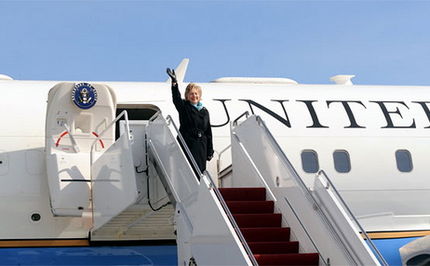


Hillary Clinton met with diplomatic officials and heads of state in China, Korea, Japan and Indonesia and did not hesitate to jump into a wide range of key issues on her first official trip as Secretary of State.  Ms. Clinton prioritized her discussions around North Korean nuclear disarmament, the world financial crisis and laying groundwork for cooperation on climate change.  Clinton did not push the issue of human rights in meetings with Chinese leaders, emphasizing the growing importance given to cooperation on economic and environmental issues.     The most immediate challenge was to establish the Obama administration’s position on North Korean nuclear disarmament by encouraging U.S. allies to reinvest in firm bilateral negotiations and by signaling to the North Korean government that cooperation will bring rewards.
North Korean leader Kim Jong Il has pressed back hard against efforts by both the administrations of George Bush and Bill Clinton to obtain denuclearization. North Korea has claimed to need the weapons defensively, accusing South Korea and the United States of intending an attack. North Korea has also tested both nuclear weapons and long-range missiles, boasting of its power to retaliate for any attack against it.
Secretary of State Clinton’s task was to entice North Korea to participate in negotiations towards completing disarmament.  However, she clearly needed to warn the communist nation that it would suffer further isolation and harsh treatment in the region if it failed to cooperate and that the United States stood with its allies in the six party talks. “North Korea is not going to get a different relationship with the United States while insulting and refusing dialogue with the Republic of Korea. . . . The Republic of Korea’s achievement of democracy and prosperity stands in stark contrast to the tyranny and poverty in the North,” Clinton said

Negotiations have in the past also included offering the North Koreans foreign aid in exchange for their cooperation, but have never concluded a lasting agreement.  Secretary of State Clinton said before her trip that the United States is willing to normalize relations with North Korea in return for disarmament. 

This approach is consistent with the position that President Barack Obama took during the presidential campaign, stating that he would not hesitate to talk to foreign nations in an effort to reach compromise, even those whose positions the United States rejects.  However, Secretary Clinton was threading a needle in giving substantial incentive for North Korea to comply and yet speaking out on behalf of ally South Korea in unity against the North’s nuclear saber-rattling.

Nationalization: Cutting Losses and Creating Solutions

A debate rages on different plains about rescue of the banking industry and real estate market.  That is a clean way of putting it.  Not the debate–the debate is pretty clean.  But the notion that it is just the banks and homeowners who are at risk is pretty sanitary. 

Without banks there is no substantial financing of business activity.  We could reinvent financing, especially since the Internet was not around when the current banking system was begun, but it would take years to reach anything like national capacity.  In the meantime, now, falling business activity continues a downward spiral of unemployment, business failures, investment losses, and postponed planning and recovery.

With no finance and no confidence, there can be no real estate market.  There is only deterioration in values and losses in investment.  Forward business activity and healthy market forces require confidence in the future. 

Hence, the nationalization debate.

If the government takes over weak segments of the banking system, it can, at a cost, make them stable institutions of the recovery economy.  They can loan money without fear of failing for lack of sufficient loan reserves.  Similarly, the government could buy up and hold real property at discounted prices throughout the United States.  This would eliminate the concern that numerous properties sit in default with no payments made on the mortgages and with no interested buyers.  The government is used to owning land in America–it owns much of what is not developed or used.  Add to that a fraction of the housing stock, to be resold later, and you have a more stable marketplace for the remaining property.  (You would have to create a formula such as automatic purchase of all homes in foreclosure at a set percentage discount for a six month period).

Why not nationalize one or both fractions of the marketplace?  Certainly this is not an efficient method of setting prices and running financial and real estate markets.  It would be a really bad idea if you had a functioning marketplace because like the communist economies, it would lead to poor allocation of resources, lack of private incentive and declining productivity.  But, should we be holding out for efficiency, when the very functioning of the system is so broken down?

It must be particularly hard for the Obama administration to look towards nationalization as an option.  The first African American president is hardly a financial liberal or political radical.  He taught at the University of Chicago, a free-market powerhouse.  He was not, so far as I know, part of the “Chicago School” of conservative economics, but neither was he ever noted as a liberal economic standout.  His centrist, free market, choices for Treasury department and economic advisors confirm this.  

What’s the solution?  How about giving a group of responsible Republicans the challenge of crafting and selling the temporary-nationalization plan?  Cherry-pick them in advance so they are willing, at least, to do what is needed.  Despite all our anti-politician rhetoric, there are many among them who are in an of themselves, profiles in courage. 

Rather than indulging in battle over whose party it is, and what it stands for, why not take on the problems of the day and solve some?  

We are clearly at a point of great uncertainty.  The recovery may come as the bottom of the market is reached according to market forces or it may not.  The stimulus spending and tax cuts may aid the recovery or they may not.  But the hole in the plan needs to be repaired, one way or another.

There is a significant, whether that’s one percent or more, risk of more devastation to business activity and investment value.  At some point, rather than aiming for a refined solution, you need to aim to protect yourself from the risk of catastrophe.  Protection from disaster is different than planning for optimal results.  We should, at least someone should, be advancing ideas on that level.

When the countries of the former Soviet Union endured its collapse and economic crisis in the 1990s, industrial production, standards of living, and life expectancy declined deeply.  Painful as it was, within a few years, conditions improved.  We might learn from these experiences as well as from other nations that have had to nationalize collapsing industries, and our own savings and loan crisis in the 1980s.  In each of these cases privatization was eventually successful, so we should not worry about a slippery slope towards socialism or the communist domino effect.  The real risk in those directions comes only if the United States is unable to pull itself up by its bootstraps and demonstrate a viable system.

Big Spender or Economic Reformer?

Originally published on March 5, 2009 at care2.com


In the midst of this economic downturn, the president has proposed a budget that gives further definition to his vision for American progress.  In some ways it may not be the best time to propose something new, as many people, shocked by financial insecurity and instability, investment and pension losses, and business and job distress feel the need to hunker down and survive, rather than experiment and take risks.

On the other hand, the government is stirred to take significant steps to repair a major crisis, and while thinking big, there is opportunity to take bold action.  That, I think, can be said of President Obama’s political vision.  The question is, what kind of action is it?

Probably the most sensitive issue at the present time, is the issue of government spending.  Americans are mistrustful of congress’ ability to spend responsibly and are deeply concerned with the deficit.  How should Obama’s grand, if evolving, plan be looked at from this perspective? 

Is he the big-spending liberal, willing to meet any “progressive” goal with tax-payer dollars, giving only secondary consideration to the harm to the economy of tax increases, redistribution of wealth, and deficit spending? 

If we turn to conservatives for an answer, we hear the harsh critique of a socialist redistribution of wealth.

Even moderates, such as David Brooks, find the size and target of the fiscal stimulus legislation and budget proposal too big and too progressive, while expressly embracing parts of the program such as education.

If we ask liberals, they may very well see an increase in public spending on education, health care, and alternative energy that bespeaks progressive values, liberal causes and Democratic agenda.

I disagree.  Mr. Obama is a financial reformer, using public funds as necessary to do what government truly needs to do, but intent on cutting waste, corruption, and mismanagement out of the workings of government?

The main thrust of the vision is still investment in parts of the economy that need repair:  a struggling education system that is needed to produce a work force on which our prosperity will be based; an inefficient health care system that uses too much of our national budget, is a drag on our businesses large and small (unless like Walmart did they force these costs on private individuals and on state tax-payers when private citizens use public resources) and is too expensive for too many to afford; and energy that is imported at great cost to our economy and national security.  These are issues of fundamental importance to our economic prosperity, our business climate, our capitalist system.

Couldn’t we call what Obama is doing long-range economic reform? 

It might even make a good Republican agenda, as they are rooting around for one. 

Let us not quarrel with the targets of public spending as they are, in fact, economically productive and necessary.  Let us not quarrel with the amount of funds because they are realistic and necessary.  Let us organize and fight for the right use of these funds so that every dollar engenders in our children the philanthropic, creative, entrepreneurial and leadership qualities of business and civic leaders like Bill Gates, Steve Jobs, Warren Buffet and Colin Powell. Let’s make sure our businesses and citizens can afford economical health care benefits, and our citizens receive worthy care, and let us, using the scientific and entrepreneurial genius among us, develop alternative energy or at least efficient energy that is home grown, as clean as is reasonably possible, and marketable to the world.

Is that liberal?  Really?

President Obama’s First 50 Days

Originally published on March 11, 2009, at http://www.care2.com


The first 50 days of the Obama Presidency have seen a flurry of major legislative activity, historic signing ceremonies, substantial policy speeches and high-stakes politics. In fact, “hit the ground running” doesn’t do it justice, as the President began giving press conferences about his economic plans — sensing the markets were collapsing into the vacuum — in the days leading up to his inauguration.

When Barack Obama was sworn in January 20, 2009, the financial crisis had already engulfed the global economy and given direction to his presidency. The celebrations of the 232 year-old democracy, of its first African American President, and of the orderly and ceremonial transition of authority were quickly consigned to history. Mr. Obama made clear that he believed the current crisis to be a historic one, and that he intended to put the considerable financial resources of the American government in play to stabilize the financial system, support the economy, and aid citizens in need.

That said, what has been astonishing, in reviewing Mr. Obama’s first 50 days, is the speed, force and size of the President’s early efforts. While an assessment should also mention stumblings on high-level appointments and near unanimous Republican opposition to the President’s legislative agenda, this pales in comparison with the scale of Mr. Obama’s accomplishments:

January 20 — In his inaugural address, Mr. Obama pressured congress to put stimulus legislation on his desk in record time.
February 17 — The resulting 787 billion dollar American Recovery and Reinvestment Act contained no congressional earmarks, per the President’s request, yet provides for more than five hundred billion dollars in government spending and hundreds of billions in tax cuts and support of state programs.
February 26 — The administration introduced an annual budget dramatically shifting federal spending priorities towards education, health and energy policies and launched health care reform with 600+ billion in funding.
By executive action the President has raised ethics, transparency, and lobbying standards, begun new policies on treatment of enemy combatants, and ended restrictions on stem cell research funding.
March 10 — As if he wanted to start of the next 50-day sprint off with a bang, the President called for sweeping changes in education.

Elements of Power

Beyond the honeymoon authority of all incoming presidents, Obama’s substantial power results from several factors; the chief among them undoubtedly is the economic crisis. Fed. Bank Chair Ben Bernanke, a scholar of The Great Depression has opined that the U.S. government’s initial failure to act was a contributing cause of the Depression’s depth and length. Bernanke and Former Treasury Secretary Henry Paulson saw in the credit freeze of late 2008 the potential that the cyclical downturn, compounded by financial collapse, could lead to a much larger protracted economic crisis without government intervention.

Persuaded by this analysis, President Obama came into office prepared to act. Mr. Obama never campaigned for shifting economic power to the public sector or achieving reform of health care in record time. But neither did he display timidity. His ambition and soaring rhetoric bespeak a desire for bold action and significant achievement.

The overwhelming congressional Democratic victory in November offered Mr. Obama a crucial legislative base. Roughly 58% of both houses of Congress are aligned with the President and a few Republican moderates have been willing to work with the Democrats, thwarting the impediment of a filibuster in the Senate.

Also increasing the President’s power is the fact that he has the Federal Reserve, Treasury and economic advisers, an unrivaled economic analysis powerhouse, close at hand on issues that are highly complex and fluid. Congress, too, has hearings and testimony by experts, and the press has access, but this is no match for the President’s daily meetings with advisors. Some Congressional and press deference is likely the result.

Conversely, this may, in part, be responsible for the nearly unanimous opposition by congressional Republicans. As the recent and much derided Republican response by Louisiana Governor Jindal revealed, Republican positions are based on conservative theory, but do not show in-depth analysis of current conditions.

Another important factor is that Mr. Obama has chosen powerful and experienced professionals for his foreign policy team. Secretaries Clinton and Gates and Diplomats Richard Holbrooke and George Mitchell bring star stature, sober experience, and appropriate diplomatic skill sets to the foreign policy agenda. Secretary Clinton has already held discussions on North Korean and Iranian nuclear disarmament, yet the President has not been called away from his efforts on the domestic agenda.

Finally, polling has given Mr. Obama approval ratings above 60%. While presidents are not beholden to pubic opinion polls, positive approval ratings do support presidential authority. Journalists get out a president’s message far more effectively when approval is up and focus more on opposition to the president when approval is down. The cumulative result is an administration engaged with experts and open to contrary advice, but with great power to advance the President’s agenda.

Bailout Protests Take a Page from History

Originally published on March 5, 2009, at politicsunlocked.com


The memory of the Boston Tea Party was revived last week as Americans in more than thirty cities gathered to protest financial and automobile bailouts, record-breaking stimulus spending, and Democratic leadership in general. Street demonstrations like this are something new, as far as the financial crisis is concerned: both the current and the former president’s actions have inspired anger and mistrust among some, but until now, that dissatisfaction had registered mainly in polls, man-on-the-street interviews, and letters to Congressional offices.

Now, though, a more visible movement appears to be underway. Beginning with calls during Januaryfor a mass-mailing of teabags to government leaders, and later with a series of small public protests around the United States in February and scheduled through at least July 4 of this year, organizersare channeling frustration and fear into protest.

The original Boston Tea Party, in 1773, was an action against British colonial authority over the American colonists. Colonists rejected British control of trade and taxes and argued that taxation without parliamentary representation was unlawful. In protest, colonists dumped a substantial quantity of highly valuable British tea into the harbor. The event angered the crown and united colonists in solidarity against perceived injustice of the crown’s authority.

Current anger over the burden of taxation and fears about the squandering of public funds have made the Tea Party an apt reference point for present-day protest organizers. A group called the Political Exploration and Awareness Committee PAC appears to have played a central role in scheduling and promoting the recent spate of tea parties. The group, whose website was initially full of laudatory references to CNBC correspondent Rick Santelli, has since clarified that Santelli has nothing to do with the site or movement, though their sentiments seem to be aligned. (Santelli was lately made famous for his February 19th on-air tirade about the bailout plan, in which he exhorted a Chicago trading floor, “How many of you people want to pay for your neighbor’s mortgage that has an extra bathroom and can’t pay their bills? Raise their hand.”)

The tea mail-in campaign hasn’t netted extensive news coverage, but a number of the recent protests have gotten write-ups — particularly the larger gatherings, like the crowd of about three hundred that congregated in Atlanta last Friday. Several journalists and bloggers have called into question the grassroots authenticity of the protests, alleging that they may have been financed, organized, and publicized, to an unknowable extent, by professional conservative advocacy groups or corporate interests with ties to same.

There is another tea-bag mailing scheduled for April 1.

Public v. Private: Which part of “of the people, by the people, for the people” don’t you get?

Originally published on February 26, 2009, at care2.com


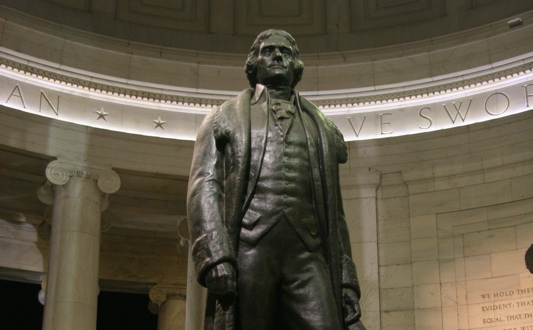
Thomas Jefferson -- photo by chadh, licensed creative commons

Thomas Jefferson -- photo by chadh, licensed creative commons

If it were possible to take a step back from the current focus on the economic crisis with its financial breakdown, housing glut, contracting commerce, growing unemployment, and menacing deficits, we could make out an even broader political picture:  the failure of the me-only private vision of civic life and its replacement by a public-private partnership of sound leadership.

Take the four areas that President Obama has now committed to reform:  finance, education, energy and health care.  In each area, those whose political philosophy is that public vision is necessarily faulty, and private interest is all, have pushed and pulled their version of reform through the Republican Revolution of 1994, talk-radio over-simplification, and anti-government rhetoric.  This is not to say that Republicans, per se, embrace a private-only solution to reform, as they don’t, but many who have sought to gut the government and replace all regulation and public funding with self-interest and free-markets have done so at least masquerading as conservatives.

In the financial arena, faith was placed in the market to regulate itself.  Instead, short-term self-interest led too many to take fatal risks requiring government bailout to protect the larger economy.

In public education, anti-government vision led to stripping schools of resources, spurring many who could afford it to choose private schools with outstanding resources and leaving others to suffer emaciated public education.

Our energy system allowed the market to dictate the most economically efficient energy despite the consequent flow of money to nations who act against our national interests.  Short- and long-term environmental costs associated with self-interested energy choices were shifted to the public from the private sector.

Finally, health care expenditures press business and family budgets and leave many under-served, yet there is resistance to public supervision of the health care system, where industry money influences elections and portrays government action as the problem, despite huge inefficiencies in the current system.

Critics of the new president’s budget and priorities attack the plan as “big government.”  This is nonsense.  Limited regulation, adequate funding for education, and limited macro-management of sectors of the economy with strategic and economic national importance are not big government but good government. Calling spending “socialism” because it increases the budget is pure political rhetoric. We need to balance the budget, but we need education as well.  Good government provides oversight, restricts harmful actions, and promotes positive ones.

There are, of course, inefficiencies in the system.  President Obama has in no way acted to protect and preserve government waste.  Improvements are also part of good government.  But the fact that members of the government, whose philosophy was “hands off,” failed to regulate the financial sector, is hardly an indictment of the ability of Americans to benefit from government of the people, by the people, for the people.  Good public leadership and judgment has tremendous potential, not to take over for private action, but to guide private enterprise to serve democratically determined purposes and to fill the vacuum created in public decision-making by those seeking to gut, rather than reform government.

President Obama’s Speech at Signing of Stimulus Legislation

Originally published on February 18, 2009, at http://www.care2.com/causes/politics/blog/obamas-speech-at-signing-of-st/


President Obama spoke briefly today in Denver before signing the stimulus bill. His remarks and the event were thoughtfully orchestrated to make clear the President’s vision of an American renewal through public investment.  The President’s entire speech as well the introduction by Blake Jones of Namaste Solar, a Denver company aided by the stimulus legislation, is well-worth viewing.

View the CNBC broadcast of the President’s speech here.

President Obama made plain that he believes investment in public education, green technologies, traditional infrastructure, and health care information technology contained in the bill is a recipe for America’s long-term growth, prosperity and leadership.  The President made references to John F. Kennedy’s Mission to the Moon and Dwight Eisenhower’s interstate highway program as examples of large-scale public investment that stimulated private enterprise and served a national purpose.

President Obama did not shy away from his accomplishment, just three weeks into office, calling it, “the most sweeping economic recovery package in our history.”  The President touted its support by governors and mayors and, in a comment aimed to shore up support among skeptics, proclaimed,

“What makes this recovery plan so important is not just that it will create or save three and a half million jobs over the next two years, including nearly 60,000 in Colorado. It’s that we are putting Americans to work doing the work that America needs done in critical areas that have been neglected for too long – work that will bring real and lasting change for generations to come.” (Transcript)

He noted jobs saved, but focused on education, noting that 14,000 New York City teachers will likely keep their jobs because of the bill.  Over and over he attempted to demonstrate that the spending was in areas that were necessary to meet the needs of tomorrow.

The President also brought up discipline and responsibility to remind Americans that the road ahead will not be easy.  But he returned to his belief that the stimulus bill achieved a balance between public and private, present and future. 

Obama was introduced by Blake Jones, a Denver area entrepreneur in solar technologies.  Mr. Jones aptly discussed his firm’s difficulties because of the recession and the likely benefits to his firm and his industry because of the new legislation.  He enthusiastically pointed out that in green technology, the legislation was good for employment, for the environment, and for America’s bid for energy independence.

Barack Obama on Abraham Lincoln

Originally published on February 16, 2008, at http://www.care2.com/causes/politics/blog/barack-obama-on-abraham-lincol/


Abraham Lincoln, 16th president of the United States

licensed creative commons: http://www.flickr.com/photos/seamusnyc/295921575/sizes/m/</a&gt;


President Obama reflected recently on Abraham Lincoln at the 200th anniversary of Lincoln’s birth.  His remarks, and the fact that Obama has mentioned focusing on the 16th president in looking to the past, give some indication of how Mr. Obama sees the nation and the presidency:

“It’s only by coming together to do what people need done that we will, in Lincoln’s words, . . . ‘Give an unfettered start and a fair chance in the race of life.’  That’s all people are looking for: a fair chance in the race of life.  That’s what’s required of us —  now, and in the years ahead.”  

“We will be remembered for what we choose to make of this moment, and when posterity looks back on our time, as we are looking back on Lincoln’s, I don’t want it said that we saw an economic crisis but did not stem it, that we saw our schools decline and our bridges crumble, but we did not rebuild them, that the world changed in the 21st century, but that America did not lead it, that we were consumed with small things, petty things, when we were called to do great things.”  

“Instead, let them say that this generation, our generation of Americans rose to the moment and gave America a new birth of freedom and opportunity in our time.”

Clear themes of coming together, fairness, action in the face of challenges, and rising to the historical moment show that the current president is thinking about his and the nation’s choices in a historic context.  

This may be rhetoric or it may be Obama’s belief that the financial crisis is a major historic event in line with the Great Depression, but he seems to be asking the people of the United States to move beyond competing political parties and social agendas to act together on common interests in education, infrastructure and leadership. 

The rush to pass stimulus legislation did not bridge any partisan divides, but President Obama will have a chance at a more deliberate pace to gather together political leaders, parities and populace, going forward.  

It may be worth remembering that Abraham Lincoln called the people of his time to make great personal sacrifice for the nation, and in honoring the fallen and leading the living he reminded Americans of the noble purpose of the American experiment:

“the great task remaining before us — that from these honored dead we take increased devotion to that cause for which they gave the last full measure of devotion — that we here highly resolve that these dead shall not have died in vain — that this nation, under God, shall have a new birth of freedom — and that government of the people, by the people, for the people, shall not perish from the earth.” (excerpted from Gettysburg Address)

After the Spending Spree

Originally published on February 18, 2009, at http://www.politicsunlocked.com/item/after-the-spending-spree


Efforts to balance long-term budget through entitlement reform could help restore confidence.

Efforts to balance long-term budget through entitlement reform could help restore confidence.


Following the historic passage of substantial stimulus legislation, President Barack Obama must now show he is capable of fiscal discipline.  

The 789 billion spending and tax relief bill passed with overwhelming Democratic support, and despite almost unanimous Republican opposition, showing that bi-partisanship, a central theme of his campaign, proved to be harder to achieve than propose.  

The President urgently sought a short-term stimulus bill to reverse the economic decline. Now that he has achieved this goal, the President should turn his attention to the long-term fiscal health of the nation.   

Most Americans are dismayed at the fiscal irresponsibility of government leaders and feel powerless to stop the government from spending their money unwisely.  Mr. Obama has a unique opportunity to put his political weight behind drafting legislation to control long term spending, including outlays for Social Security and other so called entitlement programs, that will only take effect once the recession passes.

The government is currently committed to spend more than it is projected to take in on Social Security and Medicare.  This deficit will require spending cuts or revenue increases to make up the difference.  The public will certainly not like either solution.

Operating with a deficit is justifiable under certain conditions such as emergency needs or long term improvements, programs which could not be afforded without borrowing.  However, operating the government with a chronic deficit is irresponsible and hardly confidence-inspiring.  

If President Obama were to begin the work of entitlement reform and act with the deliberate and decisive hand that has guided his campaign and his Presidency so far, he would again succeed.  Leaders must compromise.  The public must make sacrifices.  This will truly have to be a bi-partisan effort. 

This debate must be had in the next few years, before it is too late to plan responsibly.  Why not move on it now in order to show a very skeptical public that the government is not only good at spending its money, but can manage it as well?

New Foreign Policy Emerging

Originally published at politicsunlocked.com

Secretary of State Hillary Rodham Clinton

Secretary of State Hillary Rodham Clinton

(Photo credit:  Marc Nozell; license — creative commons)

Hillary Clinton’s confirmation hearing reveals Obama’s new approach to the world.

The Senate confirmation hearing of Hillary Rodham Clinton provided the first insights into Barack Obama’s foreign policy.

The nominee for Secretary of State sought to make clear the principles that would guide the administration in its approach to international problems from terrorism, wars in Iraq and Afghanistan and nuclear proliferation in Iran and North Korea.  

The most clear break with the Bush administration came in the insistence on a multilateral approach, recognizing the “overwhelming fact of our interdependence.”

“For me, consultation is not a catch-word.  It is a commitment,” Ms. Clinton stated.

Clinton also spoke for a greater emphasis on diplomacy and the use of what she labeled smart power, citing negotiation, development aid and cultural support to supplement the traditional use of military and economic power.  She cited Secretary of Defense Robert Gates, who will retain his position in the new administration, for the belief that “our civilian institutions of diplomacy and development have been chronically undermanned and under-funded for far too long.”

Ms. Clinton took a hard line however, with Hamas, currently facing a costly war in Gaza, and Iran, whose nuclear ambitions will be a high priority in the next administration. 

Clinton stated that the administration would not negotiate with Hamas until it renounces violence and acceptsIsrael’s right to exist, and told Senators that Iran would not be allowed to obtain nuclear weapons.  When asked by Senator John Kerry, Chairman of the Foreign Relations Committeehow far the administration was prepared to go in standing up to Iran, she replied, “nothing is off the table.” 

This aggressive tone may upset some Obama supporters, depending on their isolationist or less confrontational views.  There has been a nearly universal hope that after the Bush Administration’s tough talk (axis of evil) and willingness to use military force, the incoming administration would tone down the rhetoric.  

Clinton appears to be trying to signal both an increased effort at diplomacy and a willingness to consider force when necessary.

“We will lead with diplomacy because it’s the smart approach.  But we also know that military force will sometimes be necessary, and we will rely on it to protect our people and our interests when and where needed, as a last resort.”

Presidential campaigns contain many general statements of philosophy, but not until the incoming administration finds itself face to face with the facts on the ground can a specific program be developed. Israel’s recent invasion of the Gaza strip is just the type of unanticipated event administrations are forced to deal with at their peril.  The risk for the Obama administration is that efforts at solving the Palestinian dilemma will take attention away from Iran’s nuclear ambitions, Russia’s resurgent power in Europe and effective action to manage the current world economic crisis as well.