Category Archives: economics

Comment to NPR story: Experts Say Bills Won’t End ‘Too Big To Fail’

Comment to NPR story:  Experts Say Bills Won’t End ‘Too Big To Fail’

I disagree. The new legislation uses higher capital requirements and lower leverage limits to control systemic risk. This is the right approach. It makes the entire financial industry less risky and more insulated from downturns. “Break up the banks” sounds more anti Wall Street and sounds tougher, but remember in the Great Depression 5000 banks failed in the early years. It is no better for 5000 small banks to fail than it is for 10 large banks to collapse. What counts is that all banks are more regulated with stronger restrictions. Canada has superbanks, among the largest in the world, but suffered no financial crisis and required no bailouts. Canada’s banks incurred losses, but they were small compared to resources of the banks, because regulators there expect banks to be better capitalized and they can demand bigger banks, which pose more risk the system, to meet higher requirements than small ones. For a comparison of Geithner’s plans and Canadian approach: https://marcivanseltzer.wordpress.com/2010/01/29/what-can-canada-teach-us-about-banking/

Comment at NPR Planet Money about the Ugly Comment Trail There

Second comment on:

Experts Say Bills Won’t End ‘Too Big To Fail’

As to the comment trail here, I want to say that I respect the earnest Conservative vision of free-market capitalism and small-government individualism, but those who call President Obama a Socialist or Maoist simply illustrate their lack of education about the historical references they make and undermine the credibility of political arguments for libertarianism and against Progressive or Democratic-party principles. Obama, viewed reasonably, is no different than most Presidents who have attempted to solve problems of their time.

The differences between practical Republican and practical Democratic platforms, on the role of government and its financing, are not so different as they are made out to be in the public debate. There are differences and there are merits to Conservative and Liberal positions, but the key is to learn about the real distinctions and make the best choices among them. Instead, the current anti-Obama hatred is parroted from talking points for partisan political purposes, without getting the analysis, or as I say, even the terms, correct. It’s a shame, because good policy is a mix of Libertarian, Conservative, liberal, bureaucratic ideas put to practical use to meet specific real world challenges. http://wp.me/pm5qY-ig

Stinginess with public dollars

Stinginess with public dollars (comment to US News story April 16, 2010)

I externed for the federal district court judge Harry L. Hupp a few years back. I still remember that when it came time for the annual judicial conference, which took place at the Dana Point Ritz Carleton that year, Judge Hupp disapproved of the extravagance for a government meeting. I do not begrudge such judges anything as they are remarkable high-achievers, accepting far less in salary than they would receive in the private sector, but I will say that his attitude made an impression on me, as does that of Clarence Thomas, reported here.

The public purse is a strange beast, where it is all but impossible for the spenders of it to feel the pain of those who give it through their taxes. It is not just these two judges who exemplify careful stewardship of public funds, but we would be well to have this attitude infect our congressional leaders, rather than the ethic we have now, which is still, The more you bring home the bacon by steering public funds into your district, the more likely you are to get personal support in your re-election campaign.

If Justice Thomas’ ethic were pervasive, the public would feel much better about paying its share of taxes and about the government those taxes fund.

Hate That Obama’s Near the Middle? Think Again

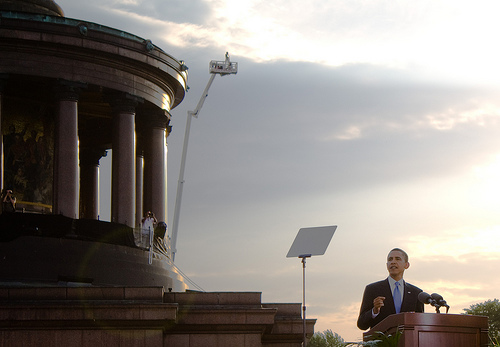
(Photo:  Obama speaking in Europe, where his views are well received and highly regarded)

By Marc Seltzer; originally published on April 13, 2010, at care2.com

. .

Contrary to all the talk of disenchantment with the state of the nation, there is reason to be optimistic that President Obama is leading the government in exactly the right direction.  While his critics voice disappointment and outrage, calling on Mr. Obama to govern to the left and to the right, President Obama governs by judgment, not ideology.  This will always disappoint ideologues who see the world through conservative or liberal glasses, but do critics have credible political ideas behind them?

At the outset, a few things need to be set straight.  First, the biggest thing President Obama has done since taking office is not health care reform.  (Complete Story)

Republican Calls for Repeal Invite Deficit Scrutiny and Skepticism

By Marc Seltzer; originally published on March 29, 2010 at care2.com

. .

Reform is Bitter Medicine

One aspect of President Obama’s health care reform legislation that has not received enough serious discussion is deficit reduction.  Despite claims that the legislation expands government, the non-partisan Congressional Budget Office (CBO) says that it will reduce the deficit by a significant amount over the next twenty years.

This has not stopped Republicans, such as Lindsey Graham, from announcing a campaign to “repeal and replace” the legislation.  What the Republicans have not said, is whether they would increase the deficit by such repeal, or find a way to match or improve upon the projected $130+ billion dollars in deficit reduction over first ten years and more than a trillion dollars in projected saving by 2030 contained in the Obama plan.  (Atul Gawande in the New Yorker gives some context)

It’s not hard to create popular legislation if it gives benefits that it does not pay for.  Remember that President Bush’s Medicare Prescription Drug benefit was popular, but was also a giveaway, increasing the deficit.  The harder part is to create legislation that lowers the deficit, without losing support among constituents, who like the idea of deficit reduction, but don’t want to see their own benefits taken away.

No matter what happens in November, President Obama would surely veto any attempts to repeal health care reform.  He may be open to improving upon current legislation, but he has promoted the “PayGo” (from pay-as-you-go) rule, which requires that new legislation not raise the deficit.  “PayGo” requires cuts in spending or increases in taxes to offset any new program spending.  “PayGo” led to surpluses in the Clinton presidency, and will again, so long as it is followed.  However, Republicans have no credibility on fiscal discipline.  They may run for office on a repeal platform, but will they propose alternatives to health care reform that cut the deficit?

Remember, repealing the current law would, in itself, raise the deficit, since Obama’s new legislation substantially lowers the deficit.

Republicans’ most appealing political argument, superficially, at least, against Obama’s health care reform, is that it takes money from Medicare.  Republicans claim it will bankrupt Medicare and hurt senior care.  Democrats refute these claims, arguing that the elimination of waste, fraud and abuse and the establishment of an independent panel to review Medicare spending will lower costs without cutting the quality of senior’s care.

An ongoing disagreement over doctor reimbursement rates may be another difficult challenge or an opportunity for creative problem solving, when it resurfaces in coming months or years.

It is no surprise that Republicans have come down on the side of spending more, and reassuring constituents, rather than bold action and fiscal responsibility.  But if Republicans are going to have any relevant part in the health-care debate going forward, they must be willing to offer potentially unpopular proposals that the CBO agrees will cut the deficit.  So far, Republicans have shown no appetite for the politically difficult task of cutting spending, not in Medicare, not in Social Security, and not in Defense.

President Obama has taken criticism for his stimulus spending.  But this was one-time emergency spending to stave off economic crisis, and the benefit of a rebounding economy should include increased tax revenues and a lowering of the deficit over time.  The President has since made it clear that he came to Washington to make the tough decisions, including long-term deficit reduction.  His health care reform triumph follows through on that promise.

. .

For more on health care reform:  You’ve Got to Hand it To Them:  Obama, Pelosi and Reid.

To Protest or Reform — Who’s Messing with Our Minds?

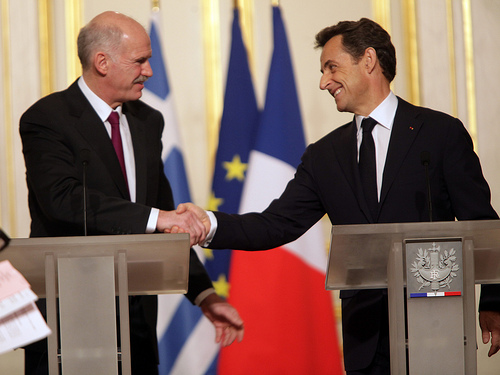
(photo:  Greece’s P.M. Papandreou and France’s Sarkozy in Davos, Switzerland, recently, managing economic turbulence)
. .
By Marc Seltzer; originally published on March 19, 2010, at care2.com

. .

There is still a strong undercurrent of anger in the United States about bailouts and stimulus spending.  Republicans, and even Democrats and Progressives, have reacted angrily to President Obama and his financial team.  This is significant because President Obama lost political capital on the economic recovery plan, and has far less power now to push though health care, education and financial reforms than he would have absent these actions.

The common critique from the Right is that Mr. Obama is moving in a socialist direction, while from the Left it is that Geithner, Summers, Romer and Bernanke, the U.S. government’s economic chieftains, are corporatist and beholden to the bankers.

More puzzling than the conservative complaints about the administration’s stewardship of the economy, is the Left’s opposition to it.  A significant part of the Democratic party seems to believe that our current leadership is on the side of the wealthy in a new class struggle, and that the government bailouts have effected a transfer of wealth from the little guy to the fat cats.  To be fair, this antagonism towards saving the financial system is in part a more structural distaste for corporate political and legal power — unrelated to recent U.S. government actions.  None-the-less, Obama is now trying to enact reforms in this across-the-spectrum, anti-government political climate.

To challenge the idea that Obama’s actions were pro-bank, pro-corporate, or designed to bail out the fat cats at the expense of the public, I want to compare the European response to the financial crisis with U.S. actions.  European nations, often called “social democracies,” are respected by the American Left and cited as examples for their stronger safety net of worker protections, health care and liberal benefits.

Jean-Claude Trichet, the head of the European Central Bank, equivalent to our Federal Reserve Bank (Ben Bernanke), said recently about American and European government interventions:

“We had to put on the table on both sides of the Atlantic around 25% of taxpayer risk to avoid the Depression, a major Depression, which would have come had we not been that bold.  When I say we, I mean the governments.  Of course, the central banks also have been very bold, in engaging in non conventional measures — the Fed and us [European Central Bank].”  (Bloomberg on Demand, March 12, 2010, from interview with Tom Keene)

What is insightful here is that European governments and related institutions behaved much as the American government did.  As the New York Times reported in early 2009:

“So far, Europe’s largest economies, France, Germany and Britain, have been spared demonstrations. All three governments have introduced huge stimulus measures aimed at spurring employment and protecting banks.

Regardless of the outcome, the three countries will face large budget deficits and higher state borrowing, which economists say will be passed on to taxpayers. And in the case of France and Germany, the governments could find it more difficult to introduce bold reforms at a time of recession.” (New York Times, January 26, 2009.)

To be sure, European nations have faced public protests over the past year, including demonstrations in recent weeks against the Socialist government in Greece.  And modern European nations are a mix of strong state intervention in industry and free markets.  But despite their more left-leaning perspectives, European government actions to save banks and support their nations’ economies with emergency stimulus spending, resemble US approaches.

The underlying reason for this is plain: Healthy economies require healthy banking systems.  The only other option for lawmakers in 2009 would have been to nationalize, through government takeover, the major banks and investment companies.  This would not only have been too radical for a young American President in the first days of his Presidency, but was not favored by European nations, which, despite more Socialist political visions, prefer to keep most individual businesses in the hands of private owners.

It is as much of a stretch to believe that Barack Obama, community-organizer-turned-politician, attained the Presidency in order to embrace the rich and powerful over the little guy, as it is to draw the conclusion that the Socialist and left-leaning governments of Europe transformed in 2009 into standard bearers for corporate and special interests across the Continent.

Why the American Left should find itself so opposed to the positions of both European and American governments requires little guesswork.  The greed, irresponsibility and power in the financial system made the public angry.  The Republicans, with little post-election political power and prospects, turned anti-corporate anger into anti-government anger with some clever “grass roots” anti-Democrat marketing messages.

Now, instead of joining the administration and embracing reforms, many a Democrat flirts with anti-government energy, which is really just self-serving partisan manipulation pushed by the Republican party.

Democratic Congressman Dennis Kucinich, in discussing his last-minute decision to vote for the President’s health care reform, acknowledged the tension between pressing for progressive reform and falling into a trap laid by the opposition:

“With three years left in the Obama Presidency we have to continue to encourage him, but we’ve got to be careful that we don’t play into those who want to destroy his presidency and say, you know, the birthers and others who say he should never have been President to begin with.  There is a tension that exists. . . .  we have to be very careful about how much we attack this president even as we disagree with him because we may play into those who just want to destroy his presidency.”  (Democracy Now!, March 18, 2010 (radio interview with Amy Goodman))

Careful indeed!  It’s about time.

Universal Coverage or Maintaining the Status Quo?

Photo credit: cdc.gov

By Marc Seltzer; originally published on March 13, 2010 at care2.com.

. .

For all the smoke and mirrors, all the outrageous claims, and all the frustration about what is not in the Democrat’s health care reform legislation, the fundamental impact of the proposed reform is very simple.  The Senate bill, soon to be voted on by the House, uses public funds to insure Americans who do not have insurance.  (Making sense of the polling, from the Washington Post)

In providing for universal coverage, it satisfies President Obama’s preeminent campaign goal — one he has not walked away from despite profound economic turmoil and deep political resistance.

It is amazing that the debate over such a simple idea took so long and involved so many distractions.

Republicans do not want to spend public funds to insure the uninsured — plain and simple.  Though they do not say it so clearly, instead, hiding behind claims that the deficit, the recession, and public opinion polls are the reason that the bill is wrong for America.

Smoke and mirrors.  (Krugman dispels some myths)

President Obama seeks to add an entitlement, consistent with contemporary democratic principles of capitalism with a social safety net.  Republicans, consistent with principles of individual effort and individual reward, seek to resist it.

What is more puzzling is why the left is so fractured in its desire for reform.  There has not been a serious proposal for an open-enrollment public option or for single payer public insurance on the table since the beginning.  This is not to say that the United States wont move towards public insurance or public medicine in the long run.  But with only a subsidy and insurance regulation on the table, the left’s threats to undermine President Obama’s universal coverage program because it does not do away with the for profit medical system makes little sense.

What would make sense is to take a longer range view:  To believe that universal coverage is an important step in the direction of providing good care for all; to trust that reforms included in this legislation can be used to regulate for-profit insurance practices to eliminate exclusions and rescissions which kept people who wanted insurance from receiving it; and to recognize that a variety of reasonable cost-containment measures will be used to slow the growth of health care inflation.

I have written often about deficits and debt, reform of fee for service medicine and changing financial incentives in health care.  And I think this legislation is serious medicine for the problems we have in these respects.  And I have spoken with Canadians and Europeans who love their publicly funding health care systems.  And I still think that this legislation is a serious attempt to insure that all Americans can receive adequate health care.  If I were like most supporters of this health care reform, I would say that this legislation is poor, for one reason or another, and then suggest that it was the best we could get under the circumstances.  But this legislation is powerful, historic and designed to solve the problems we face.  So why, complain?

Pass the bill.

(Sign the petition)
. .
More thoughts on national issues: my podcast ramblings and conversations with Jessica Pieklo.

March 19, 2010 Update:  Paul Krugman sounding more positive, as well, in the New York Times.

Podcast March 10, 2010

“My show” podcast — March 10, 2010

David Leonhardt’s article on health care finance.

Why don’t we leave the lawyers alone?  Detainee lawyers criticized by Lynn Cheney, while other conservatives come to their aid.  (New York Observer commentary) (New York Times article)  The left criticizes Bush administration lawyers.  This is politics.  The lawyers are doing their job, fulfilling an important role in the system — in both cases.  What do you think?

The Chief Justice wonders, “why we’re there” referring to the State of the Union address and Obama’s criticism of the court.

Podcast March 6, 2010

March 6, 2010 “My Show”

Iraqi election and the courage of starting a new democracy.

Health care reform and whether “reconciliation” is really just a buz word and political attack with no real historic significance.

Email or call with comments (310) 928 1408 and I will try to discuss in the next show.

Questioning Conventional Wisdom — “Jobless Recovery”

By Marc Seltzer; originally published January 6, 2010

Don’t be too sure

. .

“Jobless Recovery”

No adjective characterizes political and media discussions of the recovery from the 2008 recession more than the word “jobless.”

Is it true?  Have the stars aligned to deny us a bright future?  Should we be worried?

LIBERAL EXPRESSIONS OF CONCERN

One way to evaluate what people are saying is to look at their motivation.  In this case, liberals and conservatives are both motivated to characterize the job prospects as worse than they likely are.  Many liberals, such as outspoken Nobel Laureate Economist Paul Krugman, want the government to take action in support of job creation so they focus on the high unemployment rate.  Ten percent is certainly higher than a more ideal 5 or 6 percent that would be a healthy level for the economy, if it were not in either an excessive boom or bust cycle.  But the current high unemployment reflects the depth of the recession, not a “jobless” recovery.

In 2009, the growth rate only turned positive in the third quarter.  Jobs are a lagging indicator and always follow the business turn-around and improvement in growth rate by many months.

Thus, the 2009 recovery is not “jobless” because unemployment has not yet come down.  Every recession involves the loss of jobs and every recovery involves the improvement in business conditions and higher growth rate long before jobs return.

Professor Krugman is worried about a weak recovery and thus wants to see additional stimulus aimed at creating jobs.  He is particularly concerned that the slow return of jobs creates great suffering and harms employment prospects for the long-term unemployed.  His proposals could help alleviate high unemployment and move the economy more quickly towards full employment, but they do not indicate that this is a jobless recovery whereas other recoveries were not.  Rather they reflect the fact that the severity of the recession led to millions of layoffs and that it will take time for millions of workers to be rehired into the labor market.

HOW ABOUT THOSE REPUBLICANS?

On the other side of the isle, the Republicans are constantly saying that the Obama administration actions such as stimulus spending and health care reform are bad for the economy and that we are headed for a jobless recovery.  However, it serves the Republican political goals if the Obama administration can be described as failing to lead an economy out of recession.  Millions of people are unemployed and many who are employed face job insecurity.  The Republicans exploit this to political advantage by claiming that current policies are wrong and pointing to a “jobless” recovery as evidence of failure.  The Republicans will continue to have every incentive to claim that Democratic policies are causing a jobless recovery until the 2010 elections.

But that doesn’t make it so.  Remember that it is far quicker to lay off employees than it is to rehire them.  Layoffs can be done by thousands on a single day, while rehiring takes substantial human resource department efforts, paperwork and staffing in itself.  Unless employees were simply furloughed, a thousand employees laid off in a single afternoon could take months to rehire in ordinary conditions.  For this reason, and because the recession of 2007-2008 involved a spectacular financial crisis with fast and deep layoffs, reaching a peak 750,000 a month in January of 2009, unemployment may only decrease by 750,000 to two million new jobs a year in coming years.  Remember, we lost more than seven million jobs.

Nonetheless, six to eighteen months after the growth rate becomes strong, we should expect to see substantial gains in employment.  It will be correct to say during the recovery that jobs are not created as fast as they were lost, but that is a hardly the standard for a “jobless” recovery.  The real key is the growth rate.  It reached more than 2% in the third quarter of 2008.  Six months from now it should be higher still.   The activity is reflected in increased hours and temp job hires for now, but inevitably job creation will follow.

The real question is whether innovative action in the public and private sector can increase the speed of job creation without distorting the marketplace and creating waste.  Nations such as Germany subsidized jobs during the crisis to limit layoffs.  Many nations, including ours, supported public and private sectors with stimulus spending, preventing layoffs from getting worse than they did.  Now, the question is whether means will be found to efficiently return to higher employment more quickly than in other deep recessions.

May 6, 2010 UPDATE:  Recent jobs data finally confirming predictions:  Denver Post