Category Archives: economics

Bailout Protests Take a Page from History

Originally published on March 5, 2009, at politicsunlocked.com


The memory of the Boston Tea Party was revived last week as Americans in more than thirty cities gathered to protest financial and automobile bailouts, record-breaking stimulus spending, and Democratic leadership in general. Street demonstrations like this are something new, as far as the financial crisis is concerned: both the current and the former president’s actions have inspired anger and mistrust among some, but until now, that dissatisfaction had registered mainly in polls, man-on-the-street interviews, and letters to Congressional offices.

Now, though, a more visible movement appears to be underway. Beginning with calls during Januaryfor a mass-mailing of teabags to government leaders, and later with a series of small public protests around the United States in February and scheduled through at least July 4 of this year, organizersare channeling frustration and fear into protest.

The original Boston Tea Party, in 1773, was an action against British colonial authority over the American colonists. Colonists rejected British control of trade and taxes and argued that taxation without parliamentary representation was unlawful. In protest, colonists dumped a substantial quantity of highly valuable British tea into the harbor. The event angered the crown and united colonists in solidarity against perceived injustice of the crown’s authority.

Current anger over the burden of taxation and fears about the squandering of public funds have made the Tea Party an apt reference point for present-day protest organizers. A group called the Political Exploration and Awareness Committee PAC appears to have played a central role in scheduling and promoting the recent spate of tea parties. The group, whose website was initially full of laudatory references to CNBC correspondent Rick Santelli, has since clarified that Santelli has nothing to do with the site or movement, though their sentiments seem to be aligned. (Santelli was lately made famous for his February 19th on-air tirade about the bailout plan, in which he exhorted a Chicago trading floor, “How many of you people want to pay for your neighbor’s mortgage that has an extra bathroom and can’t pay their bills? Raise their hand.”)

The tea mail-in campaign hasn’t netted extensive news coverage, but a number of the recent protests have gotten write-ups — particularly the larger gatherings, like the crowd of about three hundred that congregated in Atlanta last Friday. Several journalists and bloggers have called into question the grassroots authenticity of the protests, alleging that they may have been financed, organized, and publicized, to an unknowable extent, by professional conservative advocacy groups or corporate interests with ties to same.

There is another tea-bag mailing scheduled for April 1.
Ponzi Scheme or Free Market?

Originally published on March 3, 2009, at politicsunlocked.com

A pyramid scheme or “Ponzi scheme” (named after legendary swindler Charles Ponzi) is the name given to a bit of financial trickery in which early investors are rewarded with big returns from money put in by later investors. The promise of big returns lures more and more people to keep adding to the pot, until the public is spooked, the market for funds tapped, or the game shut down by authorities. At that point, the later contributors, who greatly outnumber the early participants thanks to publicity and word of mouth (hence “pyramid”), are left empty-handed, as the funds have already been paid out to the first investors who generated buzz and paid off the scheme’s instigators.

Stock market

Compare this with the stock market, where investors bid against other investors for shares in companies. The more people are willing to pay for shares of a company, the higher the price, according to supply and demand. The company uses the investment funds as capital to finance their operations, and successful businesses reward stockholders with dividends, higher share prices, or simply confidence that the business will grow and the stock will increase in value. In a successful business, even if shareholders abandon the stock, one could retain shares — albeit with little value — until a later time where the stock might again come into favor.

Real estate

Real estate is similar in that people purchase land at a price based on supply and demand. The price goes up if many people want to buy and are willing to pay more in order to have what’s being sold. Price goes down when there is less demand, but if you own the land, you really own it and it has some value as a home or as land to be developed.

Added leverage

Unfortunately, it’s not that simple. In recent years, stock prices have gone up so fast, and real estate values have increased so much, that many people wanted to invest even after they had no more money to invest. But interest rates were lower than the profit they believed they could make, so they borrowed money and invested it in stock and real estate. This is called leveraging, and it’s perfectly legal: borrow money, buy stock or real estate, sell stock or real estate, pay back interest, keep the profit.

An individual who had ten thousand dollars to invest might borrow another ten or twenty or hundred thousand and invest the total. If they doubled their money in a year, they would have sixty thousand dollars, minus the thousand they had to pay in interest to borrow the funds for one year. Institutions did this with millions of dollars; one million to invest might be added to ten million or thirty million borrowed.

Then something happened. Was it the price of oil sucking the profits out of companies large and small? Was the limit of leverage as everyone willing to borrow heavily to invest had already done so and there were no more people lining up to play the game? Was it fear of the growing deficit (2006), the flailing war effort in Iraq (2007), or the pending presidential election exacerbating tension and uncertainty (2008)? Risks went up and the expectation of reward fell. The real estate market slowed; the stock market topped.

People began to sell, to take their profits.

Prices started to fall, and economic clouds darkened. People who borrowed money to invest were still paying interest. They had to make the calculation. Was the fast run-up in prices going to continue? Would a gradual gain in prices outpace the cost of the funds that they borrowed? Was it worth the risk? The answer was likely “no.”

“Deleveraging”

As prices fell, the stock and real estate prices fell below the purchase price for many investors. Now they were taking a loss on their borrowed funds. Paying back the bank became more difficult. Banks started to find that the risk of default was going up.

Ponzi scheme or free market? The bank’s fault or the investors? Where is all this going?

These days, financial experts are looking for the bottom. At what point is the speculation gone, the deleveraging complete, and the more authentic supply and demand for productive use of land and capital remaining?

Public v. Private: Which part of “of the people, by the people, for the people” don’t you get?

Originally published on February 26, 2009, at care2.com


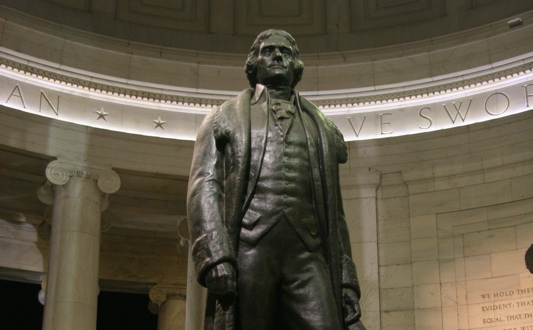
Thomas Jefferson -- photo by chadh, licensed creative commons

Thomas Jefferson -- photo by chadh, licensed creative commons

If it were possible to take a step back from the current focus on the economic crisis with its financial breakdown, housing glut, contracting commerce, growing unemployment, and menacing deficits, we could make out an even broader political picture:  the failure of the me-only private vision of civic life and its replacement by a public-private partnership of sound leadership.

Take the four areas that President Obama has now committed to reform:  finance, education, energy and health care.  In each area, those whose political philosophy is that public vision is necessarily faulty, and private interest is all, have pushed and pulled their version of reform through the Republican Revolution of 1994, talk-radio over-simplification, and anti-government rhetoric.  This is not to say that Republicans, per se, embrace a private-only solution to reform, as they don’t, but many who have sought to gut the government and replace all regulation and public funding with self-interest and free-markets have done so at least masquerading as conservatives.

In the financial arena, faith was placed in the market to regulate itself.  Instead, short-term self-interest led too many to take fatal risks requiring government bailout to protect the larger economy.

In public education, anti-government vision led to stripping schools of resources, spurring many who could afford it to choose private schools with outstanding resources and leaving others to suffer emaciated public education.

Our energy system allowed the market to dictate the most economically efficient energy despite the consequent flow of money to nations who act against our national interests.  Short- and long-term environmental costs associated with self-interested energy choices were shifted to the public from the private sector.

Finally, health care expenditures press business and family budgets and leave many under-served, yet there is resistance to public supervision of the health care system, where industry money influences elections and portrays government action as the problem, despite huge inefficiencies in the current system.

Critics of the new president’s budget and priorities attack the plan as “big government.”  This is nonsense.  Limited regulation, adequate funding for education, and limited macro-management of sectors of the economy with strategic and economic national importance are not big government but good government. Calling spending “socialism” because it increases the budget is pure political rhetoric. We need to balance the budget, but we need education as well.  Good government provides oversight, restricts harmful actions, and promotes positive ones.

There are, of course, inefficiencies in the system.  President Obama has in no way acted to protect and preserve government waste.  Improvements are also part of good government.  But the fact that members of the government, whose philosophy was “hands off,” failed to regulate the financial sector, is hardly an indictment of the ability of Americans to benefit from government of the people, by the people, for the people.  Good public leadership and judgment has tremendous potential, not to take over for private action, but to guide private enterprise to serve democratically determined purposes and to fill the vacuum created in public decision-making by those seeking to gut, rather than reform government.

President Obama’s Speech at Signing of Stimulus Legislation

Originally published on February 18, 2009, at http://www.care2.com/causes/politics/blog/obamas-speech-at-signing-of-st/


President Obama spoke briefly today in Denver before signing the stimulus bill. His remarks and the event were thoughtfully orchestrated to make clear the President’s vision of an American renewal through public investment.  The President’s entire speech as well the introduction by Blake Jones of Namaste Solar, a Denver company aided by the stimulus legislation, is well-worth viewing.

View the CNBC broadcast of the President’s speech here.

President Obama made plain that he believes investment in public education, green technologies, traditional infrastructure, and health care information technology contained in the bill is a recipe for America’s long-term growth, prosperity and leadership.  The President made references to John F. Kennedy’s Mission to the Moon and Dwight Eisenhower’s interstate highway program as examples of large-scale public investment that stimulated private enterprise and served a national purpose.

President Obama did not shy away from his accomplishment, just three weeks into office, calling it, “the most sweeping economic recovery package in our history.”  The President touted its support by governors and mayors and, in a comment aimed to shore up support among skeptics, proclaimed,

“What makes this recovery plan so important is not just that it will create or save three and a half million jobs over the next two years, including nearly 60,000 in Colorado. It’s that we are putting Americans to work doing the work that America needs done in critical areas that have been neglected for too long – work that will bring real and lasting change for generations to come.” (Transcript)

He noted jobs saved, but focused on education, noting that 14,000 New York City teachers will likely keep their jobs because of the bill.  Over and over he attempted to demonstrate that the spending was in areas that were necessary to meet the needs of tomorrow.

The President also brought up discipline and responsibility to remind Americans that the road ahead will not be easy.  But he returned to his belief that the stimulus bill achieved a balance between public and private, present and future. 

Obama was introduced by Blake Jones, a Denver area entrepreneur in solar technologies.  Mr. Jones aptly discussed his firm’s difficulties because of the recession and the likely benefits to his firm and his industry because of the new legislation.  He enthusiastically pointed out that in green technology, the legislation was good for employment, for the environment, and for America’s bid for energy independence.

After the Spending Spree

Originally published on February 18, 2009, at http://www.politicsunlocked.com/item/after-the-spending-spree


Efforts to balance long-term budget through entitlement reform could help restore confidence.

Efforts to balance long-term budget through entitlement reform could help restore confidence.


Following the historic passage of substantial stimulus legislation, President Barack Obama must now show he is capable of fiscal discipline.  

The 789 billion spending and tax relief bill passed with overwhelming Democratic support, and despite almost unanimous Republican opposition, showing that bi-partisanship, a central theme of his campaign, proved to be harder to achieve than propose.  

The President urgently sought a short-term stimulus bill to reverse the economic decline. Now that he has achieved this goal, the President should turn his attention to the long-term fiscal health of the nation.   

Most Americans are dismayed at the fiscal irresponsibility of government leaders and feel powerless to stop the government from spending their money unwisely.  Mr. Obama has a unique opportunity to put his political weight behind drafting legislation to control long term spending, including outlays for Social Security and other so called entitlement programs, that will only take effect once the recession passes.

The government is currently committed to spend more than it is projected to take in on Social Security and Medicare.  This deficit will require spending cuts or revenue increases to make up the difference.  The public will certainly not like either solution.

Operating with a deficit is justifiable under certain conditions such as emergency needs or long term improvements, programs which could not be afforded without borrowing.  However, operating the government with a chronic deficit is irresponsible and hardly confidence-inspiring.  

If President Obama were to begin the work of entitlement reform and act with the deliberate and decisive hand that has guided his campaign and his Presidency so far, he would again succeed.  Leaders must compromise.  The public must make sacrifices.  This will truly have to be a bi-partisan effort. 

This debate must be had in the next few years, before it is too late to plan responsibly.  Why not move on it now in order to show a very skeptical public that the government is not only good at spending its money, but can manage it as well?

Can We Have Accountability with Our Stimulus?

Originally published at http://www.care2.com/causes/politics/blog

1044957_431


President Barack Obama and the 111th Congress have achieved their goal of creating stimulus legislation to bring aid to the declining economy.  

While both parties agreed that some action was needed to stimulate the economy, the Democratic embrace of public spending did not receive Republican support. Both sides did agree on tax cuts, which put more money in private hands, where it theoretically could be entrusted without fear of misuse.

Remarkably, the stimulus legislation was assembled, debated and negotiated quickly and follows the Bush administration’s $700 billion financial support program, showing both administrations’ willingness to act quickly and boldly–to avoid mistakes made by Depression-era governments.

The public has largely followed party positions with Democrats accepting President Obama’s claims that spending, with accountability, is necessary and proper, and Republicans rejecting public spending beyond the financial bailout as unjustified, except that a significant vocal minority of the public from across the political landscape believe that the government’s management of public funds is corrupt, self-serving, and unnecessary.

The conflict highlights a problem President Obama gave voice to in the 2008 presidential campaign, before the economic crisis captured center state. Many Americans have lost faith in their government. They perceive government as the game board of the wealthy and powerful, where tax revenues and rights to government spending are divided up by lobbyists and their representatives in office.

The truth is likely more complicated.  But Obama campaigned for more openness and accountability in the federal government, and crucially in the government’s use of public funding. Now is the time to make good on those promises.

Both the Treasury plan to support bank balance sheets and real estate values and the new stimulus legislation will only gain legitimacy if the public believes that they are worth the money. President Obama must put great effort into communicating and demonstrating that each dollar was spent wisely, obtained value, and served a public purpose that could not have been achieved otherwise.

This is no easy task. But with such doubt in the responsibility of government and the economic justice of our system, it is necessary. When the crisis ends and President Obama needs to move to the difficult tasks of cutting government spending, including entitlements, and working again towards a balanced budget, such calls for sacrifice by our leaders will require for their success the trust of the American people.

Economy in Decline (part 2 of a 3 part series)


thumbnail-2php

Stimulus legislation comes in at $789 billion.


As the stimulus legislation is formalized into law, the public is still reeling at the price tag.  

Congress has committed $789 billion in new spending and tax relief, as well as the $700 billion already committed in October of 2008 to support failing banking institutions and an additional $2 trillion dollars, proposed by Treasury Secretary, Tim Geithner, to support financial and real estate sector recovery.

Economists from government, academia and business, whose trade is big numbers and abstract concepts, have been at the forefront of analyzing this crisis.  There is fervent activity among economists across the political spectrum and disagreement as to what should be done to solve problems that individually and collectively are not exactly like those faced, studied and dealt with in the past.

A Major Government Effort

A significant number of leading economists agree that stimulation of the economy, as it slows, will help counter the worst effects of its decline. 

This is more than a political concern for the personal hardships of unemployment, foreclosure, bankruptcy and lost opportunity that recessions engender.  The overall cost to the nation in growth, productivity and economic leadership is also significant.

With an economy estimated to lose trillions of dollars in activity because of the credit crisis and recession, only a massive stimulus law could have substantial impact.

Painted with a broad brush, the stimulus bill gives money to the pubic in the form of tax cuts ($282 billion – $400 per individual, $800 per family or $250 in Veterans and Social Security benefits) and increased unemployment benefits.  It increases public spending ($507 billion) on a wide variety of programs including infrastructure, green technology, support for cancer research and education.  It also provides emergency funding to states ($87 billion) to support state Medicaid funding.  

The hope is that this money will keep people employed, spending and receiving services until the worst of the recession is over and private business activity resumes at a level sufficient to increase employment, spending and tax revenue.

Doubts and Fears

The bill is only a part of the government’s efforts to remedy the economic decline, and yes, the price tag is staggering. 

Despite fears about the economic decline, many Americans have expressed concern and outrage at the scale of public spending, fearing that the money will be wasted and that increasing the deficit will pass the buck for fiscal responsibility to our children and grandchildren.  

Some accept the tax cuts as needed for stimulation of the economy, preferring money in private hands to government spending.  The abrupt increase in public spending also raises fears of inflation in the long run, even as deflation from falling prices and incomes is the current worry.

Among supporters, there is the belief that money lost from the private economy should be made up at least in part through public and private spending, but also that public services have been shortchanged and commitments to public education, green initiatives and infrastructure will improve the nation and lives of citizens.

Costs and Benefits

The real aim of the legislation is to stabilize the economy by supporting business activity through the most dangerous phase of the slowdown.  President Barack Obama has spoken of keeping the recession from spiraling downward as more layoffs cause more foreclosures and drops in personal and business spending, eventually leading to more businesses closing their doors and a snowball effect of economic contraction.

An alternative to this action is to accept dramatic decreases in economic activity with resulting unemployment, business closures and cuts in government services and wait for the eventual economic recovery.  

While this approach would risk less in the way of upfront public spending, current leaders feel that to do nothing or only cut taxes, when the risk of long-term economic decline is significant, would be to repeat the mistakes that led to the Great Depression, which lasted more than a decade.  Other proposals, such as one for a short-term capital gain tax waiver to stimulate reinvestment and market confidence were ignored in this bill, but remain available to a government firmly committed to fighting large-scale economic collapse moving forward.

From this perspective, the aggressive action taken by Federal Reserve Chairman Ben Bernanke, Treasury Secretaries Henry Paulson and Geithner, President Obama and two Congresses seem promising.   

The government is being responsive, bold and aggressive.  Now, whether it will work, remains for the future to tell. 

Economy in Decline (part 1 of a 3 part series)


thumbnail-1php1

More evidence surfaces in spite of Bush tax cuts, bank support and lower interest rates.


With more bad economic news pointing toward bank failures, business closures and layoffs, politicians on both sides of the aisle are crafting plans to aid the economy.  As the recession teeters on the brink of an even deeper slump, politicians are reaching for ever-larger and less traditional solutions.

The next few weeks will unleash an unprecedented national recovery program.  This three part series will examine the problems, proposed solutions and politics of the economic crisis.

What We Know


While Republicans and Democrats certainly have different philosophical beliefs about the causes, both sides agree we are in a severe recession.  The growth rate of the economy has fallen (by 3.8 percent annual rate last quarter) and unemployment is now rising significantly as a result.  This recession is more precarious than many others in that the failings of two specific industries, the financial industry and real estate, have seen extreme shifts and have threatened to slow other sectors of the economy dramatically beyond a “normal” recession.


The financial industry collapse is particularly devastating because it is restricting financing to consumers and businesses, which must further curtail their activity to avoid risking hardship and failure.  The deflation in real estate has undermined American wealth and confidence since so many counted their home as a no-risk asset and investment vehicle. 

Stakes Are High


Economists fear that the speed, breadth and worldwide scope of decline could lead to a downward spiral in world economies.  Markers of this decline include extremely high unemployment rates, poor business confidence and long-term economic stagnation with low or negative GDP growth.  The decline in gross domestic product for the U.S. in the first quarter of 2009 is already anticipated to be at a -5 percent annual rate.

The choices for private businesses under stress are limited.  Either downsize and try to weather the economic storm, file bankruptcy and try to maintain operations in a leaner structure, or shut down.  In some cases, the writing is on the wall; in others, it depends on how long the recession lasts.

In the face of this economic distress, the Bush administration moved to support the economy as a whole and the institutions in greatest risk of failure.  Interest rates were lowered to promote borrowing for future business activity.  Taxes were lowered so the public could spend more.  Controversially, banks were given public funds to keep them in business.


What We Don’t Know


Unfortunately, neither interest rate cuts, tax cuts, nor bank bailouts have stopped the decline.  It is not just the fact that government action can take many months or years to filter its way through the economy and show up in statistics.  In the immediate term, the banking system continues to fail, the real estate market continues to worsen and the economy stands on the doorstep of a significant period of decline.  

Adding to these larger-than-life issues is the fact that many Americans are facing the reality of large-scale layoffs.

No recovery can occur until the banking crisis and real estate decline have stabilized.  These problems require extraordinary solutions that will be costly, uncertain and politically unpopular.   Yet, only once a permanent fix has been set in place, can the government’s plans for stimulus have meaningful effect.

The next parts of this series will focus on the Obama administration’s banking and real estate fixes, as well as the Congressional stimulus proposals and their effectiveness at returning the economy to health and prosperity.

The Obama administration has promised to present proposals on these issues in coming weeks.

Temporary Bank Nationalization


Money

Image by http://www.flickr.com/photos/gi/388322867/; license under creative commons


I believe it is likely that President Barack Obama and his Treasury Secretary, Tim Geithner, will move to nationalize one or more major banking institutions in the coming weeks. 

This would be a controversial step for the new administration.  And a courageous one. 

The very idea of nationalization is so antithetical to free market economic principles, that this article is bound to illicit alarm and condemnation.  And rightfully so.  Nationalization, especially on this scale, must truly be a last resort.

The two most likely targets are Citibank and Bank of America, with an estimated combined worth of more than $100 billion.  Two banks that are “Too big to fail.”

These banks are also very likely insolvent.  

The Bush administration tried to solve immediate financial problems by investing through the Treasury’s previous $700 billion bailout fund.  Bank of America and Citibank (Citigroup), in addition to receiving their portion of the bailout, also required many additional commitments to insure against losses.  

Lately, the press has focused on scandals over executive pay, lack of accountability for public funds and concern that banks were not doing their part to extend credit. These may be valid, but they obscure the concern that the investment, to date, does not appear to be enough to keep the banks operating.  

So the government has a choice.  

Continue to invest more taxpayer funds, in hopes the tide will soon turn, or face the music and take over the failed entities.  It would be one thing if we were near the end of this recession and the funds were just a bridge to an inevitable recovery, but we’re not. 

Unfortunately, predictions for 2009 are bleak, and as finances go, so does the viability of banks.  A significant rise in unemployment risks another round of foreclosures and a further weakening of bank mortgage portfolios.  

In this light, nationalization is courageous.  With banks insolvent, doing anything else simply puts off the reckoning for a later date.  

Nationalization does not eliminate financial risk, but does give the government the sole right to collect from the sale of bank assets when they are returned to private hands.  

Under this scenario however, current shareholders would most likely see their interests wiped out.

The Obama administration’s plan to support the real estate market is still unknown.  A dramatic act could conceivably stop the mortgage weakness that continues to weigh down the banks, making the path forward more positive. 

However, for the new administration, there is great political risk.  Already facing criticism for preparing to spend nearly a trillion dollars on fiscal stimulus, some of which looks like pork-barrel politics as it goes through Congress, the administration would face a whole new magnitude of concern for its attempt to run the megabanks.
 

There is no doubt that the administration would only be seeking temporary nationalization.  The new team has professed no desire to control or profit from the business of banking, but does have a few good options.  The banks are involved in so many credit, retail and financing operations that a shut down would be disastrous for an innumerable number of its customers still fighting for survival.  

On the other hand, when the bank is returned to private hands, the government, not the current shareholders, would likely recoup much of its investment.

Let’s unlock politics, where do you stand on nationalization of insolvent banks?

Stimulus: Feel Good Spending v. Investment in the Future

1037301_431

By Marc Seltzer; Originally published on February 5, 2009, at care2.com

. .

There is no question that Barack Obama’s plan for creating jobs will ease the pain of this economic downturn.  However, in the long term, not all jobs are equal.

There are examples from the past of public spending programs that employed many Americans and paid off handsomely.  Constructing the interstate highways cost 114 billion dollars (adjusted for inflation, upwards of 425 billion) and employed hundreds of thousands over 30-plus years.  The result facilitated interstate commerce greatly, contributing to American’s industrial and commercial success and prosperity.

John F. Kennedy’s Mission to the Moon likewise employed hundreds of thousands in the effort to send a man to the moon during the 1960s.  The payoff was in leadership in science and engineering and advances in aerospace and communications technology, which have transformed our economy and way of life.

It is against these examples that our current spending proposals in congress should be measured.  Building and repairing roads today will no longer transform the industrial or productive capacity of tomorrow.  Even repairing bridges, some badly in need, though valuable, will not multiply the economic gains through new industrial and commercial success.  Roads and bridges are important, but they should simply be included in existing infrastructure plans to be paid for where they bring value within government budgets.

What does measure up?

The types of public spending that could bring jobs now and prosperity in the future are those that successfully address current economic problems.  For example, nationally, we spend far too much money on health care for the services that we receive.  We could put doctor and insurance records on line in a step towards better managing our system and we can spend more now on research and development from pharmaceuticals and cancer to genes and stem cells with an aim to achieve cost-effective health benefits.

Similarly, in urban centers we spend too much time commuting in traffic, lowering our productivity.  Investment in substantial urban public transportation, such as a comprehensive Los Angeles Metro system and smarter choices nationwide, could make a real difference in long-term productivity and savings in pollution and energy costs.

We also need clean energy that is competitive with oil, which has been economically efficient but environmentally costly.  This might take 10, 25 or even 50 years to develop.  But the investment would pay off in securing new affordable energy that was less environmentally harmful and creating a new commodity that we make and trade rather than import to our detriment.

Most importantly, our education is failing to produce a new generation that can lead the world in science, technology, research and all the other fields of importance to our continuing leadership and prosperity. Our commitment to education can’t fluctuate with the cycles of the economy unless we accept that our leadership in the 21st century will waiver.

Investment in any of these fields, that are designed to enhance productivity and profitability of public and private activity, will increase value.  In many ways the other spending included in the stimulus bill is just a temporary fix with long-term negative budget-deficit consequences.

In this light, both Democrats and Republicans have it wrong.  Spending on anything but investments in the future is wasteful–tax cuts ease the pain, but do nothing extraordinary for the future health of the nation.

We can certainly provide unemployment insurance as a safety net for the many who are suffering, but the stimulus bill must aim for productivity and prosperity in the future economy or else it robs us of our precious resources without laying the foundation for sustainable improvement.