Barack H. Obama in Week Three: How’s He Doing?


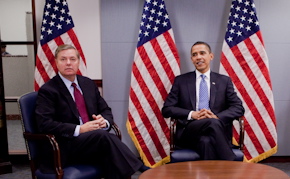
obama-and-graham

20090114_JRB_LG_BO-4206


What’s all the nonsense about Obama struggling?

The man is 47, has a sharp mind that is suited to judgment of competing ideas, makes speeches at the level of John F. Kennedy and Ronald Reagan, has a sensibility that is not so populist as to be deluded, and not so elite as to have lost touch.  He has simultaneously minority and elite status and has a genuinely all-American work ethic and positive disposition.

He begins his presidency with 58 or 59 Democratic Senators (depending on when Al Franken stops telling jokes and shows up for work) and two popular moderate and less partisan Republicans from Maine, Olympia Snowe and Susan Collins, who are not likely to stand in filibuster against him.

In the House of Representatives, Democrats number 262 to the Republicans 178, which means the President can lose more than 40 Democrats and still pass his agenda in the House.

President Obama has spent the last two years invigorating public participation and activating Democrats to tune in and take a stand.

The choices before him are complex and the problems not easy to solve.  The President has shown in just three short weeks that he is not beholden to anyone.  Liberals are irritated by his centrist nominations.  Republicans challenged his stimulus bill and lost.  Obama demanded a fast response from congress and he got one.

His decisions may or may not solve the credit crisis, real estate market collapse, or spiraling recession, but he certainly is in command.  Franklin Roosevelt made many false steps working through the Great Depression.  In the end, his policies eased the pain, but it was the publicly financed industrial development during World War II that threw off the slump and earned the United States an economic rebirth.

So too Obama may have to readjust course as he evaluates the effect of his administration’s approach to economic difficulty and the country walks a tight-rope.  When he does, critics will attack his every misstep, but if there is any clarity to be gained from his first weeks in office, it is that he will retain command.  Anticipate that this President will respond actively, and until the next election, without gridlock tying his hands.

Temporary Bank Nationalization


Money

Image by http://www.flickr.com/photos/gi/388322867/; license under creative commons


I believe it is likely that President Barack Obama and his Treasury Secretary, Tim Geithner, will move to nationalize one or more major banking institutions in the coming weeks. 

This would be a controversial step for the new administration.  And a courageous one. 

The very idea of nationalization is so antithetical to free market economic principles, that this article is bound to illicit alarm and condemnation.  And rightfully so.  Nationalization, especially on this scale, must truly be a last resort.

The two most likely targets are Citibank and Bank of America, with an estimated combined worth of more than $100 billion.  Two banks that are “Too big to fail.”

These banks are also very likely insolvent.  

The Bush administration tried to solve immediate financial problems by investing through the Treasury’s previous $700 billion bailout fund.  Bank of America and Citibank (Citigroup), in addition to receiving their portion of the bailout, also required many additional commitments to insure against losses.  

Lately, the press has focused on scandals over executive pay, lack of accountability for public funds and concern that banks were not doing their part to extend credit. These may be valid, but they obscure the concern that the investment, to date, does not appear to be enough to keep the banks operating.  

So the government has a choice.  

Continue to invest more taxpayer funds, in hopes the tide will soon turn, or face the music and take over the failed entities.  It would be one thing if we were near the end of this recession and the funds were just a bridge to an inevitable recovery, but we’re not. 

Unfortunately, predictions for 2009 are bleak, and as finances go, so does the viability of banks.  A significant rise in unemployment risks another round of foreclosures and a further weakening of bank mortgage portfolios.  

In this light, nationalization is courageous.  With banks insolvent, doing anything else simply puts off the reckoning for a later date.  

Nationalization does not eliminate financial risk, but does give the government the sole right to collect from the sale of bank assets when they are returned to private hands.  

Under this scenario however, current shareholders would most likely see their interests wiped out.

The Obama administration’s plan to support the real estate market is still unknown.  A dramatic act could conceivably stop the mortgage weakness that continues to weigh down the banks, making the path forward more positive. 

However, for the new administration, there is great political risk.  Already facing criticism for preparing to spend nearly a trillion dollars on fiscal stimulus, some of which looks like pork-barrel politics as it goes through Congress, the administration would face a whole new magnitude of concern for its attempt to run the megabanks.
 

There is no doubt that the administration would only be seeking temporary nationalization.  The new team has professed no desire to control or profit from the business of banking, but does have a few good options.  The banks are involved in so many credit, retail and financing operations that a shut down would be disastrous for an innumerable number of its customers still fighting for survival.  

On the other hand, when the bank is returned to private hands, the government, not the current shareholders, would likely recoup much of its investment.

Let’s unlock politics, where do you stand on nationalization of insolvent banks?

Richard Holbrooke Named Diplomatic Representative to Afghanistan and Pakistan


holbrook-1000-in-small

Photo of Holbrooke and Russian General by Estonian Foreign Ministry, licensed by creative commons

President Barack Obama has named senior statesman Richard Holbrooke to be the diplomatic shepherd of American foreign policy interests in Afghanistan and Pakistan.

Ambassador Holbrooke has a wealth of experience and international stature, which will serve the administration well in its effort to achieve maximum impact through renewed diplomacy.

The conflict in Afghanistan, now in its eighth year, is likely to rise in priority as the United States draws down the number of troops needed in Iraq and redeploys some of those forces to Afghanistan. The last two years have also seen a resurgence of Taliban and anti-government forces, threatening to undermine the coalition efforts to support national government authority and regional stability.  

President Obama has already begun planning for troop and supply increases to aid the coalition in Afghanistan.  Holbrooke will be deeply involved in supporting and assessing the “smart power” marriage of development, governance and cultural progress with security and offensive war-fighting operations.  

Holbrooke has extensive State Department experience in Asia and Europe, culminating in positions as Ambassador to Germany and subsequently to the United Nations under President Bill Clinton.  He promoted the expansion of NATO and its participation in the 1990s’ conflict in Bosnia. 

Recognizing, the symbolic power of American leadership was at stake in the intervention, Holbrooke stated“[this] will be the key test of American policy in Europe.  We must therefore succeed in whatever we attempt.”  He brokered the lasting peace deal in the Bosnian conflict which resulted in the Dayton accords.

In 2001, as Holbrooke left the post of U.S. ambassador to the United Nations, he said, “Iraq will be one of the major issues facing the incoming Bush administration at the United Nations.” 

Further, “Saddam Husseins activities continue to be unacceptable and, in my view, dangerous to the region and, indeed, to the world, not only because he possesses the potential for weapons of mass destruction but because of the very nature of his regime. His willingness to be cruel internally is not unique in the world, but the combination of that and his willingness to export his problems makes him a clear and present danger at all times.”  

More recently, in the face of ongoing violence in Iraq, Holbrooke called for a “new diplomatic offensive in the Gulf region to help stabilize Iraq.”

Holbrooke’s negotiating experience with parties in armed conflict may help navigate the complex issues Pakistan adds to Afghan regional security.  In the last two years, Taliban insurgents have relied on supply and manpower from neighboring Pakistan to renew and sustain offensive operations.

Meanwhile, Pakistan has had growing political instability and violence as a result of its own extremist factions. Recent terrorism in Mumbai, India, further illustrates that Pakistan is exporting terrorism beyond its borders and that the government has been unwilling or unable to effectively police insurgents.  

Holbrooke will begin intensive discussions with the recently elected leadership in Pakistan on a wide range of security issues.

Also regarded as forward-thinking, Holbrooke was among the first to focus official U.N. consideration on AIDS/HIV in African programs in 2001.  Subsequently, the Bush administration embraced a major commitment to AIDS/HIV treatment, widely regarded as one of the administration’s most successful humanitarian achievements.

War Crimes for President Bush?

Originally published February 4, 2009, at politicsunlocked.com

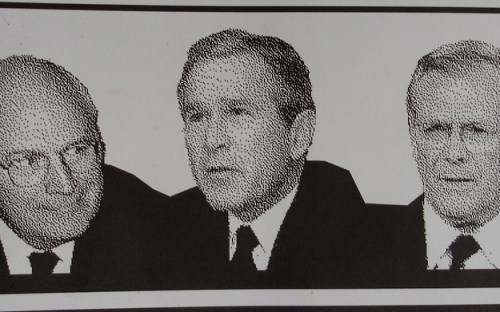
Cheney, Bush, Rumsfeld

Dick Cheney, George Bush, and Donald Rumsfeld

Photo by milesgehm; licensed creative commons http://creativecommons.org/licenses/by/2.0/


The recent executive order issued by President Barack Obama, aimed at opening more presidential records to the public, has renewed discussion of the potential investigation and prosecution of Bush administration officials, including the former President himself.

Talk show host Rush Limbaugh has gone so far as to call the executive order ‘not American,’ foreseeing a media frenzy to find evidence of war crimes against former President George W. Bush.  

In its own right, the executive order, geared toward opening presidential records to scholars and journalists, is sound policy aimed at making government “of the people” more accountable.

Prosecution of George Bush, Vice President Dick Cheney, Secretary of Defense Don Rumsfeld, or other former Bush administration officials would certainly be a colossal mistake.  

Prosecuting leaders who make unpopular decisions, instead of removing them from office by electoral vote, undermines the office of the Presidency and the democratic process itself.  The belief that such prosecution would be objective, outside politics and justified by the death and destruction in Iraq or detention facilities around the globe, is simplistic.

The decisions of George W. Bush and his administration, in response to 9/11, in protecting the nation’s securitythrough the conduct of foreign wars, through surveillance, investigation, prosecution and detention, were exactly the kinds of profoundly difficult choices that those in high office are required to make.  True, they didimpinge upon the rights and freedoms of citizens and treat some non-citizen detainees brutally.  And while we may disagree, we should not underestimate the dilemma inherent in such decisions.

The President must lead in the face of rival and enemy nations, competing ideologies, religious and ethnic strife, economic turmoil and natural calamity.  At stake is the freedom, prosperity, justice and dignity of not only 300 million Americans, but also that of the nations with whom we cooperate, guide, and in many cases, help protect.

Balancing individual rights and national security is the President’s responsibility.  There are counterbalancing institutions of Congress and courts, but they generally exist to provide legislation and oversight, constitutional interpretation and protection of individual rights.  It is not perfection we seek, but balance.  

Barack Obama expressly campaigned against controversial Bush administration policies on Iraq, detentions and torture.  His election represents a shift in policy — a sign that the democratic system is working. 

Using civil or criminal courts against Bush administration officials, even in the belief that laws have been broken, will be political and would devastate our governmental system. 

The actions of the former President have outraged many, but cannot be equated with the war crimes or genocide for which international criminal laws have been devised.

Stimulus: Feel Good Spending v. Investment in the Future

1037301_431

By Marc Seltzer; Originally published on February 5, 2009, at care2.com

. .

There is no question that Barack Obama’s plan for creating jobs will ease the pain of this economic downturn.  However, in the long term, not all jobs are equal.

There are examples from the past of public spending programs that employed many Americans and paid off handsomely.  Constructing the interstate highways cost 114 billion dollars (adjusted for inflation, upwards of 425 billion) and employed hundreds of thousands over 30-plus years.  The result facilitated interstate commerce greatly, contributing to American’s industrial and commercial success and prosperity.

John F. Kennedy’s Mission to the Moon likewise employed hundreds of thousands in the effort to send a man to the moon during the 1960s.  The payoff was in leadership in science and engineering and advances in aerospace and communications technology, which have transformed our economy and way of life.

It is against these examples that our current spending proposals in congress should be measured.  Building and repairing roads today will no longer transform the industrial or productive capacity of tomorrow.  Even repairing bridges, some badly in need, though valuable, will not multiply the economic gains through new industrial and commercial success.  Roads and bridges are important, but they should simply be included in existing infrastructure plans to be paid for where they bring value within government budgets.

What does measure up?

The types of public spending that could bring jobs now and prosperity in the future are those that successfully address current economic problems.  For example, nationally, we spend far too much money on health care for the services that we receive.  We could put doctor and insurance records on line in a step towards better managing our system and we can spend more now on research and development from pharmaceuticals and cancer to genes and stem cells with an aim to achieve cost-effective health benefits.

Similarly, in urban centers we spend too much time commuting in traffic, lowering our productivity.  Investment in substantial urban public transportation, such as a comprehensive Los Angeles Metro system and smarter choices nationwide, could make a real difference in long-term productivity and savings in pollution and energy costs.

We also need clean energy that is competitive with oil, which has been economically efficient but environmentally costly.  This might take 10, 25 or even 50 years to develop.  But the investment would pay off in securing new affordable energy that was less environmentally harmful and creating a new commodity that we make and trade rather than import to our detriment.

Most importantly, our education is failing to produce a new generation that can lead the world in science, technology, research and all the other fields of importance to our continuing leadership and prosperity. Our commitment to education can’t fluctuate with the cycles of the economy unless we accept that our leadership in the 21st century will waiver.

Investment in any of these fields, that are designed to enhance productivity and profitability of public and private activity, will increase value.  In many ways the other spending included in the stimulus bill is just a temporary fix with long-term negative budget-deficit consequences.

In this light, both Democrats and Republicans have it wrong.  Spending on anything but investments in the future is wasteful–tax cuts ease the pain, but do nothing extraordinary for the future health of the nation.

We can certainly provide unemployment insurance as a safety net for the many who are suffering, but the stimulus bill must aim for productivity and prosperity in the future economy or else it robs us of our precious resources without laying the foundation for sustainable improvement.

Senate Membership Roller Coaster


The Magic Number for Cloture Ending Senate Filibusters

The Magic Number for Cloture Ending Senate Filibusters

By Marc Seltzer; originally published on February 3, 2009, at care2.com

. .

On the way to sixty — the twists and turns on the way to the Senate.

Leading up to the Presidential election in November 2008, Senate watchers were wondering how close the Democrats would get to the magic number of 60. It takes sixty Senators, under cloture rules, to cut off debate, and proceed to a vote, even where a simple majority of Senators favor passage. There have been arguments over the validity of the filibuster rule itself (essentially a minority party bargaining chip), but it has withstood challenge in the Senate for more than a century. With no filibuster rule in the House and significant Democratic majority expected, the Senate numbers represented the only Republican check on free reigning democratic legislative authority until the 2010 congressional elections.

And so, as the Democrats went into the election with assurances of picking up seats under the sway of Obama’s popularity, Bush’s dismal ratings, looming economic meltdown, and 23 Republican incumbents facing re-election, all eyes were on the numbers.

Essentially, the Democrats needed 9 to reach sixty (two Senate independents side generally with the 49 Democrats). And they got six. Six, that is, on November 4. But that left Alaska, where the longest serving Republican, Ted Stevens, ahead in the count, had been indicted on corruption charges and was being asked by his own party to resign. And Republican Norm Coleman of Minnesota, who only ended up ahead by 230 votes, triggering an automatic recount and analysis that the types of voting machines and propensity for errors, which are corrected by the recount, gave the Democrat Al Franken real hope.

The other Senate changes, first and foremost, Barack Obama’s Illinois Senate seat, and Joe Biden’s Delaware seat, would not change the Senate make-up because Democratic governors of Illinois and Delaware would appoint Democratic replacements. (Though no one could have predicted that Illinois Governor Rod Blagojevich would be caught on tape seemingly trying to exchange the appointment for the greatest personal gain, would be indicted, impeached, and removed from office, soon after the seat was filled).

Further change in the post-election Senate make-up came from the appointment of Hillary Rodham Clinton, replaced finally by Democratic State Senator Kirsten Gillibrand.

Meanwhile, on November 18, the final count in the close Alaska election reversed Ted Steven’s early lead and put Anchorage Mayor, Mark Begich, in the Senate as Democrat 58.

After further wrangling about erroneously uncounted absentee ballots in Minnesota, ballot challenges and final recount tallies were in, the Minnesota Canvassing board declared comedian Al Franken the victor over Norm (not laughing) Coleman. Republican Coleman has challenged the final tally of 225 votes in Franken’s favor, but Democrat Franken is on his way to being Senate Democrat number 59.

And so it would have remained, except that President Barack Obama’s Commerce Secretary nominee, Gov. Bill Richardson of New Mexico, withdrew from consideration in the face of an investigation, and Republican Senator Judd Gregg of New Hampshire will be nominated instead.

The political dynamic is momentous. On the one hand, Sen. Gregg serves in a state with a Democratic Governor, John Lynch, who would ordinarily choose a Democratic replacement. This would represent the magic 60 in the Senate. Republicans have said that Gregg should not take the position in this situation.

On the other hand, the Commerce position is an important one and one which a Republican advocating free market principles will find especially significant during the economic downturn. There is already talk of protectionism creeping into stimulus legislation and the Commerce Secretary would likely take the lead in advocating against protectionism at home and abroad.

And so, like the best of roller coasters, with unanticipated twists and turns, we have to wait for one more appointment to finally determine the make-up of the 2009 Senate. New Hampshire Governor Lynch is indicating that his appointment will not change the Senate’s party politics.”I will name a replacement who will put the people of New Hampshire first and represent New Hampshire effectively in the U.S. Senate.”

To some extent the numbers will be of symbolic significance since the most moderate of the Republican Senators, such as Maine Republicans Olympia Snowe and Susan Collins are not likely to join a filibuster against the President except in exceptional circumstances. But with talk of bank nationalizations, deficit-fed stimulus and promises of dramatic change in Washington, these are exceptional circumstances.

A Time for Financial Regulation

Time-for-Financial-Regulation1_large

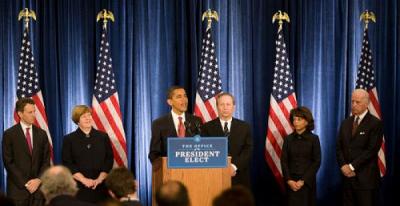
Photo credit: Obama-Biden Transition Project, licensed under creative commons

Originally published on January 28, 2009 at politicsunlocked.com

President Obama’s financial team, including Paul Volcker, Chairman of the Economic Advisory BoardTim Geithner, Treasury Secretary, Larry Summers, head of the National Economic Council and Austan Goolsbee, Advisory Board Economist, hit the ground running with a comprehensive plan for financial reform geared at filling holes in the existing regulatory system.


The plan is separate from the much discussed stimulus package before congress and provides no bailout, tax cuts or government spending to help the economy.  Yet this plan is a bold act of reasonable and necessary regulation designed to bring the government up to speed in its oversight of the financial industry.  

Against Abuses and Mismanagement, Not Free Markets

The plan calls for:

1. Increased oversight on the part of the Federal Reserve and regulatory agencies such as theSecurities and Exchange Commission.

2. Federal standards and scrutiny of insurance companies, mortgage brokers, hedge funds and credit rating agencies.

3. Oversight and listing or trading through a clearing house or exchange for derivatives and other financial instruments. 

4. Higher capitalization requirements for banks and large investment companies.  

The plan addresses specific concerns which led to some of the biggest financial scandals in history.  

Two points of focus are eliminating conflicts of interest which allowed financial rating agencies to profit from transactions with the institutions they themselves rated and limits on executive compensation for companies receiving federal bailout dollars.

Much of this regulation can be imposed by the executive branch, but some will require the passage of new legislation.  A general belief that significant failings in government oversight led to the current financial crisis is widely held, but even so, new legislation may run into opposition from those opposed to any and all government regulation of markets.  However, support for the proposed rules is coming from many corners of Washington, including Republican political circles.

The Group of 30, a respected committee of governmental and industry representatives, published a report on January 15th, 2009 calling for dramatic regulation and reform similar to the Obama administration plan.  This should be no surprise, as the commission was headed by Paul Volcker, a longtime Obama advisor prior to being named Chairman of his Economic Advisory Board.  Early reviews of the commission report and the administration’s plans are positive. 

Too Much Government Interference?
While there is a risk that new regulation will slow otherwise healthy investment and financial activity, something obviously needs to be done, and there are reasons to have faith in the proposals.  

The new administration’s economic team has a strong free-market philosophy.  The fact that these free-market economists are proposing stricter regulation is a testament to their certainty that the market is not able to correct itself.  The free reign of financial entities created layers of financial miscalculation and mismanagement which now threaten to collapse the entire economy.  

Those concerned that regulation of the financial industry is a move toward Socialism should rest assured that the regulations proposed are no bailout or nationalization.   These rules aim to stop financial mismanagement and criminal fraud rather than affect the redistribution of wealth.

While the traditional view is that stricter regulations do nothing to aid an economy in recession, our current problems may be the exception.  

Much of the distress in the credit market is a result of a failure in confidence.  This lack of confidence surrounding asset valuation, as well as the essential underlying health of the financial system, calls for the imposition of strict, yet reasonable regulations.  Such reform may indeed signal a return to responsible management and begin to restore shaken confidence in the financial system.

Obama Faces an Auspicious Beginning

By Marc Seltzer; originally published on January 19, 2009, at politicsunlocked.com

. .

Four Faces on the Wall

While I was visiting with friends over the holidays – and being treated to delicious homemade tamales – the conversation eventually turned to President-elect Barack Obama.  My friend’s entire family was very excited about Obama, especially since one member of this Mexican-American household had recently taken a position in Washington D.C., working in the Congressional Office of Representative Linda Sanchez.  Soon, one of the children appeared, proudly showing an autographed picture of Mr. Obama.

My friend explained that each generation of the family had placed a portrait on the wall.

Older Mexican Americans, she continued, traditionally have a picture of the PopeCatholicism is the majority religion in Mexico and much of Latin America, and the Mexican-American community maintains their Catholic identity in the United States.  In fact, the immigrant communities in the U.S. have continued to embrace Catholicism, while many in the general population have lessened their bonds with Church traditions.

The second picture was of President John F. Kennedy.  For those old enough to have experienced the election of the first Catholic President of the United States, Kennedy represents the elevation of the Catholic minority in the United States to the mainstream.  Kennedy was also a charismatic orator remembered for inspiring calls to service, guiding the United States though the risk of nuclear confrontation with the Soviet Union during the Cuban Missile Crisis and for proposing to send a man to the moon within ten years.

The somewhat younger generation had placed a portrait of former President Ronald Reagan.  It was during Reagan’s second term that immigration reform legislation allowed millions of immigrants living in the United States illegally to file for legal status and, eventually, citizenship.

The “Amnesty” program, as it was called, offered millions of Mexican Americans, and other undocumented residents living in the United States for at least five years, improved legal and social status and economic opportunity.  Many of the political achievements of the Latino communities in the United States date from this period, as those who had remained politically quiet, gained a voice and seat at the table in American politics.  Reagan’s passionate belief in a “new dawn” of individual opportunity resonated with our new citizens as it did with Americans on Main Street.

These esteemed figures present very different worldviews, but they are all deeply revered by their followers.

The fourth picture on the wall was none other than Barack Obama.

But is it a surprise that Barack Obama is so honored, even before taking office?  Like the other three, the President-elect moved audiences worldwide with his charisma and eloquence, addressing our common problems with faith and vision.

To many, Obama’s election represented, in itself, the rise of the underdog, despite challenges, to the heights of possibility.  Seeing themselves in Obama, children of the world are looking at what this man accomplished and seeing that any individual can strive to greatness.

Obama, Choose Your Battles

Photo credit: Amir Farshad Ebrahimi; license http://creativecommons.org/licenses/by/2.0/deed.en

By Marc Seltzer; originally published on January 9, 2009, at politicsunlocked.com

. .

Obama is undoubtedly feeling the pressure, felt jointly in capitals around the world, to help end the conflict in Gaza, where a fierce Israeli military operation, has resulted in significant death and destruction.

The U.S. has traditionally played a major role in facilitating negotiations throughout Israeli-Palestinian conflicts.  The deeply divisive and longstanding battle goes to the heart of the security and future of the state of Israel and rights to statehood and autonomous homeland for the Palestinian people.

However, despite the best intentions, the conflict in Gaza will not be solved easily.  At this point, President Obama’s involvement risks squandering substantial energy and political momentum desperately needed for domestic reforms.

A lesson from history

Republicans will remember:  The first significant act in office for President William Jefferson Clinton was to revisit the military ban on service by gay soldiers.

It was January 1992, and Clinton took on his own Joint Chiefs to establish a new compromise policy, commonly known as don’t ask, don’t tell.  Merits of the reform aside (which allowed many soldiers serving honorably to continue service) it angered the political right, which took sights on the Clinton Presidency and never looked back.

In retrospect, the action cost the Clinton Presidency dearly.  Despite significant improvements in welfare reform, balanced budgets and economic prosperity during his presidency, the Clinton Presidency never ceased to arouse conservative ire.  The animosity from the right dogged the President in office, played a role in Al Gore’s unsuccessful Presidential bid, and may have lingered into the campaign of Hillary Clinton, eight years later.

All this comes as a warning to President-elect Barack Obama:  Choose your first battles carefully.

Global perspectives

Obama would do well to remember that the U.S. is involved in other conflicts throughout the world, some demanding presidential attention. India, Pakistan, and Afghanistan, for example, have a joint population of 1.3 billion people, with robust nuclear arsenals in the first two and an ongoing U.S. military operation in the third.  All have recently been unwilling hosts to tragic terrorist violence directed against civilians.

While sympathetic in their distress, the civilian population of Gaza remains less than 500,000 people. Israel, and the greater Palestinian population number less than 8 million.

Barack Obama has spoken solemnly about his commitment to the faltering U.S. economy, the foundation of this nation’s prosperity and security.  His steady hand convinced voters that he was best candidate to keep a nasty recession from turning into something historic and much worse.  Americans will be looking to President Obama for leadership.

At least at the outset, Obama must avoid any temptation to solve all the world’s problems.  Being drawn into negotiating a cease-fire in Gaza risks squandering the new administration’s goodwill and focus.

Barack Obama’s Political Philosophy

Photo by Aaron Muszalski; licensed http://creativecommons.org/licenses/by/2.0/

By Marc Seltzer; originally published on December 15, 2008, at politicsunlocked.com

. .

A new political party has appeared on the American scene. It is the Pragmatic Party and Barack Obama is its leader. The platform is so new and disconcerting that many have not yet wrapped their minds around the implications.

What his critics fail to understand is that Obama is not just about be-nice politics.  He’s about practical solutions rather than simplistic party ideologies.

After two years in the national spotlight as a transformational candidate – captivating audiences, filling stadiums and talking straight about his priorities (the middle class, economics, health care, education) people are still asking if he has been clear and upfront with his politics.

One month into the transition, carrying references to Lincoln, FDR and Ronald Reagan, people are showing surprise with his cabinet picks.  In despair, some suspect a closet conservative, while others are hoping for a liberal double agent.

Some Republicans are calling him a socialist, while Fred Barns in the Weekly Standard observes “he’s pragmatic so far in one direction, rightward – who knew?”

The public went along with the old-style reporting it seems. 68 percent of Americans polled expected Mr. Obama to be liberal. They have their reasons. Mr. Obama ran as a Democrat, after all. In our essentially two-party system, if Obama had run on a new third-party platform, he might have received 4 or 5 percent of the vote, or because he sounds remarkably intelligent, 12 percent tops. Obama ran instead as a Democrat, a pragmatic choice it seems, since he won 53 percent.

It’s also true that minority candidates are often champions of more progressive political parties and organizations, which traditionally labored to advance rights and protections for disenfranchised groups. True, but Colin Powell and Condoliza Rice, not to mention Clarence Thomas, were all Republican administration appointments.

Jessie Jackson ran for President in 1984 and 1988 on a rainbow coalition for a new kind of inclusiveness. He may have paved the way in part for the Obama presidential bid, but in sharp contrast, Barack Obama, ran on behalf of the middle class.

On the other hand, the University of Chicago, where Obama taught Constitutional Law, is a center of free-market economics.  Note too, that Obama’s selections for his cabinet and crew in economics and foreign affairs are centrists.  Centrists can adopt policies from, and forge policies which appeal to, both sides of the political spectrum, without being called traitors.

There is still no approved vocabulary for describing pragmatism in politics.  What’s that Berkeley’s Professor Lakoff said, until there’s a metaphor, there’s no word and no thought?

It’s about time that someone described this new party to the pundits so that they can start using its lingo in their coverage. Not that the President Elect has been hiding anything. He has said on more than one occasion, that he is looking for “what works,” or, when things look really bad, “whatever works.”  Let’s start describing policy, not for its political effect, but its accomplishment on the merits.  The words “results oriented” and “consequences” come to mind.

“Pragmatic,” in this context, is the opposite of ideological. Democrats and Republicans aren’t always ideological, but often are, with important consequences.  The mantra “Government regulation is a drag on the economy” rings a bell.  The notion of raising taxes to balance the budget during a recession is not quite ideology, but it is cured by pragmatism, none-the-less.  Pragmatism works against ideology and lunacy, it seems — an added benefit.

What should we expect from the Pragmatic party? It’s hard to say, but we should expect an Obama administration to look to the facts and circumstances of the problems we face, rather than applying ready-made doctrines from yesteryear. Obama doesn’t seem to care whether a policy is liberal or conservative; he seems to believe it is more important to talk about whether it will accomplish its goals. It turns out that many of the liberal v. conservative debates have already been, well, decided.

Take, for example, raising taxes.  This is done to balance budgets, but also to fund entitlements and spending programs.  Obama’s appointment to head the Economic Council of Advisors, Christina Romer, recently published a serious historical analysis showing that tax hikes measurably retard economic growth.  A pragmatist will have to weigh how much the revenue is needed in the short term against the eventual harm to the economy and resulting loss of revenue over the long term.  Not very exciting in a televised debate, but logical, maybe even “good government.”

Better let the economists calculate the optimal results, rather than have politicians debate raising taxes vs. lowering taxes, without really knowing what they are talking about. Politicians with ideology don’t actually have to know what they are talking about, but pragmatists do for they are only as good as the results obtained by solutions they propose.