Tag Archives: democrats

To Protest or Reform — Who’s Messing with Our Minds?

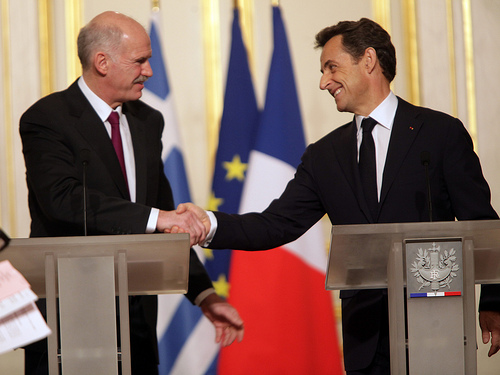
(photo:  Greece’s P.M. Papandreou and France’s Sarkozy in Davos, Switzerland, recently, managing economic turbulence)
. .
By Marc Seltzer; originally published on March 19, 2010, at care2.com

. .

There is still a strong undercurrent of anger in the United States about bailouts and stimulus spending.  Republicans, and even Democrats and Progressives, have reacted angrily to President Obama and his financial team.  This is significant because President Obama lost political capital on the economic recovery plan, and has far less power now to push though health care, education and financial reforms than he would have absent these actions.

The common critique from the Right is that Mr. Obama is moving in a socialist direction, while from the Left it is that Geithner, Summers, Romer and Bernanke, the U.S. government’s economic chieftains, are corporatist and beholden to the bankers.

More puzzling than the conservative complaints about the administration’s stewardship of the economy, is the Left’s opposition to it.  A significant part of the Democratic party seems to believe that our current leadership is on the side of the wealthy in a new class struggle, and that the government bailouts have effected a transfer of wealth from the little guy to the fat cats.  To be fair, this antagonism towards saving the financial system is in part a more structural distaste for corporate political and legal power — unrelated to recent U.S. government actions.  None-the-less, Obama is now trying to enact reforms in this across-the-spectrum, anti-government political climate.

To challenge the idea that Obama’s actions were pro-bank, pro-corporate, or designed to bail out the fat cats at the expense of the public, I want to compare the European response to the financial crisis with U.S. actions.  European nations, often called “social democracies,” are respected by the American Left and cited as examples for their stronger safety net of worker protections, health care and liberal benefits.

Jean-Claude Trichet, the head of the European Central Bank, equivalent to our Federal Reserve Bank (Ben Bernanke), said recently about American and European government interventions:

“We had to put on the table on both sides of the Atlantic around 25% of taxpayer risk to avoid the Depression, a major Depression, which would have come had we not been that bold.  When I say we, I mean the governments.  Of course, the central banks also have been very bold, in engaging in non conventional measures — the Fed and us [European Central Bank].”  (Bloomberg on Demand, March 12, 2010, from interview with Tom Keene)

What is insightful here is that European governments and related institutions behaved much as the American government did.  As the New York Times reported in early 2009:

“So far, Europe’s largest economies, France, Germany and Britain, have been spared demonstrations. All three governments have introduced huge stimulus measures aimed at spurring employment and protecting banks.

Regardless of the outcome, the three countries will face large budget deficits and higher state borrowing, which economists say will be passed on to taxpayers. And in the case of France and Germany, the governments could find it more difficult to introduce bold reforms at a time of recession.” (New York Times, January 26, 2009.)

To be sure, European nations have faced public protests over the past year, including demonstrations in recent weeks against the Socialist government in Greece.  And modern European nations are a mix of strong state intervention in industry and free markets.  But despite their more left-leaning perspectives, European government actions to save banks and support their nations’ economies with emergency stimulus spending, resemble US approaches.

The underlying reason for this is plain: Healthy economies require healthy banking systems.  The only other option for lawmakers in 2009 would have been to nationalize, through government takeover, the major banks and investment companies.  This would not only have been too radical for a young American President in the first days of his Presidency, but was not favored by European nations, which, despite more Socialist political visions, prefer to keep most individual businesses in the hands of private owners.

It is as much of a stretch to believe that Barack Obama, community-organizer-turned-politician, attained the Presidency in order to embrace the rich and powerful over the little guy, as it is to draw the conclusion that the Socialist and left-leaning governments of Europe transformed in 2009 into standard bearers for corporate and special interests across the Continent.

Why the American Left should find itself so opposed to the positions of both European and American governments requires little guesswork.  The greed, irresponsibility and power in the financial system made the public angry.  The Republicans, with little post-election political power and prospects, turned anti-corporate anger into anti-government anger with some clever “grass roots” anti-Democrat marketing messages.

Now, instead of joining the administration and embracing reforms, many a Democrat flirts with anti-government energy, which is really just self-serving partisan manipulation pushed by the Republican party.

Democratic Congressman Dennis Kucinich, in discussing his last-minute decision to vote for the President’s health care reform, acknowledged the tension between pressing for progressive reform and falling into a trap laid by the opposition:

“With three years left in the Obama Presidency we have to continue to encourage him, but we’ve got to be careful that we don’t play into those who want to destroy his presidency and say, you know, the birthers and others who say he should never have been President to begin with.  There is a tension that exists. . . .  we have to be very careful about how much we attack this president even as we disagree with him because we may play into those who just want to destroy his presidency.”  (Democracy Now!, March 18, 2010 (radio interview with Amy Goodman))

Careful indeed!  It’s about time.

Universal Coverage or Maintaining the Status Quo?

Photo credit: cdc.gov

By Marc Seltzer; originally published on March 13, 2010 at care2.com.

. .

For all the smoke and mirrors, all the outrageous claims, and all the frustration about what is not in the Democrat’s health care reform legislation, the fundamental impact of the proposed reform is very simple.  The Senate bill, soon to be voted on by the House, uses public funds to insure Americans who do not have insurance.  (Making sense of the polling, from the Washington Post)

In providing for universal coverage, it satisfies President Obama’s preeminent campaign goal — one he has not walked away from despite profound economic turmoil and deep political resistance.

It is amazing that the debate over such a simple idea took so long and involved so many distractions.

Republicans do not want to spend public funds to insure the uninsured — plain and simple.  Though they do not say it so clearly, instead, hiding behind claims that the deficit, the recession, and public opinion polls are the reason that the bill is wrong for America.

Smoke and mirrors.  (Krugman dispels some myths)

President Obama seeks to add an entitlement, consistent with contemporary democratic principles of capitalism with a social safety net.  Republicans, consistent with principles of individual effort and individual reward, seek to resist it.

What is more puzzling is why the left is so fractured in its desire for reform.  There has not been a serious proposal for an open-enrollment public option or for single payer public insurance on the table since the beginning.  This is not to say that the United States wont move towards public insurance or public medicine in the long run.  But with only a subsidy and insurance regulation on the table, the left’s threats to undermine President Obama’s universal coverage program because it does not do away with the for profit medical system makes little sense.

What would make sense is to take a longer range view:  To believe that universal coverage is an important step in the direction of providing good care for all; to trust that reforms included in this legislation can be used to regulate for-profit insurance practices to eliminate exclusions and rescissions which kept people who wanted insurance from receiving it; and to recognize that a variety of reasonable cost-containment measures will be used to slow the growth of health care inflation.

I have written often about deficits and debt, reform of fee for service medicine and changing financial incentives in health care.  And I think this legislation is serious medicine for the problems we have in these respects.  And I have spoken with Canadians and Europeans who love their publicly funding health care systems.  And I still think that this legislation is a serious attempt to insure that all Americans can receive adequate health care.  If I were like most supporters of this health care reform, I would say that this legislation is poor, for one reason or another, and then suggest that it was the best we could get under the circumstances.  But this legislation is powerful, historic and designed to solve the problems we face.  So why, complain?

Pass the bill.

(Sign the petition)
. .
More thoughts on national issues: my podcast ramblings and conversations with Jessica Pieklo.

March 19, 2010 Update:  Paul Krugman sounding more positive, as well, in the New York Times.

President Obama Achieving the Possible

By Marc Seltzer; originally published on December 20, 2009, at care2.com

. .

I, for one, would like to see a re-energized Republican party.  I don’t think its good for America when one party has lost its way and we have to rely, at least temporarily, on the leadership of only one political team.

I rather like medical malpractice reform, a piece of the current Republican puzzle.  If Republicans could coalesce around a message of discipline and sacrifice for the common good on post-recession budgets — and maybe cleaning up the terrible problem in states that elect judges without asking them to recuse themselves when they preside over the cases of their campaign donors, they could have the beginning of a party platform.

Instead, I had to read in the NY Times today that the Republican response to President Obama’s efforts to reach reasonable and practical agreements to reduce international pollution and to the President’s leadership on health care — again seeking compromise in order to achieve what is possible — is that the President should only be working on the economy.

As if it weren’t bad enough that the Republicans have opposed serious efforts at health care reform — including opposing the current reform package that takes significant steps at cost control, while providing health care to those priced out of the system.  (The New York Times reported “the $871 billion cost of the bill would be more than offset by the new revenues and cuts in spending, so that it would reduce future federal budget deficits by $132 billion between 2010 and 2019” per the CBO.)

As if denying that environmental pollution could have a global impact, and claiming that serious scientists doing their best to understand and report climate change were balanced by a far smaller number of skeptics, many of whom represent polluting interests, wasn’t holding America back.

Now the Republican message is that the President of the United States should not do more than one thing at a time.  No matter that the nation is at war, that China presents capitalist competition at a whole new level, that environmental damage is not bound by borders and China, India, Brazil and the like are industrializing fast, that regulation of our private financial system needs obvious overhall and that the great gains in productivity and commerce of recent years got absorbed into rising health care costs rather than making our products more competitive on the international market or our workers better paid and businesses more profitable.  The Republicans want the President to address no more than the economy.  And on the economy, they want unregulated markets, without government action.  In other words, laissez faire, and let the chips fall where they may.

This President is tackling real problems in the economy, health care, and national security, and laying the groundwork for longer-term progress on environmental protection, education, and financial regulation.  His administration is developing new partnerships in international cooperation in keeping with changes in the dynamic power and nature of world nations.

Take for example, the health care compromise aiming to garner 60 votes in the Senate.  It will be picked on mercilessly by those who wanted something more or something less.  Some will say it does nothing and others will say it remakes the American economy into a socialist order.  But read the basics of what it achieves and think.  It offers an estimated 30 million people, who were rejected from or priced out of health insurance, the opportunity to obtain coverage.  It subsidizes low income wage earners and it taxes enough of those parts of the health care industry that are subsidized and overused to achieve significant cost-cutting.  It has features which draw the praise of economists like Paul Krugman. See his recent NY Times op-ed “Pass the Bill.”

The fact that Mr. Obama speaks well and that he uses expressions, such as “don’t let the perfect be the enemy of the good,” which turn out to perfectly capture the political dynamic, is a mighty bonus.  The President has clear insight into what realistic progress looks like.  Those who criticize compromise do not, although they may have a point that in the future progress can go beyond what we agree to today.  But we have to start from where we are, and sometimes getting started is the hardest part.  Once we move in the direction of cleaner energy, we can invest our education, creativity, entrepreneurial spirit and regulatory know-how to take us farther than we can now imagine.  Or more dire circumstances may force us to take other measures.  But this is still the beginning.  We are not lacking leadership at the top.  Let’s take advantage of where we are and get started.

To hear my conversation with care2.com blogger Jessica Pieklo on Copenhagen hopes and Health Care votes follow this link and click on the “December 15, 2009 podcast, Copenhagen’s Promise and Health Care Reform Politics.”

The Vice President’s Op-ed is also worth reading:  Joe Biden in the NY Times.

December 21, 2009 UPDATE: NY Times Editorial in favor of the Senate bill.

Obama Approval, Progressive Politics and Democratic Unity

By Marc Seltzer; originally published on November 25, 2009, at care2.com

. . .

Pundits have focused recently on President Obama’s declining public opinion polls.  As the President drops to fifty percent approval ratings, the talk speculates on whether the poor economy will sink Democratic prospects in the 2010 midterm elections.  The economy is important and the administration’s policies will not cure recession blues before the election, but of greater concern is the question of Democratic political unity.

Republicans have criticized the President’s leadership and policies from the get go, but with Progressives attacking the administration and fracturing the President’s base, some of the moderates who elected him are beginning to wonder.  Have the progressives gone off in search of Ralph Nader?

Neither the left nor the right have a majority in national American politics.  The candidate that convinces the pragmatic middle to join the ideological left or right wins both in electing candidates and in charting policy.  President Bush succeeded in maintaining the right-middle coalition between 2000 and 2008.  He used the power he was given to lower taxes on the wealthy, promote hands-off financial oversight, conduct aggressive foreign and military policy and tilt the delicate balance between rights and security not so delicately in favor of security.

President Obama won back moderates in 2008, promising to shift economic policy towards the middle class, embracing government regulation in finance, the environment and health care, and seeking new strategic solutions in international relations.  His is not, in fact, a liberal vision, despite Republican characterizations, but it is a more moderate one than what came before, and one that aims to learn from the experiences of prior administrations.As long as his coalition continues, the President’s approach to taxes and budget, justice and rights, and foreign policy and war will prevail.

However, after nine months in office, it seems the President can no longer count on the Progressive wing for support.  In the guise of influencing the President to move to the left, Progressive critics attack the President and his administration.  Calls for Treasury Secretary Geithner to resign by Rep. Peter DeFazio D-Or are but the most recent example.  The left is also troubled by economic decision-making and the potential increase in troops headed for Afghanistan.  Of course, any coalition will contain different viewpoints.  A goal of our democratic process is for hearty debate to distinguish the best ideas from all others.  But Progressives fail to grasp that the President needs the full support of those that elected him in order to achieve his agenda and present a successful Democratic party to the electorate in 2010 and 2012.  If the party is not unified, the President will not succeed and the power will shift back to the Republicans.

It is only because President Obama joined, at least temporarily, the moderate center of the electorate with the traditional Democratic party that he succeeded in bringing his moderate voice to the fore.

Follow me on Twitter

What can Canada teach us about banking regulation?

By Marc Seltzer and Leslie Schreiber; originally published as “Northern Light” on June 19, 2009, in Commonweal Magazine and at Commonwealmagazine.org.

US Regulatory Reform Follows Canadian Model

. .

Amid the greatest worldwide financial meltdown since the Great Depression, there have been few examples of sound financial management and regulation. Public authorities have had to provide billions of dollars to support ailing institutions and have acknowledged far-reaching gaps in public oversight. Responding to the disastrous bubble and bust, the Obama administration is calling for comprehensive reform. International leaders have even gone so far as to call for the creation of a world financial regulator.

U.S. Treasury Secretary Timothy Geithner, while not going that far, is asking Congress to grant the Treasury broad oversight authority for virtually all financial institutions, and a mandate to monitor systemic risk. Additional proposals seek to insure that financial instruments, such as credit-default swaps, are subject to federal regulation. While Congress will ultimately be responsible for crafting legislation, Geithner’s proposals provide a road map for a new financial order, in his words-“not modest repairs at the margin, but new rules of the game.”

The economic crisis has tested the stability of financial systems across the international community. The results differ widely, from Iceland’s near-bankruptcy to Canada’s remarkable financial health and insulation from risk. Beyond the private gains and losses, the crisis has revealed strengths and weaknesses of different regulatory environments. Remarkably, not a single major Canadian financial institution has needed a bailout. In March, the International Monetary Fund praised Canada’s banks for their “remarkable stability amid the global turbulence.” Howard Kaplow, an investment executive and director of financial services in Montreal, noted that Canadians “tend to be more conservative, but we also have a more restrictive financial authority with tougher rules to follow.” The IMF agrees, commending Canada’s “strong regulatory and supervisory framework.”

In this light one may ask how Secretary Geithner’s proposals for regulatory reform measure up against the Canadian model. Are the Obama administration’s efforts to monitor systemic risk and regulate all substantial financial entities and instruments in line with the Canadian approach?

In contrast to Canada’s conservatism, the U.S. system has gone through a period of “irrational exuberance.” Over the past twenty years, Congress deregulated financial industries in order to maximize business opportunity. New financial instruments, markets, and conglomerates were unleashed without oversight. In a recent debate over the causes of the crisis, New York University Professor Nouriel Roubini (nicknamed “Dr. Doom” for having predicted the current crisis) argued that, “deregulation occurred too fast and in ways that did not provide prudential regulation for provision of the financial system.”

The dominant political ethos was trust in free markets, competition, and modest regulation-even self-regulation. Where regulators did act, they followed a framework that called for distinct regulators in compartmentalized markets. The FDIC has been highly praised for its success at handling the closing of failed banks, but neither the FDIC nor the Federal Reserve had authority to intervene when an investment bank or insurer acted unwisely or teetered on the brink of bankruptcy.

In the end, the failures were systemic and pervasive. They could not be limited to one sector of the financial system, nor were they detected by any existing regulatory agency. In warning that the problems would not respond to a quick fix, President Barack Obama observed that the crisis “didn’t result from any one action or decision. It took many years and many failures to lead us here.”

New regulations were contemplated long before Secretary Geithner was confirmed. Former Treasury Secretary Henry Paulson and the General Accounting Office oversaw substantial groundwork in 2008, but it now falls to Geithner to finish the job. While Geithner is promoting a more comprehensive regulatory regime, the proposals have been developed by financial and market experts and insiders who believe in free-market capitalism. They do not wish to stifle financial innovation. Instead, the aim is to protect the overall system while allowing risk-taking activity to continue. This approach is in line with the Canadian system, where, despite strong regulatory authority, the financial sector has prospered. Today, five of the country’s banks are among the top fifty banks in the world. Ten years ago none of them was.

The lead financial regulatory authority in Canada is the Office of the Superintendent of Financial Institutions (OSFI), currently headed by Julie Dickson. She chairs the Financial Institutions Supervisory Committee, which has broad authority to monitor systemic risk and, for that purpose, brings together regulators who oversee market stability, risk-management, and business practices from across the financial economy. The OSFI mandate covers “all banks, along with federally regulated property, casualty, and life insurers, and trust and loan companies, plus about 10 percent of private pension plans” according to OSFI spokesman Jean Paul Duval. If any of the institutions “raise a red flag, the OSFI can implement a range of disciplinary measures, affecting everything from bank capitalization to controlling assets, and even getting directly involved in business planning.” Indirectly, this also includes securities firms, which are 70-percent bank-owned in Canada (for example, RBC Dominion Securities is part of the Royal Bank of Canada). The OSFI oversees 450 banks and insurers, and approximately 1,350 private pension plans. Its authority, while not reaching all financial institutions (hedge funds are not regulated by the OSFI), is fairly comprehensive and is foundational for the soundness of the Canadian system.

Secretary Geithner told Congress in March that the oversight he was proposing “would include bank and thrift holding companies and holding companies that control broker-dealers, insurance companies, and futures commission merchants, or any other financial firm posing substantial risk” (emphasis added). Not every financial entity reaches the size and significance to affect systemic risk, but Geithner wants to avoid a system where the legal form of an entity can be used to shield it from regulation. A key component of meaningful oversight is the ability of the regulator to set standards for institutional risk management. Geithner is asking Congress for authority to increase capital requirements, to restrict leverage ratios, and to enact additional prudential rules.

In Canada, the OSFI has substantial experience with such oversight. According to Duval, since its creation in 1987, the OSFI “has always been vigilant in the development of its risk-management practices.” Capital requirements for Canadian banks have been held at 7 percent, while the global average is closer to 4 percent. Similarly, Canada’s bank-leverage ratio has been kept under twenty-to-one, while international bank leverage ratios were thirty-to-one and even forty-to-one. OSFI Superintendent Dickson remarked in November 2008, “We have seen how strong capital cushions in Canada have paid off to the benefit of our institutions and overall financial system.”

Canadian institutions were not free from risk-taking or even from exposure to subprime loans from the United States, but strong capital and leverage standards kept the damage from overwhelming Canada’s banks, let alone destabilizing the economy. In addition, Canadian banks generally still maintain the mortgage portfolios of loans they originate, retaining direct knowledge and responsibility for their management. These conservative practices reinforce sound regulation, and vice versa.

Canadian regulators give special attention to larger, “too big to fail” organizations. Duval explains that “OSFI utilizes a risk-based methodology, where institutions that we believe are operating in a riskier manner are subject to increased supervision. That said, the larger institutions will be operating in larger parts of the market, so [they] would naturally receive greater attention…and can be subject to different supervisory requirements.”

Similarly, the U.S. federal regulator proposed by Geithner will have the power to step in and manage problems when institutions fail to meet prudential standards or find themselves in financial difficulty. Special consideration would be given to entities deemed “too big to fail.” Geithner is asking Congress for the flexibility to intervene where there is risk to the wider economy. He has already intervened with a few of the big banks. Recent “stress tests” resulted in some banks being required to raise capital, although banks could choose whether to seek private or public funds.

Critics have called for regulations that would cap the size or restrict the legal structure of financial institutions. However, noting that other countries have allowed hybrid entities such as Canada’s banking and securities conglomerates, Geithner appears to trust that oversight will protect the system, and that private decision making should be allowed as much leeway as possible. The changes he proposes will require legislation. Under his lead, the Obama administration should be pushing hard for a substantial increase in federal regulatory authority. What might have been politically impossible before the crisis is now high on the legislative agenda. In addition, the chairman of the Federal Reserve, Ben Bernanke, has spoken in concert with the administration. While Congress will take a significant role in designing new regulation and is not likely to rubber-stamp the administration’s proposals, momentum is strong for the creation of comprehensive financial reform. The success of the regulatory system across the border should inspire both humility and hope.

Senate Membership Roller Coaster


The Magic Number for Cloture Ending Senate Filibusters

The Magic Number for Cloture Ending Senate Filibusters

By Marc Seltzer; originally published on February 3, 2009, at care2.com

. .

On the way to sixty — the twists and turns on the way to the Senate.

Leading up to the Presidential election in November 2008, Senate watchers were wondering how close the Democrats would get to the magic number of 60. It takes sixty Senators, under cloture rules, to cut off debate, and proceed to a vote, even where a simple majority of Senators favor passage. There have been arguments over the validity of the filibuster rule itself (essentially a minority party bargaining chip), but it has withstood challenge in the Senate for more than a century. With no filibuster rule in the House and significant Democratic majority expected, the Senate numbers represented the only Republican check on free reigning democratic legislative authority until the 2010 congressional elections.

And so, as the Democrats went into the election with assurances of picking up seats under the sway of Obama’s popularity, Bush’s dismal ratings, looming economic meltdown, and 23 Republican incumbents facing re-election, all eyes were on the numbers.

Essentially, the Democrats needed 9 to reach sixty (two Senate independents side generally with the 49 Democrats). And they got six. Six, that is, on November 4. But that left Alaska, where the longest serving Republican, Ted Stevens, ahead in the count, had been indicted on corruption charges and was being asked by his own party to resign. And Republican Norm Coleman of Minnesota, who only ended up ahead by 230 votes, triggering an automatic recount and analysis that the types of voting machines and propensity for errors, which are corrected by the recount, gave the Democrat Al Franken real hope.

The other Senate changes, first and foremost, Barack Obama’s Illinois Senate seat, and Joe Biden’s Delaware seat, would not change the Senate make-up because Democratic governors of Illinois and Delaware would appoint Democratic replacements. (Though no one could have predicted that Illinois Governor Rod Blagojevich would be caught on tape seemingly trying to exchange the appointment for the greatest personal gain, would be indicted, impeached, and removed from office, soon after the seat was filled).

Further change in the post-election Senate make-up came from the appointment of Hillary Rodham Clinton, replaced finally by Democratic State Senator Kirsten Gillibrand.

Meanwhile, on November 18, the final count in the close Alaska election reversed Ted Steven’s early lead and put Anchorage Mayor, Mark Begich, in the Senate as Democrat 58.

After further wrangling about erroneously uncounted absentee ballots in Minnesota, ballot challenges and final recount tallies were in, the Minnesota Canvassing board declared comedian Al Franken the victor over Norm (not laughing) Coleman. Republican Coleman has challenged the final tally of 225 votes in Franken’s favor, but Democrat Franken is on his way to being Senate Democrat number 59.

And so it would have remained, except that President Barack Obama’s Commerce Secretary nominee, Gov. Bill Richardson of New Mexico, withdrew from consideration in the face of an investigation, and Republican Senator Judd Gregg of New Hampshire will be nominated instead.

The political dynamic is momentous. On the one hand, Sen. Gregg serves in a state with a Democratic Governor, John Lynch, who would ordinarily choose a Democratic replacement. This would represent the magic 60 in the Senate. Republicans have said that Gregg should not take the position in this situation.

On the other hand, the Commerce position is an important one and one which a Republican advocating free market principles will find especially significant during the economic downturn. There is already talk of protectionism creeping into stimulus legislation and the Commerce Secretary would likely take the lead in advocating against protectionism at home and abroad.

And so, like the best of roller coasters, with unanticipated twists and turns, we have to wait for one more appointment to finally determine the make-up of the 2009 Senate. New Hampshire Governor Lynch is indicating that his appointment will not change the Senate’s party politics.”I will name a replacement who will put the people of New Hampshire first and represent New Hampshire effectively in the U.S. Senate.”

To some extent the numbers will be of symbolic significance since the most moderate of the Republican Senators, such as Maine Republicans Olympia Snowe and Susan Collins are not likely to join a filibuster against the President except in exceptional circumstances. But with talk of bank nationalizations, deficit-fed stimulus and promises of dramatic change in Washington, these are exceptional circumstances.

Barack Obama’s Political Philosophy

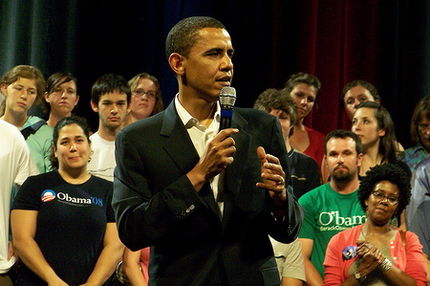
Photo by Aaron Muszalski; licensed http://creativecommons.org/licenses/by/2.0/

By Marc Seltzer; originally published on December 15, 2008, at politicsunlocked.com

. .

A new political party has appeared on the American scene. It is the Pragmatic Party and Barack Obama is its leader. The platform is so new and disconcerting that many have not yet wrapped their minds around the implications.

What his critics fail to understand is that Obama is not just about be-nice politics.  He’s about practical solutions rather than simplistic party ideologies.

After two years in the national spotlight as a transformational candidate – captivating audiences, filling stadiums and talking straight about his priorities (the middle class, economics, health care, education) people are still asking if he has been clear and upfront with his politics.

One month into the transition, carrying references to Lincoln, FDR and Ronald Reagan, people are showing surprise with his cabinet picks.  In despair, some suspect a closet conservative, while others are hoping for a liberal double agent.

Some Republicans are calling him a socialist, while Fred Barns in the Weekly Standard observes “he’s pragmatic so far in one direction, rightward – who knew?”

The public went along with the old-style reporting it seems. 68 percent of Americans polled expected Mr. Obama to be liberal. They have their reasons. Mr. Obama ran as a Democrat, after all. In our essentially two-party system, if Obama had run on a new third-party platform, he might have received 4 or 5 percent of the vote, or because he sounds remarkably intelligent, 12 percent tops. Obama ran instead as a Democrat, a pragmatic choice it seems, since he won 53 percent.

It’s also true that minority candidates are often champions of more progressive political parties and organizations, which traditionally labored to advance rights and protections for disenfranchised groups. True, but Colin Powell and Condoliza Rice, not to mention Clarence Thomas, were all Republican administration appointments.

Jessie Jackson ran for President in 1984 and 1988 on a rainbow coalition for a new kind of inclusiveness. He may have paved the way in part for the Obama presidential bid, but in sharp contrast, Barack Obama, ran on behalf of the middle class.

On the other hand, the University of Chicago, where Obama taught Constitutional Law, is a center of free-market economics.  Note too, that Obama’s selections for his cabinet and crew in economics and foreign affairs are centrists.  Centrists can adopt policies from, and forge policies which appeal to, both sides of the political spectrum, without being called traitors.

There is still no approved vocabulary for describing pragmatism in politics.  What’s that Berkeley’s Professor Lakoff said, until there’s a metaphor, there’s no word and no thought?

It’s about time that someone described this new party to the pundits so that they can start using its lingo in their coverage. Not that the President Elect has been hiding anything. He has said on more than one occasion, that he is looking for “what works,” or, when things look really bad, “whatever works.”  Let’s start describing policy, not for its political effect, but its accomplishment on the merits.  The words “results oriented” and “consequences” come to mind.

“Pragmatic,” in this context, is the opposite of ideological. Democrats and Republicans aren’t always ideological, but often are, with important consequences.  The mantra “Government regulation is a drag on the economy” rings a bell.  The notion of raising taxes to balance the budget during a recession is not quite ideology, but it is cured by pragmatism, none-the-less.  Pragmatism works against ideology and lunacy, it seems — an added benefit.

What should we expect from the Pragmatic party? It’s hard to say, but we should expect an Obama administration to look to the facts and circumstances of the problems we face, rather than applying ready-made doctrines from yesteryear. Obama doesn’t seem to care whether a policy is liberal or conservative; he seems to believe it is more important to talk about whether it will accomplish its goals. It turns out that many of the liberal v. conservative debates have already been, well, decided.

Take, for example, raising taxes.  This is done to balance budgets, but also to fund entitlements and spending programs.  Obama’s appointment to head the Economic Council of Advisors, Christina Romer, recently published a serious historical analysis showing that tax hikes measurably retard economic growth.  A pragmatist will have to weigh how much the revenue is needed in the short term against the eventual harm to the economy and resulting loss of revenue over the long term.  Not very exciting in a televised debate, but logical, maybe even “good government.”

Better let the economists calculate the optimal results, rather than have politicians debate raising taxes vs. lowering taxes, without really knowing what they are talking about. Politicians with ideology don’t actually have to know what they are talking about, but pragmatists do for they are only as good as the results obtained by solutions they propose.