Tag Archives: president obama

Obama Power Source — Centrism and Pragmatism

By Marc Seltzer; originally published on July 21, 2009, at care2.com

In a fairly strong critique of the direction of Democratic party leadership, New York Times columnist David Brooks tells us Democrats in Congress and President Obama are going too far in a liberal direction (Liberal Suicide March, July 21).  Comparing their “out of touch-ness” with that of the Republican party’s loose deficit spending in the Bush years, Brooks asserts that the current President risks losing moderate support for his agenda, if liberals hold sway.

Mr. Brooks cites the $878 billion stimulus, the 2009 federal budget and now proposed health care legislation as three examples of where the President has abandoned the moderate center, inhabited by a majority of Americans.

I have to disagree on the stimulus count.  Such stimulus was offered up by moderate economists as one reasonable approach to protecting the economy from a Depression.  Other options, such as Republicans’ suggested payroll tax cut or Professor Roubini’s capital gains tax cut, were likewise logical, but no more certain to work or free of political problems (each could also have raised the short-term deficit and might been saved rather than spent).

The U.S. economy experienced an unprecedented financial freeze in the midst of a cyclical recession.  If we escape this disaster with only a severe recession and some unfair sharing of the burdensome bailout, contributors in the economic rescue will be the heros of the early 21st century.  The fact that people cannot fathom what could have happened or gloss over it for political gain does not change financial reality.

In this light, Brook’s impatience with the speed of stimulus spending is unwarranted.  Only 10% so far?  The spending was intended to be rolled out over two years and there is no question that this is happening.  Wasn’t the clamor in April that it was going out too quickly, without enough record-keeping?

Of course, there are few things as difficult as the loss of a job and financial safety, but that doesn’t mean that the unemployment rate can be kept below 10% or even 15% by force of will.  There is no magic wand — only reasonable policies that support the private economy and time for supply and demand to correct itself.  Republicans calling the stimulus a failure, at this point, or blaming Obama for the rising unemployment rate, play politics at the expense of their integrity.

The federal budget was a closer call.  It contained many earmarks and spending habits that did not fit with the President’s campaign rhetoric.  On the other hand, the bill was prepared during the previous year and Obama only took office weeks before Congress sent it to him for approval.  It might have been a great symbol of “change,” if the President had vetoed the bill and demanded that Congress change its ways from the start of his administration.  On the other hand, in the midst of financial devastation, a budget fight and potential government shutdowns would have caused further economic harm.  This would have been the more irresponsible, if emotionally satisfying, route.

But the health care debate is President Obama’s chance to demonstrate his leadership and vision.  Here, I agree with Mr. Brooks that pragmatic centrist leadership is necessary.  If the President doesn’t tackle the very real problems with health care costs, any solution will be unsustainable.

Mr. Brooks refers to polls showing that Americans are losing confidence in Democratic proposals for health care reform. Americans are savvy enough to know that additional deficit spending is irresponsible.  Thus, while many Americans support the President’s vision of providing insurance to nearly all and forcing change upon a powerful insurance industry, the public still needs to see a coherent financial plan.  Tax increases on upper-income Americans may be part of that plan, but large tax hikes would represent a change in policy beyond what President Obama spoke of in his campaign, and too fast or two great an increase could damage the economy.

The other option is to cut costs.  After efficiency, cutting costs equals cutting back on covered medical care.  Rationing already goes on, across the system as public and private insurers choose what procedures to cover.  After that, only those with enough money are able to purchase additional care. Those without insurance or funds have only what is offered in emergency rooms and subsidized or charitable clinics.

Somehow, many Americans have come to view raising taxes and cutting costs as bad options.  That’s why we find ourselves (Congress) legislating programs and services that we can’t pay for.

Brooks credits Obama for having ideas that go in the right direction, citing his proposed cost-cutting, limits on tax hikes, and an independent commission on Medicare spending.  But Brooks laments that Obama is not feared by the Congressional leadership, and he believes they have the power in the current battle, unless “Blue Dog” conservative Democrats can force a moderate compromise.

One such idea would be to lower the subsidy for employer-provided insurance.  The current system encourages overspending, exactly what we need to remove from the system.  Another would be to provide clearer limits on coverage for end of life treatment, which is very costly and often of debatable value.

I have hope that the President is up for a fight on health care.  He can speak to the nation like few others at this time, and his forceful leadership could shape a responsible compromise.  The President may be afraid that asking too much of Congress risks failing to achieve any reform.  But there is no reason for this to be a repeat of President Clinton’s experience.

President Obama should go to the mat for a bill that restrains costs, targets fiscal balance, aids the underserved, and corrects inefficiencies in the system.  If he fails to get the bill, he should start over after the recess, asking less.  Legislators will not want to go home empty handed a second time with a popular President telling the American people that they deserve more. The President has tremendous national goodwill and strong majorities in the Congress.  Americans will accept compromise, but not without fighting for what is right.  This is the time for the President to spend his political capital.

Judicial Nominee Sparks Debate on Racism, Discrimination

By Marc Seltzer; originally published on July 13, 2009 at politicsunlocked.com

. .

As the hearing on Judge Sonia Sotomayor’s nomination to the Supreme Court commences, there is a great focus on whether Judge Sotomayor is biased. This reflects more the nations’ prejudices than it does any real question about the judge. She has been on the bench for sixteen years, and there is little informed concern about the impartiality of her decisions.

The Ricci decision, in which she rejected claims by Hispanic and white firefighters in favor of the city of New Haven’s effort to aid African American firefighters, clearly does not show a bias towards her Hispanic cultural identity. Her decision followed federal law, which allowed cities such as New Haven to take remedial efforts where discrimination was argued or perceived. In concert with other federal judges, she deferred to Congress in its lawmaking and the city in its application of the law. While a five-member majority of the U.S. Supreme Court reversed her decision last week and provided a new authority for lower courts, this hardly paints her as either biased or activist.

Her comment, “I would hope that a wise Latina woman with the richness of her experiences would more often than not reach a better conclusion than a white male who hasn’t lived that life,” has also inspired a strong reaction and many questions regarding her perspectives on race and gender.

News reports about her judicial temperament showed her to be no-nonsense, tough, smart, detail-oriented, and fair. Even those on the losing side held her in high regard. Some critics have harped on her toughness on lawyers appearing before her as a negative aspect, which reminds me of a very tough senior federal judge I have often appeared before. He sometimes berated lawyers and their arguments and had no tolerance for the unprepared. In my experience, I went out of my way to make sure I was ready for every hearing, and I was nervous in my uncertainty about how each hearing would go. But I did not question his capacity for the job because he was particularly demanding.

Judge Sotomayor’s comments off the bench do raise questions about the role of personal characteristics such as gender, race, religion and culture in judging, but do not create real issues about her capability or about the nature of her judicial philosophy. Justice Sanual Alito said essentially the same things that Judge Sotomayor has said – noting the impact of his Italian heritage and experience as an Italian American on his judicial outlook – without raising an eyebrow. When this kind of sentiment is expressed by a white male, it sounds “cultural,” like a tribute to our shared melting-pot cultural identity. But when the same ideas are expressed by a minority voice, it raises the concern in some of reverse discrimination as if minorities given a voice must necessarily use it in a power grab.

After a period of being attacked, without the opportunity to respond, the hearings will be Judge Sotomayor’s forum to speak. Republicans have noted that while they cannot seriously expect to thwart Sotomayor’s confirmation, they can use the hearings as a platform to argue judicial philosophy. As their criticism so far has been off the mark, it is likely that it is they who will receive a schooling in the Senate.

Supreme Court Reverses Sotomayor Panel in Ricci Case

By Marc Seltzer; originally published on July 8, 2009 at politicsunlocked.com

. .

The Supreme Court recently overturned an opinion issued from a three-judge appellate panel including Supreme Court nominee Judge Sonia Sotomayor. The core of the case turned on how a government agency, in this case the city of New Haven, Connecticut, should deal with potential discrimination against minority employees.

The city took a number of steps to address concerns about discrimination in promotions for fire department officer positions, such as making great efforts to create a race-neutral test and ensuring that minority officers from other departments participated in the candidate evaluation process. The lawsuit arose when the city decided to throw out the results of the firefighter promotion exams because no African-American applicants achieved top scores, meriting promotion.

The Supreme Court decision sheds some light on how government entities are expected to handle discrimination concerns. However, it does not fit as nicely into the affirmative action debate as commentators claim. It also fails to provide any significant evidence against Judge Sotomayor’s promotion to the U.S. Supreme Court.

It was white and Hispanic firefighters who sued the government in Ricci v. DeStefano when their success on the exams was disregarded. They lost their case in the lower courts and petitioned the Supreme Court for a final review. The Supreme Court found that once the promotion exams were completed, the city needed evidence that the exam was discriminatory, beyond just the results themselves, to justify disregarding those results. This, the city did not have. It had a history of discrimination, where only one of 21 fire captains was African-American, and it had a fear of lawsuits from unsuccessful black candidates, a legitimate concern recognized in the law guiding cities’ decision making on employment matters, but it did not have evidence that this test was unfairly discriminatory.

The Supreme Court decision was 5-4, with Justice Anthony Kennedy writing an opinion joined by Justices Scalia, Thomas, Alito and Chief Justice Roberts. The decision does not seem to overturn much law on affirmative action or to allow discrimination against minorities to go unchecked. It does say that once a hiring process is completed and candidates are ranked for promotion, it should not be upended without evidence that it was faulty.

The dissent would have allowed the city to disregard the test results in light of past discrimination and suspicion and potential legal challenges over the results themselves. There was evidence that another type of exam process might have yielded different results and the dissenting opinion considered that sufficient to put the test results into question and justify the city’s action.

Judge Sotomayor, along with two other appellate judges, had agreed with the trial judge that the city was within its rights to redress what it perceived was a problem in the test results. Justice Sotomayor will be asked about the decision in the nomination hearings next week. However, her position was hardly the type that should concern the judiciary committee reviewing her nomination. Sotomayor followed existing law on an issue where there is obviously substantial disagreement.

What can Canada teach us about banking regulation?

By Marc Seltzer and Leslie Schreiber; originally published as “Northern Light” on June 19, 2009, in Commonweal Magazine and at Commonwealmagazine.org.

US Regulatory Reform Follows Canadian Model

. .

Amid the greatest worldwide financial meltdown since the Great Depression, there have been few examples of sound financial management and regulation. Public authorities have had to provide billions of dollars to support ailing institutions and have acknowledged far-reaching gaps in public oversight. Responding to the disastrous bubble and bust, the Obama administration is calling for comprehensive reform. International leaders have even gone so far as to call for the creation of a world financial regulator.

U.S. Treasury Secretary Timothy Geithner, while not going that far, is asking Congress to grant the Treasury broad oversight authority for virtually all financial institutions, and a mandate to monitor systemic risk. Additional proposals seek to insure that financial instruments, such as credit-default swaps, are subject to federal regulation. While Congress will ultimately be responsible for crafting legislation, Geithner’s proposals provide a road map for a new financial order, in his words-“not modest repairs at the margin, but new rules of the game.”

The economic crisis has tested the stability of financial systems across the international community. The results differ widely, from Iceland’s near-bankruptcy to Canada’s remarkable financial health and insulation from risk. Beyond the private gains and losses, the crisis has revealed strengths and weaknesses of different regulatory environments. Remarkably, not a single major Canadian financial institution has needed a bailout. In March, the International Monetary Fund praised Canada’s banks for their “remarkable stability amid the global turbulence.” Howard Kaplow, an investment executive and director of financial services in Montreal, noted that Canadians “tend to be more conservative, but we also have a more restrictive financial authority with tougher rules to follow.” The IMF agrees, commending Canada’s “strong regulatory and supervisory framework.”

In this light one may ask how Secretary Geithner’s proposals for regulatory reform measure up against the Canadian model. Are the Obama administration’s efforts to monitor systemic risk and regulate all substantial financial entities and instruments in line with the Canadian approach?

In contrast to Canada’s conservatism, the U.S. system has gone through a period of “irrational exuberance.” Over the past twenty years, Congress deregulated financial industries in order to maximize business opportunity. New financial instruments, markets, and conglomerates were unleashed without oversight. In a recent debate over the causes of the crisis, New York University Professor Nouriel Roubini (nicknamed “Dr. Doom” for having predicted the current crisis) argued that, “deregulation occurred too fast and in ways that did not provide prudential regulation for provision of the financial system.”

The dominant political ethos was trust in free markets, competition, and modest regulation-even self-regulation. Where regulators did act, they followed a framework that called for distinct regulators in compartmentalized markets. The FDIC has been highly praised for its success at handling the closing of failed banks, but neither the FDIC nor the Federal Reserve had authority to intervene when an investment bank or insurer acted unwisely or teetered on the brink of bankruptcy.

In the end, the failures were systemic and pervasive. They could not be limited to one sector of the financial system, nor were they detected by any existing regulatory agency. In warning that the problems would not respond to a quick fix, President Barack Obama observed that the crisis “didn’t result from any one action or decision. It took many years and many failures to lead us here.”

New regulations were contemplated long before Secretary Geithner was confirmed. Former Treasury Secretary Henry Paulson and the General Accounting Office oversaw substantial groundwork in 2008, but it now falls to Geithner to finish the job. While Geithner is promoting a more comprehensive regulatory regime, the proposals have been developed by financial and market experts and insiders who believe in free-market capitalism. They do not wish to stifle financial innovation. Instead, the aim is to protect the overall system while allowing risk-taking activity to continue. This approach is in line with the Canadian system, where, despite strong regulatory authority, the financial sector has prospered. Today, five of the country’s banks are among the top fifty banks in the world. Ten years ago none of them was.

The lead financial regulatory authority in Canada is the Office of the Superintendent of Financial Institutions (OSFI), currently headed by Julie Dickson. She chairs the Financial Institutions Supervisory Committee, which has broad authority to monitor systemic risk and, for that purpose, brings together regulators who oversee market stability, risk-management, and business practices from across the financial economy. The OSFI mandate covers “all banks, along with federally regulated property, casualty, and life insurers, and trust and loan companies, plus about 10 percent of private pension plans” according to OSFI spokesman Jean Paul Duval. If any of the institutions “raise a red flag, the OSFI can implement a range of disciplinary measures, affecting everything from bank capitalization to controlling assets, and even getting directly involved in business planning.” Indirectly, this also includes securities firms, which are 70-percent bank-owned in Canada (for example, RBC Dominion Securities is part of the Royal Bank of Canada). The OSFI oversees 450 banks and insurers, and approximately 1,350 private pension plans. Its authority, while not reaching all financial institutions (hedge funds are not regulated by the OSFI), is fairly comprehensive and is foundational for the soundness of the Canadian system.

Secretary Geithner told Congress in March that the oversight he was proposing “would include bank and thrift holding companies and holding companies that control broker-dealers, insurance companies, and futures commission merchants, or any other financial firm posing substantial risk” (emphasis added). Not every financial entity reaches the size and significance to affect systemic risk, but Geithner wants to avoid a system where the legal form of an entity can be used to shield it from regulation. A key component of meaningful oversight is the ability of the regulator to set standards for institutional risk management. Geithner is asking Congress for authority to increase capital requirements, to restrict leverage ratios, and to enact additional prudential rules.

In Canada, the OSFI has substantial experience with such oversight. According to Duval, since its creation in 1987, the OSFI “has always been vigilant in the development of its risk-management practices.” Capital requirements for Canadian banks have been held at 7 percent, while the global average is closer to 4 percent. Similarly, Canada’s bank-leverage ratio has been kept under twenty-to-one, while international bank leverage ratios were thirty-to-one and even forty-to-one. OSFI Superintendent Dickson remarked in November 2008, “We have seen how strong capital cushions in Canada have paid off to the benefit of our institutions and overall financial system.”

Canadian institutions were not free from risk-taking or even from exposure to subprime loans from the United States, but strong capital and leverage standards kept the damage from overwhelming Canada’s banks, let alone destabilizing the economy. In addition, Canadian banks generally still maintain the mortgage portfolios of loans they originate, retaining direct knowledge and responsibility for their management. These conservative practices reinforce sound regulation, and vice versa.

Canadian regulators give special attention to larger, “too big to fail” organizations. Duval explains that “OSFI utilizes a risk-based methodology, where institutions that we believe are operating in a riskier manner are subject to increased supervision. That said, the larger institutions will be operating in larger parts of the market, so [they] would naturally receive greater attention…and can be subject to different supervisory requirements.”

Similarly, the U.S. federal regulator proposed by Geithner will have the power to step in and manage problems when institutions fail to meet prudential standards or find themselves in financial difficulty. Special consideration would be given to entities deemed “too big to fail.” Geithner is asking Congress for the flexibility to intervene where there is risk to the wider economy. He has already intervened with a few of the big banks. Recent “stress tests” resulted in some banks being required to raise capital, although banks could choose whether to seek private or public funds.

Critics have called for regulations that would cap the size or restrict the legal structure of financial institutions. However, noting that other countries have allowed hybrid entities such as Canada’s banking and securities conglomerates, Geithner appears to trust that oversight will protect the system, and that private decision making should be allowed as much leeway as possible. The changes he proposes will require legislation. Under his lead, the Obama administration should be pushing hard for a substantial increase in federal regulatory authority. What might have been politically impossible before the crisis is now high on the legislative agenda. In addition, the chairman of the Federal Reserve, Ben Bernanke, has spoken in concert with the administration. While Congress will take a significant role in designing new regulation and is not likely to rubber-stamp the administration’s proposals, momentum is strong for the creation of comprehensive financial reform. The success of the regulatory system across the border should inspire both humility and hope.

Justice Sonia Sotomayor Fits the Obama Mold

By Marc Seltzer; originally published on May 29, 2009 at politicsunlocked.com

. .

The nomination of Justice Sonia Sotomayor to the U.S. Supreme Court fits perfectly with President Obama’s vision for good government: independent intellect, moderate politics, and pragmatism.

Sotomayor is a first generation Puerto-Rican American of humble upbringing. She distinguished herself academically, graduating summa cum laude from Princeton and editing the Yale Law Journal. Like Mr. Obama she proved herself and opportunity followed academic excellence.

Sotomayor has acknowledged that being Hispanic and a woman may be qualifications, or at least qualities, important to her professional career. “I would hope that a wise Latina woman with the richness of her experiences would more often than not reach a better conclusion than a white male who hasn’t lived that life,” she said in a speech. This differs from President Obama who hesitated to make distinctions part of his political language and for whom “we” most often meant middle-class Americans.

Republicans have attacked Sotomayor’s remarks as identity politics and raised fears of a judicial philosophy of preferences. But is this just grasping for straws?

First, simply, is the question of what she meant. Did she mean that it was about time for women and Hispanics to be better represented in government service? After all, there have been 110 Supreme Court Justices since the nation’s founding, and only two have been women. None have been Hispanic except Justice Benjamin Cordozo, of European Jewish ancestry, who may have had Portuguese bloodlines a few centuries back. Arguing that Cordozo keeps Sotomayor from being recognized as potentially the first Hispanic on the Court is nonsense.

Or did Justice Sotomayor mean that experience in life – adversity, discrimination, and disadvantage – helped her to build character and taught her about life in a way that wealth and social status might not have?

Conservatives may worry that she would be an advocate for women and for minorities on the court, emphasizing sympathy over the legal rules. This treads into especially difficult waters. Politically, liberals have often taken up the causes of women’s and minority rights. In the legal context, at least, conservatives have opposed affirmative action, or race-conscious government actions as reverse discrimination.

Commentators refer to decisions rendered by Ms. Sotomayor as technical and narrow rather than ideological and sweeping. In one case she emphasized how “embarrassing and humiliating” the school strip searches can be to teenage girls. Is this comment a sign of prejudice and activism? Because Sotomayor’s decisions are mainstream and are specific responses to facts rather than sweeping pronouncements of political theory, it is a stretch to find in them judicial activism or bias.

What is easier to find is pragmatism. Justice Sotomayor is known for concentrating on the facts of each case and for diligence and care in crafting her decisions.

Closing Guantanamo Bay

Originally published on February 9, 2009, at politicsunlocked.com

Photo: Puerto Rico National Guard troops pack it in after a year's deployment at Guantanamo; The National Guard; licensed under creative commons

Photo: Puerto Rico National Guard troops pack it in after a year's deployment at Guantanamo; creative commons http://www.flickr.com/photos/thenationalguard/3229073306/in/photostream/

President Barack Obama has signaled that the U.S. military will close Guantanamo Bay detention camp within one year.  The prison has become a divisive symbol of the controversial handling of enemy combatants by the Bush administration’s War on Terror. 

President Obama has shifted responsibility for the remaining 245 Gitmo prisoners from the Defense Department to the Justice Department.  Newly appointed Attorney General for the United States, Eric Holder, Jr., will take responsibility for determining whether those prisoners will be given civil or military trials, transferred to foreign countries or released.

The outlines of the President’s new policy on detention will be filled in in coming months, but certain things are clear.

The President has forbidden the use of torture against detainees in American custody.  “The United States will not torture,” the President stated.  

This policy includes prisoners under CIA control, and while extraordinary renditions will be allowed to continue during the Obama administration review of policy, the CIA will not be allowed to transfer prisoners to any country where they will be subject to torture.  

Outgoing CIA chief Michael Hayden sent a message to staff at the agency stating that the new policy would be carried out, “without exception, carve-out or loophole.”

Holder’s justice department has begun review of enemy combatant court cases beyond Guantanamo Bay, such as that of Ali Al-Marri, held at a military brig in North Carolina.  Al-Marri has appealed to the United States Supreme Court for review of the Defense Department’s decision to imprison him without trial.  Al-Marri was living in the United States as a legal resident at the time of his arrest, giving him a stronger position to seek a trial than, say, an enemy combatant captured by coalition forces in Afghanistan.

However, the Obama administration sought a postponement of hearing by the Supreme Court.  Al-Marri “is clearly a dangerous individual,” Obama has said. “We have asked for a delay in going before the Supreme Court to properly review the evidence against him.”  

The Bush administration had also decided to close the Guantanamo Bay facility, but ran into difficulty finding new places to house the remaining detainees.  Bush policy was to hold enemy combatants without trial or transfer them to foreign countries for incarceration.

However, the U. S. Supreme Court has ruled that all Guantanamo detainees are entitled to habeas corpus, or, the right to petition a federal court for review of the decision to imprison them.

Recently, a federal court in Washington D.C. ordered five Algerian detainees to be released for lack of sufficient evidence against them.  Other detainees have been caught in legal limbo because the United States would like to release them to their native China, but are constrained by the probability that they will be subject to ill treatment or execution if returned, because of their opposition to the Chinese regime.

The Obama administration will also deal with the question of detainees held in U.S. military custody abroad, such as those held at the Bagram base in Afghanistan.

These prisoners were captured in military operations and are thus more like traditional enemy combatants, but some have been held for as long as eight years and there is still no end in sight for conflict in Afghanistan.

From a policy perspective, Obama’s intent to increase U.S. troops and coalition commitments in Afghanistan soon, will likely result in more enemy combatant prisoners, going forward.

Big Spender or Economic Reformer?

Originally published on March 5, 2009 at care2.com


In the midst of this economic downturn, the president has proposed a budget that gives further definition to his vision for American progress.  In some ways it may not be the best time to propose something new, as many people, shocked by financial insecurity and instability, investment and pension losses, and business and job distress feel the need to hunker down and survive, rather than experiment and take risks.

On the other hand, the government is stirred to take significant steps to repair a major crisis, and while thinking big, there is opportunity to take bold action.  That, I think, can be said of President Obama’s political vision.  The question is, what kind of action is it?

Probably the most sensitive issue at the present time, is the issue of government spending.  Americans are mistrustful of congress’ ability to spend responsibly and are deeply concerned with the deficit.  How should Obama’s grand, if evolving, plan be looked at from this perspective? 

Is he the big-spending liberal, willing to meet any “progressive” goal with tax-payer dollars, giving only secondary consideration to the harm to the economy of tax increases, redistribution of wealth, and deficit spending? 

If we turn to conservatives for an answer, we hear the harsh critique of a socialist redistribution of wealth.

Even moderates, such as David Brooks, find the size and target of the fiscal stimulus legislation and budget proposal too big and too progressive, while expressly embracing parts of the program such as education.

If we ask liberals, they may very well see an increase in public spending on education, health care, and alternative energy that bespeaks progressive values, liberal causes and Democratic agenda.

I disagree.  Mr. Obama is a financial reformer, using public funds as necessary to do what government truly needs to do, but intent on cutting waste, corruption, and mismanagement out of the workings of government?

The main thrust of the vision is still investment in parts of the economy that need repair:  a struggling education system that is needed to produce a work force on which our prosperity will be based; an inefficient health care system that uses too much of our national budget, is a drag on our businesses large and small (unless like Walmart did they force these costs on private individuals and on state tax-payers when private citizens use public resources) and is too expensive for too many to afford; and energy that is imported at great cost to our economy and national security.  These are issues of fundamental importance to our economic prosperity, our business climate, our capitalist system.

Couldn’t we call what Obama is doing long-range economic reform? 

It might even make a good Republican agenda, as they are rooting around for one. 

Let us not quarrel with the targets of public spending as they are, in fact, economically productive and necessary.  Let us not quarrel with the amount of funds because they are realistic and necessary.  Let us organize and fight for the right use of these funds so that every dollar engenders in our children the philanthropic, creative, entrepreneurial and leadership qualities of business and civic leaders like Bill Gates, Steve Jobs, Warren Buffet and Colin Powell. Let’s make sure our businesses and citizens can afford economical health care benefits, and our citizens receive worthy care, and let us, using the scientific and entrepreneurial genius among us, develop alternative energy or at least efficient energy that is home grown, as clean as is reasonably possible, and marketable to the world.

Is that liberal?  Really?

Public v. Private: Which part of “of the people, by the people, for the people” don’t you get?

Originally published on February 26, 2009, at care2.com


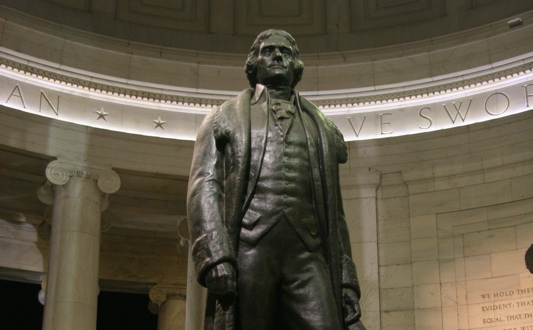
Thomas Jefferson -- photo by chadh, licensed creative commons

Thomas Jefferson -- photo by chadh, licensed creative commons

If it were possible to take a step back from the current focus on the economic crisis with its financial breakdown, housing glut, contracting commerce, growing unemployment, and menacing deficits, we could make out an even broader political picture:  the failure of the me-only private vision of civic life and its replacement by a public-private partnership of sound leadership.

Take the four areas that President Obama has now committed to reform:  finance, education, energy and health care.  In each area, those whose political philosophy is that public vision is necessarily faulty, and private interest is all, have pushed and pulled their version of reform through the Republican Revolution of 1994, talk-radio over-simplification, and anti-government rhetoric.  This is not to say that Republicans, per se, embrace a private-only solution to reform, as they don’t, but many who have sought to gut the government and replace all regulation and public funding with self-interest and free-markets have done so at least masquerading as conservatives.

In the financial arena, faith was placed in the market to regulate itself.  Instead, short-term self-interest led too many to take fatal risks requiring government bailout to protect the larger economy.

In public education, anti-government vision led to stripping schools of resources, spurring many who could afford it to choose private schools with outstanding resources and leaving others to suffer emaciated public education.

Our energy system allowed the market to dictate the most economically efficient energy despite the consequent flow of money to nations who act against our national interests.  Short- and long-term environmental costs associated with self-interested energy choices were shifted to the public from the private sector.

Finally, health care expenditures press business and family budgets and leave many under-served, yet there is resistance to public supervision of the health care system, where industry money influences elections and portrays government action as the problem, despite huge inefficiencies in the current system.

Critics of the new president’s budget and priorities attack the plan as “big government.”  This is nonsense.  Limited regulation, adequate funding for education, and limited macro-management of sectors of the economy with strategic and economic national importance are not big government but good government. Calling spending “socialism” because it increases the budget is pure political rhetoric. We need to balance the budget, but we need education as well.  Good government provides oversight, restricts harmful actions, and promotes positive ones.

There are, of course, inefficiencies in the system.  President Obama has in no way acted to protect and preserve government waste.  Improvements are also part of good government.  But the fact that members of the government, whose philosophy was “hands off,” failed to regulate the financial sector, is hardly an indictment of the ability of Americans to benefit from government of the people, by the people, for the people.  Good public leadership and judgment has tremendous potential, not to take over for private action, but to guide private enterprise to serve democratically determined purposes and to fill the vacuum created in public decision-making by those seeking to gut, rather than reform government.

President Obama’s Speech at Signing of Stimulus Legislation

Originally published on February 18, 2009, at http://www.care2.com/causes/politics/blog/obamas-speech-at-signing-of-st/


President Obama spoke briefly today in Denver before signing the stimulus bill. His remarks and the event were thoughtfully orchestrated to make clear the President’s vision of an American renewal through public investment.  The President’s entire speech as well the introduction by Blake Jones of Namaste Solar, a Denver company aided by the stimulus legislation, is well-worth viewing.

View the CNBC broadcast of the President’s speech here.

President Obama made plain that he believes investment in public education, green technologies, traditional infrastructure, and health care information technology contained in the bill is a recipe for America’s long-term growth, prosperity and leadership.  The President made references to John F. Kennedy’s Mission to the Moon and Dwight Eisenhower’s interstate highway program as examples of large-scale public investment that stimulated private enterprise and served a national purpose.

President Obama did not shy away from his accomplishment, just three weeks into office, calling it, “the most sweeping economic recovery package in our history.”  The President touted its support by governors and mayors and, in a comment aimed to shore up support among skeptics, proclaimed,

“What makes this recovery plan so important is not just that it will create or save three and a half million jobs over the next two years, including nearly 60,000 in Colorado. It’s that we are putting Americans to work doing the work that America needs done in critical areas that have been neglected for too long – work that will bring real and lasting change for generations to come.” (Transcript)

He noted jobs saved, but focused on education, noting that 14,000 New York City teachers will likely keep their jobs because of the bill.  Over and over he attempted to demonstrate that the spending was in areas that were necessary to meet the needs of tomorrow.

The President also brought up discipline and responsibility to remind Americans that the road ahead will not be easy.  But he returned to his belief that the stimulus bill achieved a balance between public and private, present and future. 

Obama was introduced by Blake Jones, a Denver area entrepreneur in solar technologies.  Mr. Jones aptly discussed his firm’s difficulties because of the recession and the likely benefits to his firm and his industry because of the new legislation.  He enthusiastically pointed out that in green technology, the legislation was good for employment, for the environment, and for America’s bid for energy independence.

After the Spending Spree

Originally published on February 18, 2009, at http://www.politicsunlocked.com/item/after-the-spending-spree


Efforts to balance long-term budget through entitlement reform could help restore confidence.

Efforts to balance long-term budget through entitlement reform could help restore confidence.


Following the historic passage of substantial stimulus legislation, President Barack Obama must now show he is capable of fiscal discipline.  

The 789 billion spending and tax relief bill passed with overwhelming Democratic support, and despite almost unanimous Republican opposition, showing that bi-partisanship, a central theme of his campaign, proved to be harder to achieve than propose.  

The President urgently sought a short-term stimulus bill to reverse the economic decline. Now that he has achieved this goal, the President should turn his attention to the long-term fiscal health of the nation.   

Most Americans are dismayed at the fiscal irresponsibility of government leaders and feel powerless to stop the government from spending their money unwisely.  Mr. Obama has a unique opportunity to put his political weight behind drafting legislation to control long term spending, including outlays for Social Security and other so called entitlement programs, that will only take effect once the recession passes.

The government is currently committed to spend more than it is projected to take in on Social Security and Medicare.  This deficit will require spending cuts or revenue increases to make up the difference.  The public will certainly not like either solution.

Operating with a deficit is justifiable under certain conditions such as emergency needs or long term improvements, programs which could not be afforded without borrowing.  However, operating the government with a chronic deficit is irresponsible and hardly confidence-inspiring.  

If President Obama were to begin the work of entitlement reform and act with the deliberate and decisive hand that has guided his campaign and his Presidency so far, he would again succeed.  Leaders must compromise.  The public must make sacrifices.  This will truly have to be a bi-partisan effort. 

This debate must be had in the next few years, before it is too late to plan responsibly.  Why not move on it now in order to show a very skeptical public that the government is not only good at spending its money, but can manage it as well?