Tag Archives: Republicans

Sacrificing the Public Option, Expanding Medicare and Universal Coverage

By Marc Seltzer; originally published on December 13, 2009, at care2.com
. . .

How does the latest health-care proposal in the U.S. Senate measure up on Progressive principles?

The Progressive movement has rallied behind single payer and public option reform proposals in the belief that not only is universal coverage a fundamental right, but not-for-profit medicine is a better way to get quality health care at a reasonable price.

Unlike most developed nations, the United States has a sizeable part of its population that goes without health insurance.  President Obama took up the cause of greatly expanding coverage in his presidential campaign. He also spoken firmly of reform in terms of bending the cost-curve, making insurance and medical care more affordable to individuals and to the nation, in light of fast-rising health-industry costs.  However, Mr. Obama stopped short of embracing single payer, leaving in question what type of structural changes would be used to achieve reform goals.

The political reality is that both the House of Representatives and Senate are split among those who want to change the system towards government-run health insurance and those intent on maintaining a mostly private system.  In the House of Representatives, the Democratic majority was able to pass legislation substantially expanding coverage and including a limited public option, a small government-run insurance program for those not insured through their employer.  The vote was fairly close and may have reflected inclusion of a controversial abortion-funding restriction, such that the exact count of Representatives who would support a public option if the anti-abortion funding provision were not part of the final bill is uncertain.

In the Senate, Democrats need sixty votes to close debate and move forward.  They have close to, but not quite, that many, who will accept some form of a public option.  Thus, negotiations have continued to explore what types of limited government insurance programs would be acceptable to at least a few conservative Democrats, independents or moderate Republicans.

This week a Senate group reached a compromise that attempts to replace the public option with a public/private non-profit insurance program like that which is currently offered to Congressional legislators and federal employees.  The compromise proposal did not stop there, however.   It also included a provision to significantly expand Medicare, by lowering the age of participation from 65 to 55.

How should Progressives look on this proposal?

All the proposals under consideration push towards universal coverage.  It is really the structure that makes them different.  The use of a public/private program is not equivalent to the public option, or government-run program.  However, the federal authority sets rates, controls profits, and guides provision of health care.  It is a strong control on profit-driven insurance.

Moreover, expanding Medicare is a major step in the direction of single payer.  The Medicare program is single payer for its participants.  Private insurance does not participate except in supplemental programs.  There are approximately 35 million additional Americans who would be eligible to participate, if the age requirement was lowered — more than 10% of the population.  Those under fifty-five would remain in their current employer-provided plans and a small number would participate in the new public/private plan.

Given that there is not political power to create a nationwide single-payer program, the expansion of Medicare to include 35 million additional participants and the coverage of uninsured by a public/private program is much more than could have been achieved by the limited public option as it was contemplated.  The small public option is replaced by a public/private plan, which covers those currently uninsured.  The vast expansion of Medicare offers many more Americans a single payer model of insurance.  Whether this shifts the political equation in the Senate or House is the big question, and this should become known in coming days.

Care2.com/causes blogger Jessica Pieklo and I discussed the new proposal as soon as we got word.  You can hear our conversation by following this link and clicking the December 11, 2009, podcast, and more information should become available as soon as the Congressional Budget Office provides “scoring” or budget estimates.

December 14, 2009, UPDATE: First responses — Senator Lieberman
Obama Approval, Progressive Politics and Democratic Unity

By Marc Seltzer; originally published on November 25, 2009, at care2.com

. . .

Pundits have focused recently on President Obama’s declining public opinion polls.  As the President drops to fifty percent approval ratings, the talk speculates on whether the poor economy will sink Democratic prospects in the 2010 midterm elections.  The economy is important and the administration’s policies will not cure recession blues before the election, but of greater concern is the question of Democratic political unity.

Republicans have criticized the President’s leadership and policies from the get go, but with Progressives attacking the administration and fracturing the President’s base, some of the moderates who elected him are beginning to wonder.  Have the progressives gone off in search of Ralph Nader?

Neither the left nor the right have a majority in national American politics.  The candidate that convinces the pragmatic middle to join the ideological left or right wins both in electing candidates and in charting policy.  President Bush succeeded in maintaining the right-middle coalition between 2000 and 2008.  He used the power he was given to lower taxes on the wealthy, promote hands-off financial oversight, conduct aggressive foreign and military policy and tilt the delicate balance between rights and security not so delicately in favor of security.

President Obama won back moderates in 2008, promising to shift economic policy towards the middle class, embracing government regulation in finance, the environment and health care, and seeking new strategic solutions in international relations.  His is not, in fact, a liberal vision, despite Republican characterizations, but it is a more moderate one than what came before, and one that aims to learn from the experiences of prior administrations.As long as his coalition continues, the President’s approach to taxes and budget, justice and rights, and foreign policy and war will prevail.

However, after nine months in office, it seems the President can no longer count on the Progressive wing for support.  In the guise of influencing the President to move to the left, Progressive critics attack the President and his administration.  Calls for Treasury Secretary Geithner to resign by Rep. Peter DeFazio D-Or are but the most recent example.  The left is also troubled by economic decision-making and the potential increase in troops headed for Afghanistan.  Of course, any coalition will contain different viewpoints.  A goal of our democratic process is for hearty debate to distinguish the best ideas from all others.  But Progressives fail to grasp that the President needs the full support of those that elected him in order to achieve his agenda and present a successful Democratic party to the electorate in 2010 and 2012.  If the party is not unified, the President will not succeed and the power will shift back to the Republicans.

It is only because President Obama joined, at least temporarily, the moderate center of the electorate with the traditional Democratic party that he succeeded in bringing his moderate voice to the fore.

Follow me on Twitter

Nationalization: Cutting Losses and Creating Solutions

A debate rages on different plains about rescue of the banking industry and real estate market.  That is a clean way of putting it.  Not the debate–the debate is pretty clean.  But the notion that it is just the banks and homeowners who are at risk is pretty sanitary. 

Without banks there is no substantial financing of business activity.  We could reinvent financing, especially since the Internet was not around when the current banking system was begun, but it would take years to reach anything like national capacity.  In the meantime, now, falling business activity continues a downward spiral of unemployment, business failures, investment losses, and postponed planning and recovery.

With no finance and no confidence, there can be no real estate market.  There is only deterioration in values and losses in investment.  Forward business activity and healthy market forces require confidence in the future. 

Hence, the nationalization debate.

If the government takes over weak segments of the banking system, it can, at a cost, make them stable institutions of the recovery economy.  They can loan money without fear of failing for lack of sufficient loan reserves.  Similarly, the government could buy up and hold real property at discounted prices throughout the United States.  This would eliminate the concern that numerous properties sit in default with no payments made on the mortgages and with no interested buyers.  The government is used to owning land in America–it owns much of what is not developed or used.  Add to that a fraction of the housing stock, to be resold later, and you have a more stable marketplace for the remaining property.  (You would have to create a formula such as automatic purchase of all homes in foreclosure at a set percentage discount for a six month period).

Why not nationalize one or both fractions of the marketplace?  Certainly this is not an efficient method of setting prices and running financial and real estate markets.  It would be a really bad idea if you had a functioning marketplace because like the communist economies, it would lead to poor allocation of resources, lack of private incentive and declining productivity.  But, should we be holding out for efficiency, when the very functioning of the system is so broken down?

It must be particularly hard for the Obama administration to look towards nationalization as an option.  The first African American president is hardly a financial liberal or political radical.  He taught at the University of Chicago, a free-market powerhouse.  He was not, so far as I know, part of the “Chicago School” of conservative economics, but neither was he ever noted as a liberal economic standout.  His centrist, free market, choices for Treasury department and economic advisors confirm this.  

What’s the solution?  How about giving a group of responsible Republicans the challenge of crafting and selling the temporary-nationalization plan?  Cherry-pick them in advance so they are willing, at least, to do what is needed.  Despite all our anti-politician rhetoric, there are many among them who are in an of themselves, profiles in courage. 

Rather than indulging in battle over whose party it is, and what it stands for, why not take on the problems of the day and solve some?  

We are clearly at a point of great uncertainty.  The recovery may come as the bottom of the market is reached according to market forces or it may not.  The stimulus spending and tax cuts may aid the recovery or they may not.  But the hole in the plan needs to be repaired, one way or another.

There is a significant, whether that’s one percent or more, risk of more devastation to business activity and investment value.  At some point, rather than aiming for a refined solution, you need to aim to protect yourself from the risk of catastrophe.  Protection from disaster is different than planning for optimal results.  We should, at least someone should, be advancing ideas on that level.

When the countries of the former Soviet Union endured its collapse and economic crisis in the 1990s, industrial production, standards of living, and life expectancy declined deeply.  Painful as it was, within a few years, conditions improved.  We might learn from these experiences as well as from other nations that have had to nationalize collapsing industries, and our own savings and loan crisis in the 1980s.  In each of these cases privatization was eventually successful, so we should not worry about a slippery slope towards socialism or the communist domino effect.  The real risk in those directions comes only if the United States is unable to pull itself up by its bootstraps and demonstrate a viable system.

Barack H. Obama in Week Three: How’s He Doing?


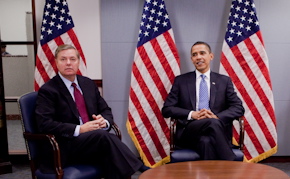
obama-and-graham

20090114_JRB_LG_BO-4206


What’s all the nonsense about Obama struggling?

The man is 47, has a sharp mind that is suited to judgment of competing ideas, makes speeches at the level of John F. Kennedy and Ronald Reagan, has a sensibility that is not so populist as to be deluded, and not so elite as to have lost touch.  He has simultaneously minority and elite status and has a genuinely all-American work ethic and positive disposition.

He begins his presidency with 58 or 59 Democratic Senators (depending on when Al Franken stops telling jokes and shows up for work) and two popular moderate and less partisan Republicans from Maine, Olympia Snowe and Susan Collins, who are not likely to stand in filibuster against him.

In the House of Representatives, Democrats number 262 to the Republicans 178, which means the President can lose more than 40 Democrats and still pass his agenda in the House.

President Obama has spent the last two years invigorating public participation and activating Democrats to tune in and take a stand.

The choices before him are complex and the problems not easy to solve.  The President has shown in just three short weeks that he is not beholden to anyone.  Liberals are irritated by his centrist nominations.  Republicans challenged his stimulus bill and lost.  Obama demanded a fast response from congress and he got one.

His decisions may or may not solve the credit crisis, real estate market collapse, or spiraling recession, but he certainly is in command.  Franklin Roosevelt made many false steps working through the Great Depression.  In the end, his policies eased the pain, but it was the publicly financed industrial development during World War II that threw off the slump and earned the United States an economic rebirth.

So too Obama may have to readjust course as he evaluates the effect of his administration’s approach to economic difficulty and the country walks a tight-rope.  When he does, critics will attack his every misstep, but if there is any clarity to be gained from his first weeks in office, it is that he will retain command.  Anticipate that this President will respond actively, and until the next election, without gridlock tying his hands.

Barack Obama’s Political Philosophy

Photo by Aaron Muszalski; licensed http://creativecommons.org/licenses/by/2.0/

By Marc Seltzer; originally published on December 15, 2008, at politicsunlocked.com

. .

A new political party has appeared on the American scene. It is the Pragmatic Party and Barack Obama is its leader. The platform is so new and disconcerting that many have not yet wrapped their minds around the implications.

What his critics fail to understand is that Obama is not just about be-nice politics.  He’s about practical solutions rather than simplistic party ideologies.

After two years in the national spotlight as a transformational candidate – captivating audiences, filling stadiums and talking straight about his priorities (the middle class, economics, health care, education) people are still asking if he has been clear and upfront with his politics.

One month into the transition, carrying references to Lincoln, FDR and Ronald Reagan, people are showing surprise with his cabinet picks.  In despair, some suspect a closet conservative, while others are hoping for a liberal double agent.

Some Republicans are calling him a socialist, while Fred Barns in the Weekly Standard observes “he’s pragmatic so far in one direction, rightward – who knew?”

The public went along with the old-style reporting it seems. 68 percent of Americans polled expected Mr. Obama to be liberal. They have their reasons. Mr. Obama ran as a Democrat, after all. In our essentially two-party system, if Obama had run on a new third-party platform, he might have received 4 or 5 percent of the vote, or because he sounds remarkably intelligent, 12 percent tops. Obama ran instead as a Democrat, a pragmatic choice it seems, since he won 53 percent.

It’s also true that minority candidates are often champions of more progressive political parties and organizations, which traditionally labored to advance rights and protections for disenfranchised groups. True, but Colin Powell and Condoliza Rice, not to mention Clarence Thomas, were all Republican administration appointments.

Jessie Jackson ran for President in 1984 and 1988 on a rainbow coalition for a new kind of inclusiveness. He may have paved the way in part for the Obama presidential bid, but in sharp contrast, Barack Obama, ran on behalf of the middle class.

On the other hand, the University of Chicago, where Obama taught Constitutional Law, is a center of free-market economics.  Note too, that Obama’s selections for his cabinet and crew in economics and foreign affairs are centrists.  Centrists can adopt policies from, and forge policies which appeal to, both sides of the political spectrum, without being called traitors.

There is still no approved vocabulary for describing pragmatism in politics.  What’s that Berkeley’s Professor Lakoff said, until there’s a metaphor, there’s no word and no thought?

It’s about time that someone described this new party to the pundits so that they can start using its lingo in their coverage. Not that the President Elect has been hiding anything. He has said on more than one occasion, that he is looking for “what works,” or, when things look really bad, “whatever works.”  Let’s start describing policy, not for its political effect, but its accomplishment on the merits.  The words “results oriented” and “consequences” come to mind.

“Pragmatic,” in this context, is the opposite of ideological. Democrats and Republicans aren’t always ideological, but often are, with important consequences.  The mantra “Government regulation is a drag on the economy” rings a bell.  The notion of raising taxes to balance the budget during a recession is not quite ideology, but it is cured by pragmatism, none-the-less.  Pragmatism works against ideology and lunacy, it seems — an added benefit.

What should we expect from the Pragmatic party? It’s hard to say, but we should expect an Obama administration to look to the facts and circumstances of the problems we face, rather than applying ready-made doctrines from yesteryear. Obama doesn’t seem to care whether a policy is liberal or conservative; he seems to believe it is more important to talk about whether it will accomplish its goals. It turns out that many of the liberal v. conservative debates have already been, well, decided.

Take, for example, raising taxes.  This is done to balance budgets, but also to fund entitlements and spending programs.  Obama’s appointment to head the Economic Council of Advisors, Christina Romer, recently published a serious historical analysis showing that tax hikes measurably retard economic growth.  A pragmatist will have to weigh how much the revenue is needed in the short term against the eventual harm to the economy and resulting loss of revenue over the long term.  Not very exciting in a televised debate, but logical, maybe even “good government.”

Better let the economists calculate the optimal results, rather than have politicians debate raising taxes vs. lowering taxes, without really knowing what they are talking about. Politicians with ideology don’t actually have to know what they are talking about, but pragmatists do for they are only as good as the results obtained by solutions they propose.